
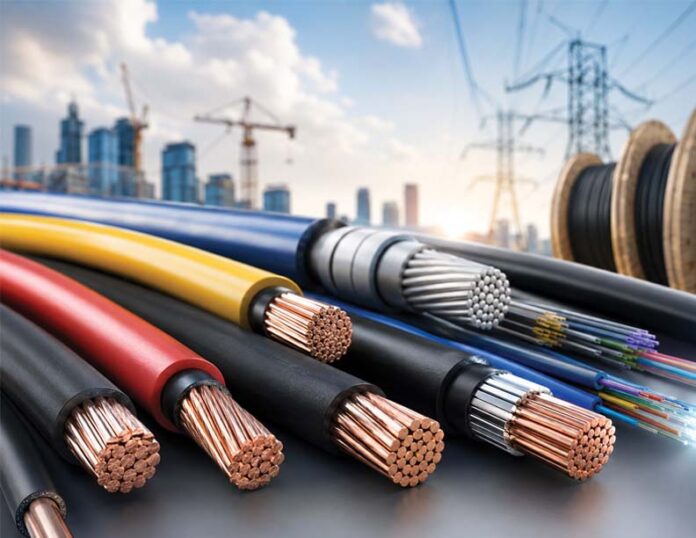
The market has a broad demand base. Housing wires account for the largest share by cable type, while fibre-optic cables have the highest projected growth rate. Copper remains the dominant conductor material, and consumer applications continue to contribute the majority of market revenue. At the same time, IT and telecom applications are recording faster growth as fibre deployment and data infrastructure expand.
Housing Holds the Lead
Housing wires accounted for 32.25% of the Indian wire and cable market in 2025, representing approximately USD 6.84 billion in revenue. Residential construction remains a major source of cable demand, with higher electrical loads and greater product specifications influencing purchasing decisions.
The requirements within residential projects are also becoming more differentiated. Flame-retardant and low-smoke wires have a strong position in premium construction, while longer cable rolls can reduce jointing requirements during installation.
Commercial buildings add further demand through power distribution, lighting, HVAC systems, fire and safety systems, building automation and communication networks. A single commercial development can therefore require several categories of electrical and communication cables. For manufacturers and distributors, residential and commercial construction provides substantial volume.
Renewables Add Volume
Renewable-energy projects require extensive cabling across generation, collection and transmission infrastructure.
Solar installations require specialised DC cables capable of operating under outdoor conditions, while large renewable projects require power cables for internal collection systems and transmission connections. The expansion of generation capacity also creates requirements for higher-voltage transmission networks.
The report identifies utility-scale renewable-energy development as one of the major growth drivers for the Indian wire and cable market. The report specifically links renewable expansion with demand for extra-high-voltage products.
The cable requirement does not end at the generating site. Renewable projects are frequently located away from major consumption centres, creating a requirement for transmission infrastructure capable of moving electricity over long distances.
Fibre Accelerates
Fibre-optic cables represent one of the strongest growth opportunities within the market. The report projects the fibre-optic cable segment to register a 12.38% CAGR through 2031, ahead of other cable categories. The growth is linked to 5G network expansion, fibreisation, data centres and increasing demand for high-speed connectivity.
India’s telecom infrastructure requires large quantities of optical fibre for backhaul networks and connectivity between network locations. Data centres add another layer of demand as operators require high-capacity communication infrastructure within facilities and between data-centre locations.
The growth of fibre also creates a different manufacturing opportunity from conventional power cables. Optical-fibre production requires specialised processes and technology, while product performance depends heavily on attenuation, transmission characteristics and manufacturing quality. The report estimates that the fibre-optic cable market in India could exceed USD 5.64 billion by 2031.
For cable manufacturers, this segment provides access to telecom and digital infrastructure spending alongside conventional electrical applications.
Copper Remains Central
Copper accounted for 64.35% of the Indian wire and cable market by conductor material in 2025. High-conductivity copper variants are projected to grow at a 9.11% CAGR through 2031.
Copper’s electrical conductivity makes it particularly important in applications where electrical performance, space and efficiency are key considerations. Housing wires, industrial cables and several specialised applications depend heavily on copper conductors.
The material also represents a major cost component for manufacturers. Movements in copper prices can affect production costs, inventory values and margins, making procurement and price management important aspects of cable manufacturing.
Aluminium has an important role in applications where lower weight and material cost are priorities. It is widely used in power distribution and conductor applications, particularly where the characteristics of aluminium provide an economic advantage.
The material mix therefore varies significantly according to the application, voltage level, installation environment and project economics.
Consumer Demand Dominates
Consumer applications generated 69.40% of market revenue in 2025. Residential construction and household electrical demand form a significant portion of this segment.
The retail market remains highly competitive, with product availability, dealer networks, brand recognition and price influencing purchase decisions.
Electrical safety is another important consideration. Wires with inadequate conductor size or poor insulation can increase the risk of overheating, short circuits and electrical fires. Compliance with applicable standards and certification requirements therefore has a direct relevance to consumer safety.
It is also estimated that the organised segment accounts for approximately 74% of India’s wire and cable market. The remaining market represents a significant opportunity as manufacturers, distributors and regulators work to increase the adoption of compliant products.
For organised manufacturers, product authentication, dealer education and brand visibility are important tools in addressing low-quality and counterfeit products.
IT and Telecom Gain
IT and telecom is the fastest-growing end-user category covered in the Mordor Intelligence report, with a projected 9.92% CAGR through 2031.
The requirement for fibre infrastructure is closely linked to this growth. Telecom networks require fibre for high-capacity backhaul, while data centres require optical connectivity for high-speed communication.
The demand profile also extends beyond telecom operators. Cloud-service providers, hyperscale data centres, enterprise networks and digital infrastructure operators all require high-performance communication cabling.
This gives the wire and cables industry exposure to India’s broader digital infrastructure investment. It also creates opportunities for manufacturers with capabilities in fibre-optic and specialised communication products.
Industry Wants Specialised Cables
Industrial applications bring a different set of requirements. Manufacturing facilities, process industries, oil and gas plants and automation systems require cables designed for specific operating environments. Flexible cables, instrumentation cables, control cables and products with specialised insulation systems serve applications where standard building wires are unsuitable.
Industrial automation also increases the need for reliable communication between machines, sensors, controllers and other equipment. Cable performance becomes important in environments involving vibration, heat, chemicals, mechanical movement or electromagnetic interference.
Emerging applications such as green hydrogen can add another specialised demand category. Electrolysers and associated systems require electrical and instrumentation infrastructure capable of operating in demanding industrial conditions.
These applications may represent smaller volumes than housing wires, but they can carry greater technical requirements and product value.
Commodity Prices Matter
Copper and aluminium prices remain a major variable for cable manufacturers. Mordor Intelligence identifies volatility in copper and aluminium prices as a key restraint on market growth. Since conductors represent a substantial portion of cable manufacturing costs, changes in metal prices can directly affect production economics and margins.
Manufacturers therefore need to manage procurement, inventory and pricing carefully. Large companies with greater purchasing scale and stronger supply-chain capabilities can have an advantage when commodity markets become volatile.
Backward integration is another strategy gaining importance. Greater control over metal processing and conductor production can provide manufacturers with better visibility over input costs and supply.
Competition Stays Intense
The Indian wire and cable market is moderately concentrated. The organised segment accounts for about 74% of the market, while no single company controls one-fifth of total market share.
Polycab, KEI Industries and RR Kabel are among the major companies identified in the competitive landscape.
Competition operates across several levels. Consumer-facing manufacturers compete through distribution reach, branding and product availability, while project-focused companies compete on technical specifications, manufacturing capability, certifications and execution.
The higher-voltage segment creates another competitive barrier because EHV products require significant investment in manufacturing and testing infrastructure.
The same applies to fibre-optic cables, where specialised manufacturing capabilities and quality control become important differentiators.
Infrastructure Sets the Pace
The Indian wire and cables market is closely linked to the country’s infrastructure spending. Residential construction creates volume through housing wires. Renewable projects require specialised power cables and transmission infrastructure. Telecom networks generate demand for optical fibre. Data centres require high-performance communication and power cabling. Industrial investment creates requirements for specialised products.
For more info read on: https://shorturl.at/zclJO