
Equivalent Circuit Modeling
To predict how a transformer will behave under different loads, engineers use an Equivalent Circuit. This translates physical properties (like magnetic leakage and wire resistance) into a schematic of resistors and inductors.
In this model:
- R1 and R2 represent the resistance of the windings.
- X1 and X2 represent Leakage Reactance (magnetic flux that doesn’t quite make it from one coil to the other).
- The ‘Magnetizing Branch’ (Rc and Xm) accounts for the energy required to actually magnetize the core.
Voltage Regulation
One of the most critical calculations for grid stability is Voltage Regulation. This measures how much the secondary voltage drops when a heavy load is connected.
The formula is:
VR = {(Vno-load – Vfull-load)/Vno-load} x 100%
If the regulation percentage is too high, customers at the end of the line might experience ‘brownouts’ when industrial motors nearby kick on. To combat this, many power transformers use Tap Changers – mechanical switches that change the turn ratio on the fly to boost or lower the voltage.
Vector Groups and Three-Phase Power
Because our grid uses three-phase power, transformers aren’t just two coils; they are three sets of coils. How these are connected (Star vs. Delta) determines the Vector Group.
- Delta (Δ): Good for high current, often used in transmission.
- Star (Y): Features a neutral point, which is essential for distribution to homes.
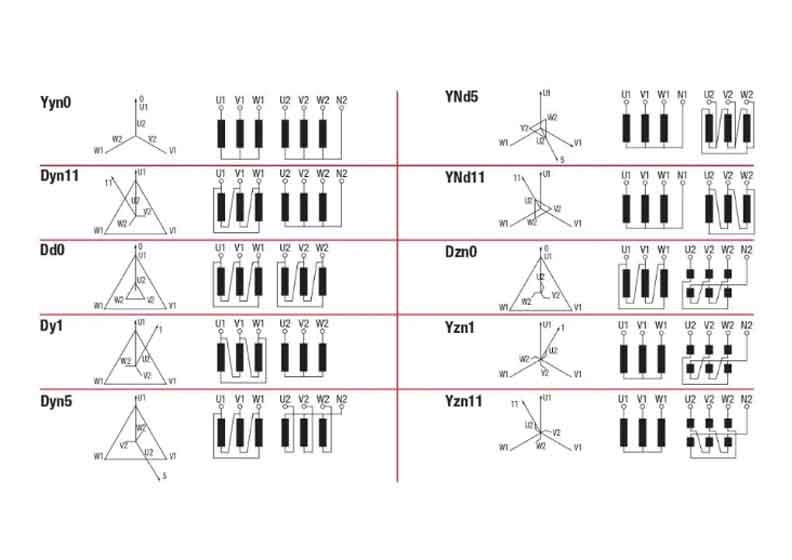
The way these are combined (e.g., Dyn11) creates a phase shift between the input and output. If two transformers with different vector groups are connected in parallel, they will essentially short-circuit each other – an expensive and explosive mistake!
Forces of Destruction: Short-Circuit Current
When a fault occurs (like a tree falling on a power line), the current can spike to 20 times the rated value. This creates massive electromagnetic forces that try to physically rip the transformer apart.
The windings experience Radial Forces (trying to burst the coil outward) and Axial Forces (trying to crush the coil vertically). This is why the internal structure is reinforced with heavy steel pressure plates and seasoned wood or synthetic spacers.
Protection and Maintenance of Power Transformer
Protection Systems (The ‘Nervous System’)
Protection devices are designed to detect internal faults (short circuits) or external stressors (lightning/overloads) and trip the circuit breakers to isolate the transformer.
Internal Protection
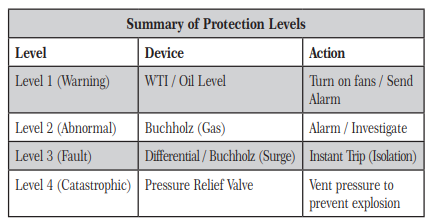
- Buchholz Relay: A gas-actuated relay installed in the pipe between the main tank and the conservator. It detects slow-developing faults (producing small gas bubbles) and catastrophic faults (massive oil surges).
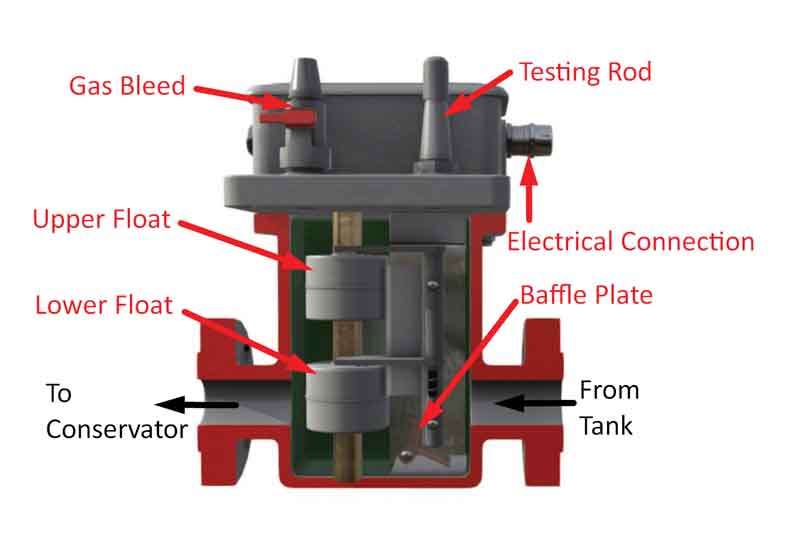
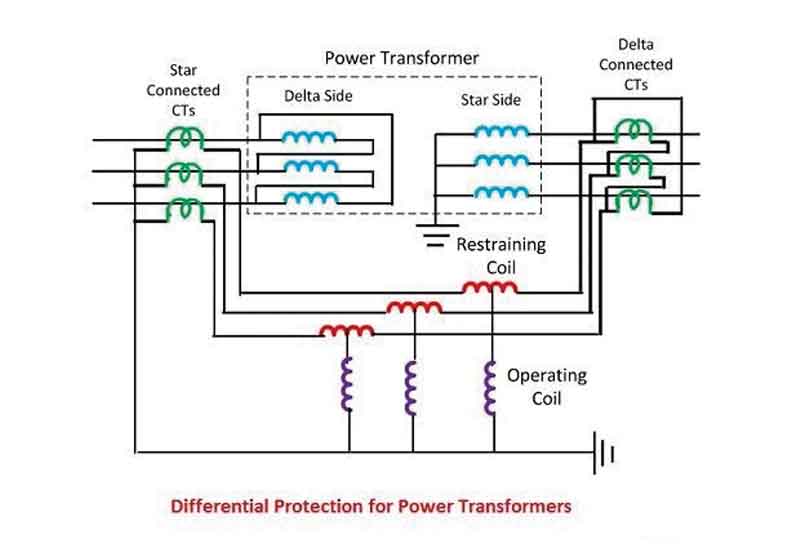
- Differential Protection (87T): This is the primary ‘fast’ protection. It compares the current entering the transformer to the current leaving it. If they aren’t equal (accounting for the turn ratio), it assumes an internal leak/short and trips instantly.
- Pressure Relief Device (PRD): A mechanical ‘pop-off’ valve. If an internal arc causes a massive pressure spike, the PRD shatters or lifts to vent the pressure, preventing the steel tank from exploding.
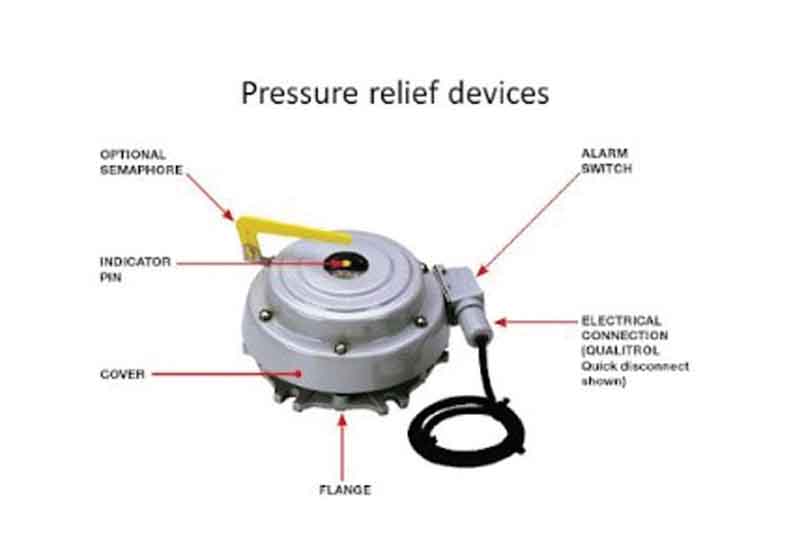
External & Thermal Protection
- Winding Temperature Indicator (WTI): Measures the hottest spot in the copper coils. If the temperature exceeds safe limits (95°C to 110°C typically), it first kicks on the fans, then sends an alarm, and finally trips the unit.
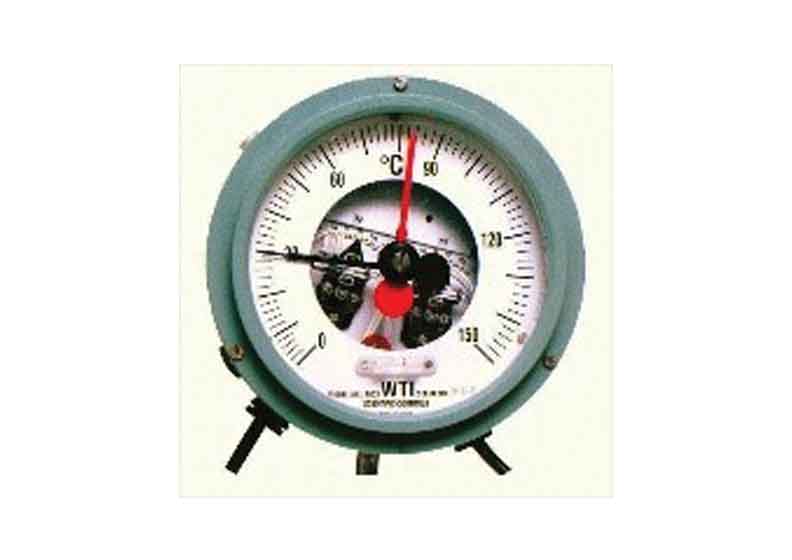
- Oil Temerature Indicator (OTI): Measures the top-oil temperature using a sensing bulb filled with liquid, usually placed in a pocket on the tank cover. It provides real-time monitoring and activates alarm/trip circuits if the oil overheats (typically > 80OC), preventing insulation failure.
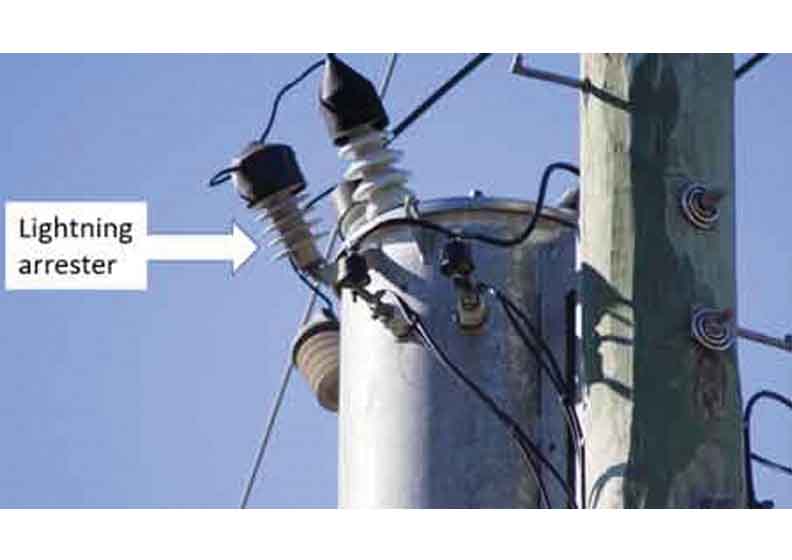
- Lightning Arresters: Located at the bushings, these divert high-voltage surges from lightning strikes directly to the ground before they can puncture the transformer’s insulation.
The Protection Logic Diagram:
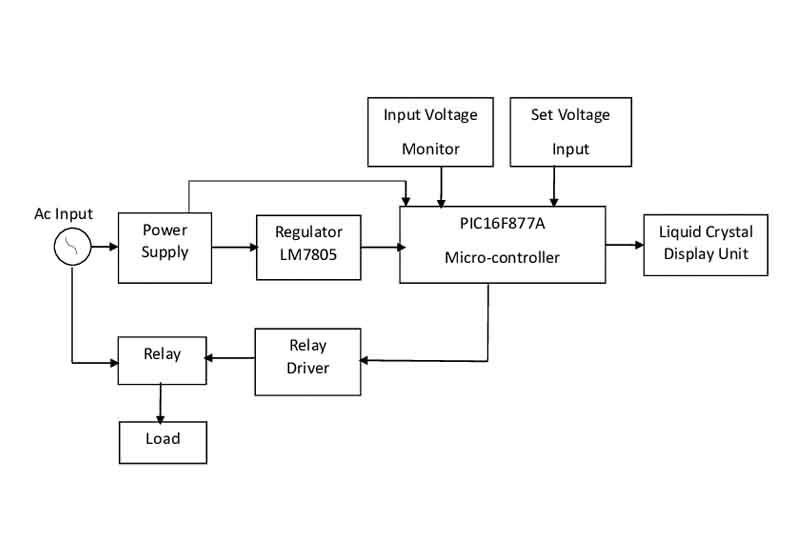
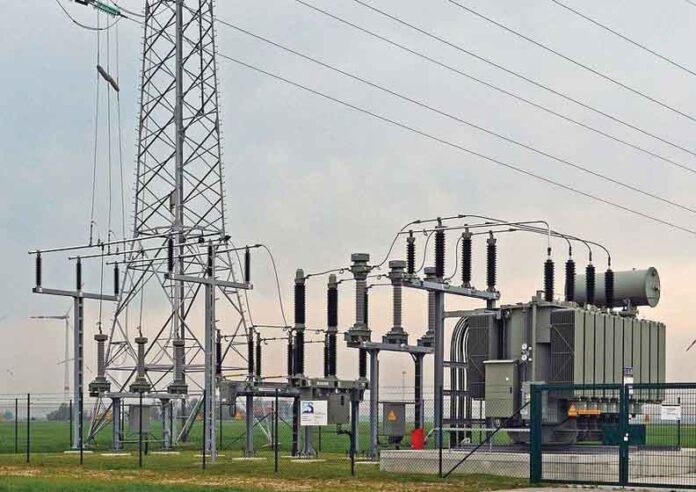
In a standard substation, the transformer is surrounded by Current Transformers (CTs). These CTs ‘sample’ the electricity and send a scaled-down version to the relays.
- Zone of Protection: The area between the primary CT and the secondary CT is the ‘Zone’. Any fault inside this zone causes the Differential Relay (87T) to trip.
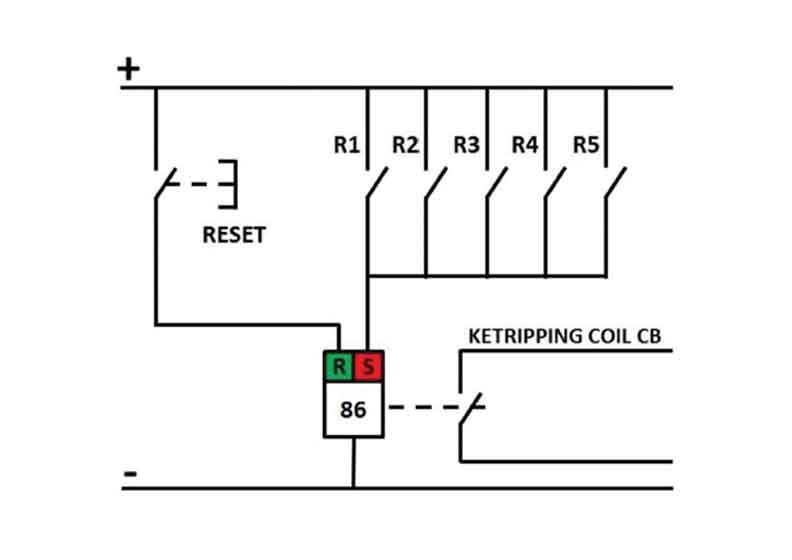
- Trip Circuit: If the relay detects a fault, it sends a DC signal to the Trip Coil of the Circuit Breaker. This physically pulls the contacts apart, stopping the flow of electricity in milliseconds.
Master Trip Relay (86)
- Because a transformer fault is a serious event, we don’t want the transformer to automatically turn back on. We use a Lockout Relay (86).
- When a Buchholz or Differential relay trips, it triggers the 86 Relay.
- The 86 Relay ‘locks’ the circuit breaker open.
- An engineer must physically visit the site, inspect the transformer, and manually reset the 86 Relay before the power can be restored.
Protection Settings (Coordination)
Protection is about Coordination. You want the fuse on a house to blow before the transformer at the street trips. This is achieved using Time-Current Curves.
- Instantaneous Trip: For massive faults (like a direct short), the transformer trips in approx. 0.02 seconds.
- Time-Delay Trip: For smaller overloads, the relay might wait 2–5 seconds to see if a downstream fuse clears the problem first. This prevents unnecessary blackouts for the whole neighborhood.
Maintenance Strategies
Maintenance has evolved from ‘fix it when it breaks’ to Condition-Based Monitoring.
Dissolved Gas Analysis (DGA) — The ‘Blood Test’
This is the most critical maintenance tool. By taking a sample of the transformer oil, chemists look for specific gases dissolved in it.
- Hydrogen (H2): Indicates partial discharge (corona).
- Acetylene (C2H2): A major red flag; indicates high-energy arcing (sparks inside).
- Methane/Ethane (CH4/C2H6): Indicates the oil is overheating.
- Carbon Monoxide (CO): Indicates the paper insulation is burning.
Insulation Testing
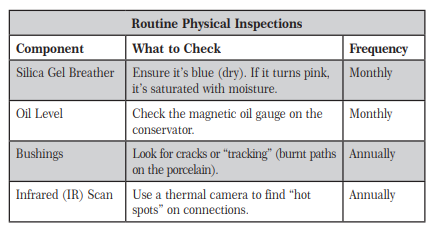
- Megger Test (Insulation Resistance): Uses high voltage to ensure the insulation hasn’t degraded to the point where current can leak to the ground.
- Power Factor/Tan Delta: Measures the “leakiness” of the insulation. A high Tan Delta indicates the oil is contaminated with water or aging acids.
Dealing with the ‘Transformer Killer’: Moisture
Water is the greatest enemy of a power transformer. Even a few drops can lower the dielectric strength of the oil, leading to a catastrophic flashover.
- Vacuum Dehydration: If DGA tests show high moisture, a mobile ‘oil rig’ is brought to the site. It heats the oil and puts it under a vacuum to boil off the water without damaging the oil itself.
Pro-Tip: The ‘Pink’ Silica Gel
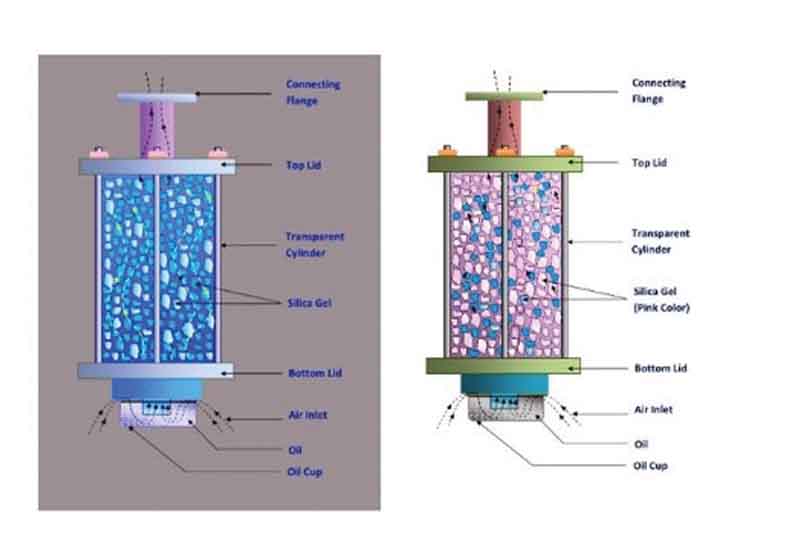
If you ever walk past a substation and see a small glass jar attached to a transformer filled with bright pink beads, it means the transformer is ‘inhaling’ wet air. This is a maintenance emergency – the silica gel needs to be baked in an oven to dry out or replaced immediately to protect the core.
Sample Maintenance & Testing Schedule
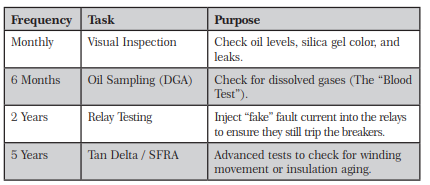
To ensure these protection systems actually work when needed, utilities follow a strict schedule:
Conclusion: The Silent Architect of Modern Civilization
The power transformer is arguably the most critical component of our global infrastructure. While it lacks the moving parts of a turbine or the visual complexity of a control room, its role as a static, electromagnetic gatekeeper is what makes the modern electrical grid possible.
The Path Forward
As we transition into a new era of energy, the transformer’s role is shifting. With the rise of renewable energy, power no longer flows in just one direction. Transformers must now handle the variable inputs of solar and wind farms and the ‘bi-directional’ demands of electric vehicle charging. The emergence of Solid-State Transformers (SST) and Digital Twins – virtual models that predict failure before it happens – marks the next frontier in this field.
Concluded

Reshmi Goppi is an Electrical Engineer with PGDM (Executive) in Operations Management from IMT CDL, Ghaziabad. She has 18 years of working experience in Power Sector in large scale Substations and Transmission projects – domestic as well as international. Being a career counsellor, writer and guest speaker, she is connected to many forums.