
It is a problem as old as the Indian grid, and it remains the single most overlooked driver of inefficiency in the country’s industrial estates today.
The Cost of an Unstable Supply
The Central Electricity Authority’s declared supply voltage is 230V single-phase and 400V three-phase, with a permissible variation of +10% to –15% at the point of supply. Reality on most LT feeders is wider than that. Voltages dip during peak load, swell during low demand, and oscillate constantly in industrial pockets where furnace loads, welding sets, and motor drives switch on and off through the day.
Each of these conditions extracts a toll. High voltage shortens insulation life and accelerates motor ageing. Low voltage forces motors to draw excess current — pushing copper losses, tripping protection, and quietly burning out windings. Frequent fluctuation does what neither extreme can: it confuses the equipment. PLCs reset. VFDs trip. UPS units cycle through their batteries. Process lines stop and restart, each restart drawing inrush currents many times the rated load.
What the plant manager sees is downtime. What the energy bill records is loss.
Three Generations of Voltage Stabilisation
The Indian voltage stabiliser has evolved through three distinct generations, each suited to the load profile of its time.
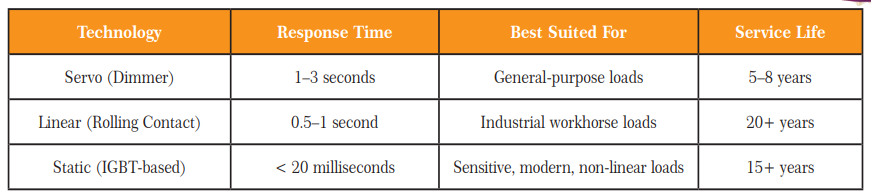
Servo-based stabilisers using carbon-brush dimmer transformers were the workhorses of the 1990s. They are still common, still cost-effective, but their internal losses (often 6–8%) and the wear on moving contacts make them ill-suited to today’s continuous, high-uptime industrial demands.
The Proven Indian Workhorse: Linear, Rolling-Contact Stabilisers
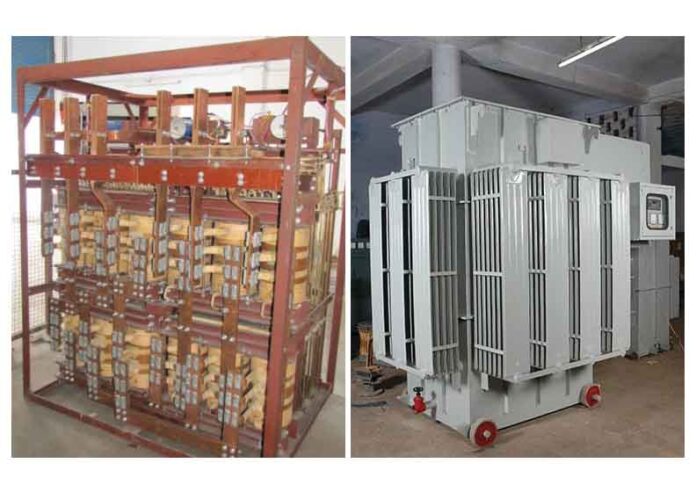
For the bulk of Indian industry, the technology that has stood the test of time is the linear-type stabiliser — built around vertical-wound transformers, copper compensating coils, and rolling-contact assemblies. This is the technology our own engineering teams have refined across more than 5,000 installations in fifteen countries, and it remains, in our considered view, the most appropriate choice for the majority of Indian industrial applications.
The reasons are practical. Internal losses sit below 1%. Service life regularly exceeds two decades with minimal maintenance. The rolling contact, properly engineered, distributes wear far more evenly than a brush-and-dimmer arrangement, and the design tolerates the dust, heat, and load swings that define real Indian operating conditions. For a furnace plant, a textile mill, a packaging line, a hospital, or a refinery — applications where the load is large, the uptime requirement is high, and the budget must justify itself over fifteen or twenty years — the linear rolling-contact stabiliser remains the workhorse it has always been.
What is Changing: The Static IGBT Stabiliser
The Indian load profile, however, is shifting. The factories of today are no longer dominated by simple induction motors and resistive loads. They run on variable frequency drives, LED arrays, server farms, electronic ballasts, and inverter-driven HVAC. These are non-linear, fast-switching, harmonic-rich loads — and they punish slow correction.
Static, IGBT-based stabilisers respond to this. With no moving parts, solid-state switching, and correction times in the order of milliseconds, they hold output voltage within a tight band even during the rapid transients that mechanical regulators cannot keep up with. They run cooler, take less floor space, and offer harmonic immunity that wound stabilisers simply cannot.
For modern data centres, pharmaceutical clean rooms, semiconductor lines, and precision manufacturing — applications where a single voltage dip is measured in lakhs of rupees of scrap or downtime — the static stabiliser is becoming the appropriate choice. Manufacturers like ours are now extending this technology into higher capacities, and at Reliable Power Systems we are preparing to commercially launch IGBT-based static stabilisers up to 1000 KVA in the months ahead — a significant step for what has, until now, been a low-capacity segment in India.
The Quiet Contribution to Energy Conservation
Voltage stabilisers do not, in themselves, save energy. They do not reduce a plant’s load. What they do is allow every other piece of equipment in the plant to operate at its rated efficiency — and that is where most industrial energy actually leaks. A motor running at low voltage draws more current. A chiller running at high voltage runs hot. A drive cycling on poor power quality spends as much energy resetting as it does working.
Stabilise the voltage, and the energy story changes by itself. Across our installations, the payback on a properly specified stabiliser typically lands between four and twelve months — measured not in headline savings but in avoided failures, restored productivity, and equipment that lasts the years it was designed to last.
The Road Ahead
As Indian industry electrifies, digitises, and grows more dependent on sensitive electronics at every level, voltage stabilisation is moving from afterthought to design choice. The linear, rolling-contact stabiliser will remain the foundation of industrial power conditioning for years to come. The IGBT-based static stabiliser will increasingly join it on the floor wherever the load demands precision and speed.
The technology will keep evolving. The principle will not. Stable voltage is the cheapest energy-efficiency upgrade most plants will ever make — and after thirty-five years of building the equipment that delivers it, that conviction has only grown firmer.
For more information: email – arun@reliable.net.in / info@reliable.net.in

Arun Sharma
Founder, Reliable Power Systems