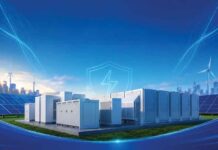

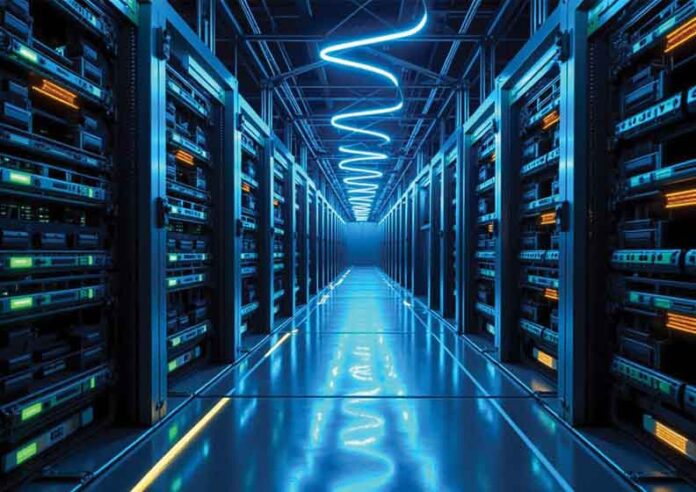
A data center is a physical facility designed to house computing infrastructure such as servers, storage systems, and networking equipment, enabling the processing, storage, and distribution of digital data (Refer figure 1).
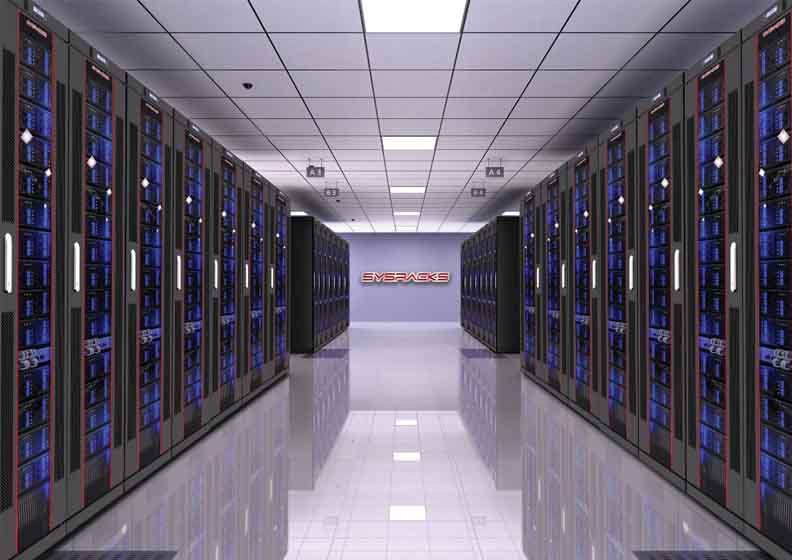
These facilities are critical for delivering services like cloud computing, Artificial Intelligence (AI), online transactions, streaming, and enterprise IT operations. Modern data centers operate 24/7 and require high reliability (99.99% uptime). They integrate power systems, cooling systems, and redundancy mechanisms.
Types of Data Centers
Hyperscale Data Centers
These are large-scale facilities operated by tech giants like Google, Amazon Web Services, and Microsoft.
Features are: (a) Massive scale (100,000+ servers) (b) Designed for cloud computing and AI workloads (c) Highly optimized for efficiency (low PUE)
Hyperscale data centers account for ~40–50% of global data center capacity.
Example: Google’s global data center network supporting Search, YouTube, and AI services
Colocation Data Centers
These are third-party facilities where businesses rent space for their servers and IT infrastructure.
Features are: (a) Shared infrastructure (power, cooling, security) (b) Cost-effective for small/medium enterprises (c) Flexible scalability
Enterprise Data Centers
Owned and operated by individual companies for internal use.
Features are: (a) Customized infrastructure
(b) Limited scalability compared to hyperscale
(c) Gradually declining due to cloud adoption
Working of Data Centers
Core Components
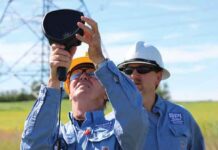
Data centers are built around three fundamental computational pillars: compute (servers), storage, and networking. These components collectively enable data processing, storage, and transmission. (Refer figure 2) Servers (Compute Infrastructure).
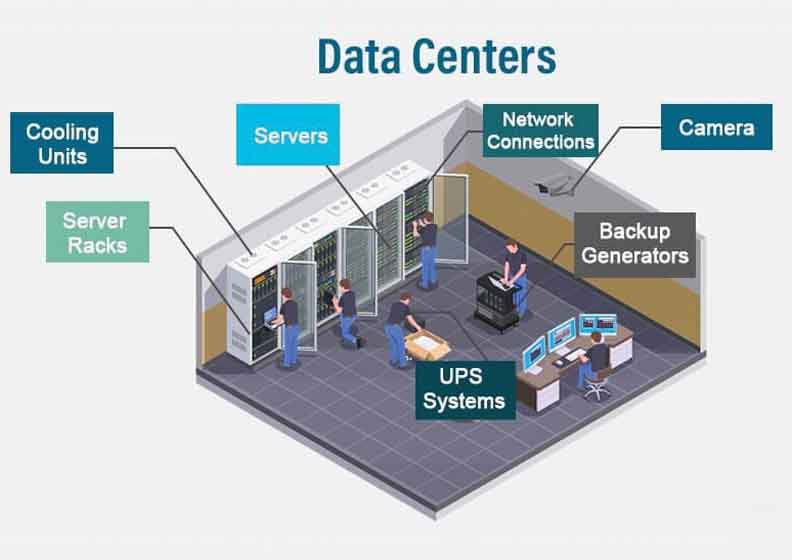
Servers are high-performance computers designed to process, manage, and deliver data continuously (24/7 operation). Main components are CPUs/GPUs (AI workloads heavily GPU-dependent), RAM (volatile memory), Motherboard + power units & Rack-mounted in rows.
Energy Consumption & Scale
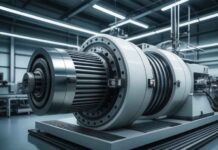
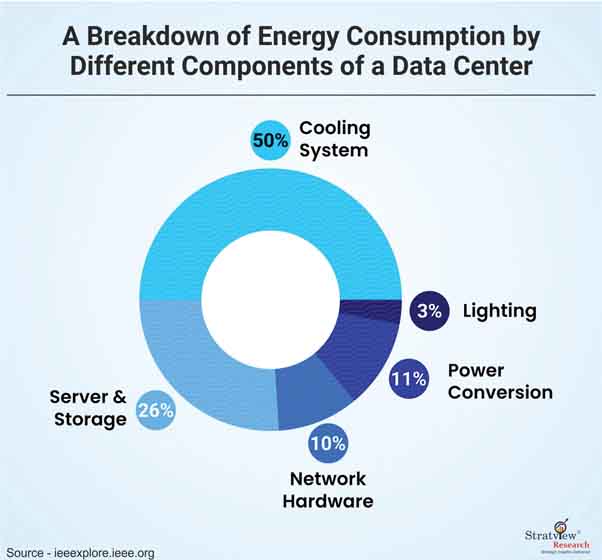
A single rack can consume 5–30 kW power, while AI racks may exceed 80–100 kW. Servers are the primary energy consumers (~50–60%) (Refer figure 3). Hyperscale facilities may contain 100,000+ servers.
Storage Systems
Storage systems are responsible for long-term data retention and retrieval.
Main Types: (a) HDD (Hard Disk Drives)
(b) SSD (Solid State Drives) – SSD adoption increasing due to: Faster access & Lower power consumption
(c) Distributed storage systems (cloud storage architecture).
Capacity: Data centers store zettabytes (10²¹ bytes) of data globally.
Energy Consumption: Storage contributes ~10–15% of total energy usage.
Networking Infrastructure
Networking systems enable data transfer between servers and external users.
Main Components: Routers, Switches & Fiber-optic communication systems.
Capacity: Data centers handle petabytes (10^15) of data traffic daily and network latency is a key performance metric (<10 ms in hyperscale systems).
Supporting Infrastructure
These systems ensure continuous, reliable, and efficient operation of core components.
Power Supply Systems
Uninterruptible Power Supply (UPS) & Backup Generators. Large data centers may have multiple MW-scale generators.
Environmental Impact: Diesel generators emit: CO2 , NOx & Particulate matters.
Grid Dependency: Most data centers rely on national grids.
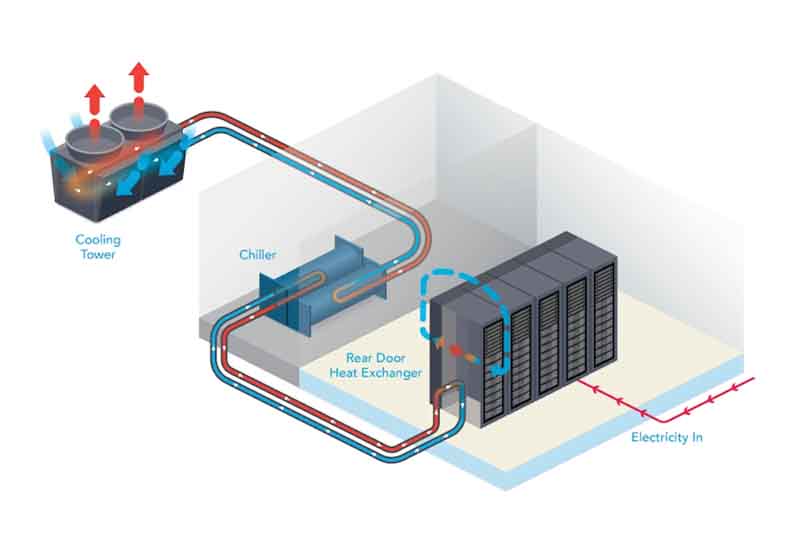
Cooling Systems (Critical Section)
Cooling is essential to maintain optimal temperature (18–27°C) for server performance.
HVAC Systems (Air Cooling): Uses chilled air circulation. It is less efficient at high densities.
Liquid Cooling Systems (Refer figure 4): (a) Direct-to-chip cooling, (b) Immersion cooling.
Benefits are: it can reduce energy use by 30–50% compared to air cooling.
Energy Consumption: Cooling alone consumes 30–40% of total data center energy.
Growth Trends in Data Centers
The exponential rise in Artificial Intelligence (AI), Cloud computing services & Internet of Things (IoT) devices has led to an unprecedented demand for data processing and storage.
Key Statistics
- Global internet traffic is growing at ~25–30% annually
- Data creation expected to reach 175 zettabytes by 2025
(1 Zettabyte = 10^21 bytes)
Energy Demand Explosion
Data centers are projected to consume ~945 TWh of electricity globally by 2030. It is equivalent to the annual electricity consumption of some large countries.
India-Specific Growth
India is emerging as a major data center hub due to digital India initiative & Rapid internet penetration.
Key locations: Mumbai (largest hub), Chennai, Hyderabad, Noida
Main Challneges of Data Centers
Climate Change Impact
- Heavy electricity consumption ® increased carbon emissions
- Dependency on fossil fuels in many regions
- Data centers contribute significantly to global greenhouse gas emissions
Resource Stress (Water + Energy)
Massive water consumption for cooling systems: Many data centers are being built in water-stressed regions.
Environmental Degradation
- E-waste generation from obsolete hardware
- Land and infrastructure pressure
- Air pollution from diesel backup generators
Sustainability vs Digital Growth Dilemma
Digital economy requires more data centers but data centers increase environmental burden.
Socio-Economic Impacts of Data Centers
Positive Impacts
Growth of the Digital Economy: Data centers act as the backbone of the digital economy, enabling E-commerce, Digital payments, Streaming services etc.
Key Statistics: (a) The global digital economy contributes ~15–16% of global GDP, (b) Expected to grow to 20%+ by 2030, (c) Data centers support billions of daily digital transactions.
Expansion of Cloud Services: Cloud computing allows businesses to Store data remotely, Scale operations dynamically and Reduce infrastructure costs.
Major Providers: Amazon Web Services, Microsoft Azure, Google Cloud etc.
Job Creation (Construction Phase)
Data center development creates significant short-term employment opportunities. It boosts local economy during development phase and stimulates related sectors like Real estate & Infrastructure.
Data Sovereignty & National Security
Data sovereignty ensures that data is stored within national borders, governed by local laws. It protects sensitive data & enhances cyber security (Reduces reliance on foreign infrastructure).
Negative Impacts
Low Long-Term Employment
Despite large investments, data centers generate limited permanent jobs.
Main Reasons are: (a) Highly automated operations, (b) Remote monitoring systems, (c) Limited on-site workforce needed.
Local Resource Stress
(a) Increased load on local power grids (b) High water consumption for cooling
Inequality in Resource Allocation
Data centers often receive priority access to resources, creating imbalance.
Key Issues are (a) Water Inequality (b) Energy Allocation.
Social Impact
(a) Community resistance to new data center projects, (b) Rising concerns about environmental justice.
Sustainable Solutions & Mitigation Strategies
Renewable Energy Integration
Transitioning data centers from fossil-fuel-based electricity to renewable energy sources is the most effective way to reduce carbon emissions.
- Solar Energy: On-site solar farms or off-site solar PPAs -Power Purchase Agreements. (Refer figure 5)
- Wind Energy: Widely used in large-scale data centers due to high capacity factors and lower cost per kWh in many regions.
- Leading companies like Google and Microsoft aim for 100% renewable-powered operations.
- Some hyperscale data centers already operate on 90–100% renewable energy (annual matching basis).
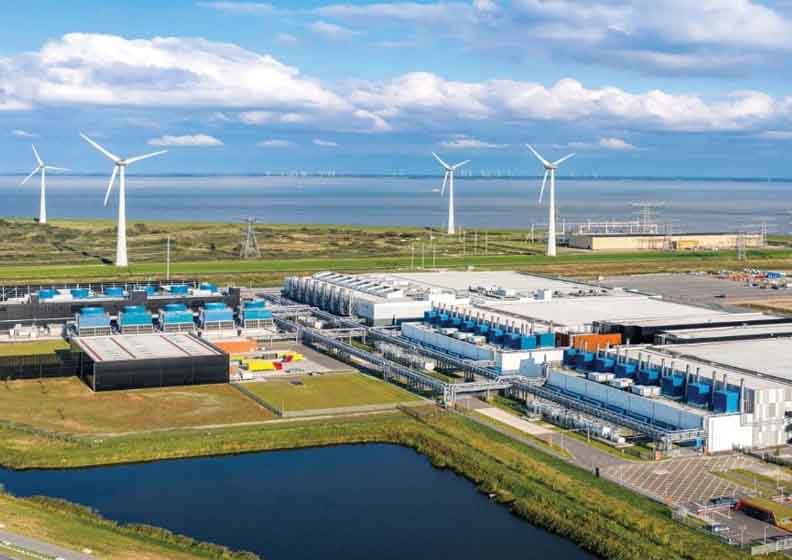
Main Challenges are: (a) Intermittency (solar/wind variability), (b) Need for energy storage (batteries), (c) Land requirements
Renewable integration reduces emissions but shifts the challenge toward energy storage and grid stability, requiring systemic energy planning and development.
Water-Efficient Cooling Technologies
Cooling systems are major contributors to both energy and water consumption, making efficiency improvements critical. (Refer figure 6)
Liquid Cooling (Closed-Loop Systems)
Types: Direct-to-chip cooling & immersion cooling
Benefits are: (a) Reduces cooling energy by 30–50%, (b) Uses closed-loop water systems so there is minimal water loss.
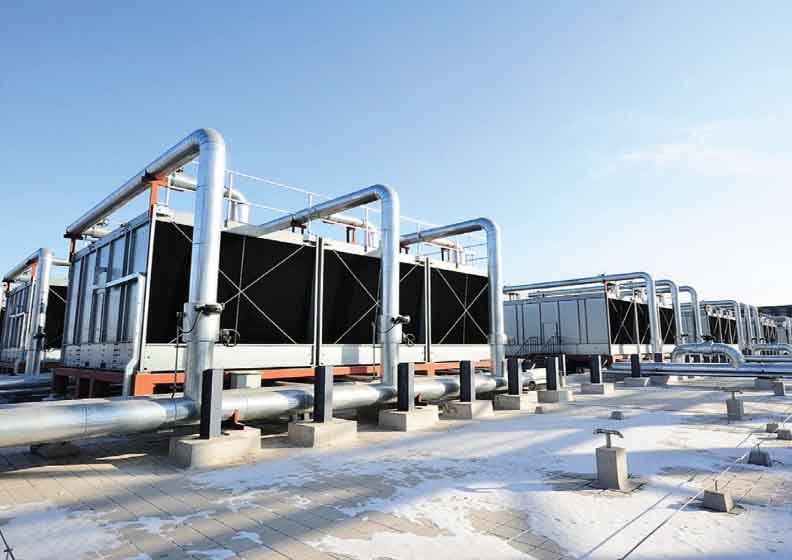
Air Cooling in Cold Climates
It uses ambient cold air (‘free cooling’)
Main Benefits are: Near-zero water usage and further Reduces energy consumption in cold regions.
Limitation: Not suitable for Hot climates (India, Middle East)
Waste Heat Recovery
Instead of releasing heat into the environment, data centers can capture and reuse waste heat. It improves overall energy efficiency and reduces need for additional heating energy. However, it requires infrastructure integration and proximity to end-users. Waste heat recovery transforms data centers from energy consumers into potential contributors to local energy systems.
Circular Economy Practices
Shifting from a linear ‘use-and-dispose’ model to a circular economy reduces resource depletion and e-waste.
Hardware Recycling: Recover metals from Servers and Storage devices.
Modular Hardware Design: Replace individual components instead of entire systems.
Circular economy approaches extend the lifecycle of data center components, significantly reducing environmental and material costs.
Smart Workload Management (AI Optimization)
AI and software optimization can dynamically manage workloads to: (a) Reduce energy consumption,
(b) Improve efficiency.
AI-based optimization can reduce carbon footprint.
Example: Google uses AI to optimize cooling systems in its data centers.
Software-level optimization represents a low-cost, high-impact solution that can significantly enhance sustainability without major infrastructure changes.
Location-Based Planning
Strategic site selection can significantly reduce both energy and water requirements.
Key Location Factors
Cold Climates
Benefits: Natural cooling ® reduced energy consumption and lower operational costs.
Example Regions: Northern Europe and Canada
Water-Rich Regions
Benefits: Sustainable cooling without stressing local resources
Renewable Energy Availability
Proximity to: Solar farms & Wind farms
Avoid: (a) Water-scarce regions, (b) Coal-dependent energy grids.
Location selection is one of the most effective yet underutilized strategies for minimizing the environmental footprint of data centers.
Conclusion
The rapid proliferation of data centers, fuelled by advancements in AI and cloud computing, underscores their critical role in modern economies. However, their growing demand for energy and water resources raises significant sustainability concerns. This duality highlights the urgent need to evaluate and optimize data center operations to balance technological progress with environmental responsibility.
Sustainable operation of data centers requires a multi-dimensional approach that integrates renewable energy adoption, efficient cooling technologies, circular economy practices, and intelligent workload management. While no single solution can address all environmental challenges, a combination of these strategies – tailored to regional conditions – can significantly reduce the ecological footprint of data centers while supporting their continued growth.
Key Statistics
- Global electricity consumption by data centers may reach ~945 TWh by 2030.
- Data centers account for ~2% of global greenhouse gas emissions.
- Hyperscale data centers consume 100–500 MW per facility.
- AI workloads consume 5–10 times more energy than traditional computing.

Divyanshu Arora is Final Year Electronics and Communication Engineering student at Bharati Vidyapeeth’s College of Engineering, Delhi. He has a specialization in Renewable Energy from Coursera.com and he truly believes in the power of continuous learning. He even has earned specializations in Data Analytics, Fintech, IT Support and Machine Learning from Coursera. Embracing the digital landscape, he has also completed the Google Digital Garage’s Digital Marketing Certificate, equipping himself with the tools to thrive in the online realm.

Dr. Rajesh Kumar Arora obtained his B. Tech. and M.E. degrees in Electrical Engineering from Delhi College of Engineering, University of Delhi. He completed his PhD in grounding system design from UPES, Dehradun. He is also a certified Energy Manager and Auditor and has worked in 400kV and 220kV Substations for more than 14 years in Delhi Transco Limited (DTL). He has also worked as Deputy Director (Transmission and Distribution) in Delhi Electricity Regulatory Commission (DERC). Presently he is working in D&E (Design and Engineering) department of DTL.