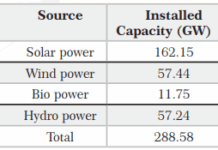


Although scientists realized many years ago that generating thermal power by burning fossil fuels is by no means environmentally friendly, a concerted effort among them to rapidly advance renewable energy was not particularly evident until the middle of the last century.
Since the beginning of the current century, scientists worldwide have become extremely active regarding renewable energy, particularly focusing on solar energy. In various countries across the world, their works are rapidly driving this field forward. This article of mine deals with news items regarding some such recent activities.
Key Additives for Perovskite Solar Cells
Perovskites are solution-processable materials and can be readily processed as a solution or deposited as vapour. By mixing two key ingredients in the precursor solution, Rice University chemical engineer Aditya Mohite and collaborators have developed perovskite crystalline films that retain 98% of their initial efficiency even after 1,200 hours of exposure under open circuit voltage conditions to accelerated aging at 90 degrees Celsius (194 degrees Fahrenheit).
The two additives used were a two-dimensional perovskite, which served as a template to guide crystal growth, and formamidinium chloride, a salt molecule that regulates crystallization and has the optimal size to sustain the atomic bonds in the crystal in the right configuration. The two additives create compressive strain in the lattice, driving the formation of the black perovskite phase and stabilizing it, while also steering degradation toward a harder-to-form phase, significantly improving durability.
The new study published in the journal Science reported the method to make perovskite-based photovoltaics more durable, allowing the films to attain the desirable black phase of crystal configuration quicker and at lower temperatures while also making it harder to degrade into the inactive yellow phase.
Focusing on the background of the study, Rabindranath Garai, a former Fulbright-Nehru Postdoctoral Fellow and current Research Specialist at Rice who is a first author on the study, said, “This research began with a simple but persistent question: Can we truly make a solar cell that is extremely stable – one that never degrades? That question stayed with us in the lab, especially on days when our black films slowly faded into the unwanted yellow phase after a certain time. It became clear that if we wanted real stability, we could not just study how the material forms but we also had to understand how it falls apart.”
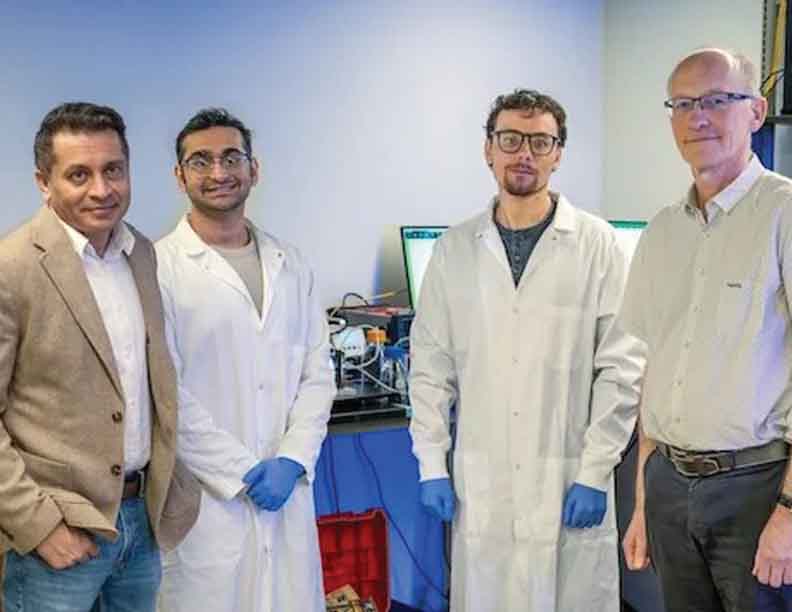
Photo by Jorge Vidal/Rice University
Formamidinum lead iodide crystals consist of a scaffold of lead-iodide octahedra – clusters made up of a central lead atom surrounded by six iodine atoms – separated by large voids known as ‘A-sites’. For a solar cell to work well, neighbouring octahedra in a three-dimensional lattice must connect at their corners rather than along their edges or faces. This geometry keeps the atoms aligned, so electrons can move freely through the material.
Focusing on the merit of this method, Isaac Metcalf, a Rice Doctoral Alum and Postdoctoral Researcher in the Mohite research group who is a Co-author on the study, said, “When connected in this way, the crystal is great at absorbing light – so great at it, in fact, that it looks black, because all the light that hits it gets absorbed. We call this the black phase of crystallization, and it is the only one that is useful as a solar cell.”
To keep the crystal structure stable and prevent it from collapsing into more compact versions, the voids between the octahedra have to be filled. Formamidinium cations, positively charged ions derived from formamidine, are well-suited to this task, yet they are slightly too large to fit easily into the A-sites.
Because of this mismatch, the crystal often rearranged itself into a compact configuration in which octahedra shared faces rather than corners. That arrangement bended the atomic bonds away from the ideal alignment needed for electronic coupling. As a result, instead of absorbing the full solar spectrum, the material reflected much of it – turning from the desired black phase to a pale yellow one that did not function well as a solar absorber.
Explaining the phenomenon, Metcalf said, “At room temperature, the perovskite crystal does not accommodate the formamidinium cations and instead forms a more compact configuration which is awful at absorbing light.”
The typical way to get around this is to heat a film in the yellow phase up to around 150 deg C (300 deg F), making the crystal lattice expand enough to allow the formamidinium cations to slide into the A-sites. However, once cooled back to room temperature, the structure tends to revert to the yellow phase. To prevent that from happening, the researchers added small amounts of chemical impurities during film formation.
One of the key ingredients used was a 2D perovskite, which forms sheets of corner-sharing octahedra with slightly more flexible internal voids or A-sites that can more easily accommodate formamidinium cations. When mixed into the precursor solution, these sheets act as structural templates that guide crystal growth.
Formamidinium chloride was the other key ingredient: Because chlorine forms stronger bonds with lead than iodine does, it was better at enabling the corner-sharing geometry needed for efficient charge transport. This offers a stepwise growth mechanism, which facilitates an energetically favourable phase transition.
Explaining the step, Garai said, “You can think of it as taking one step at a time on a staircase with control and ease rather than expending strenuous effort by jumping multiple steps in one go. The two additives’ collective effect results in superior crystallization through a uniform, gradual transition pathway that induced a compressive strain and provided exceptional stability.” One of the study’s surprising findings is that chlorine does more than guide crystallization.
Adding further, Mohite said, “Here we have shown that the chlorine actually goes into the lattice, and by doing so, it changes the way the material degrades.”
When perovskite films break down, they typically follow the lowest-energy chemical pathway. Incorporating chlorine forces degradation to proceed through a much higher-energy route, effectively slowing the process.
Explaining the change, Garai said, “Unlike the conventional degradation pathway via the yellow phase, this co-additive approach completely bypasses it and introduces an alternative, energetically uphill route.”
Together, the additives not only chemically improve the stability of the photovoltaic films, but they also structurally improve the size and orientation of the crystals in those films, giving them better defences against moisture, light and heat: The larger the crystals, the fewer surface areas sites there are for them to degrade at.
Mohite pointed out that silicon solar cells in use today operate at about 22-23% module efficiency, while “so-called tandem configurations where silicon- and perovskite-based photovoltaics are used together achieve efficiencies as high as 30-35%.”
Bottling Sun with Liquid Battery
Chemists at The University of California (UC) Santa Barbara have developed a solution that doesn’t require bulky batteries or electrical grids. In a paper published in the journal Science, Associate Professor Grace Han and her team detail a new material that captures sunlight, stores it within chemical bonds and releases it as heat on demand. The material, a modified organic molecule called pyrimidone, is the latest advancement in Molecular Solar Thermal (MOST) energy storage.
According to Han Nguyen, a Doctoral Student in the Han Group and the paper’s Lead Author, “The concept is reusable and recyclable. Think of photochromic sunglasses. When you’re inside, they’re just clear lenses. You walk out into the sun, and they darken on their own. Come back inside, and the lenses become clear again. That kind of reversible change is what we’re interested in. Only instead of changing colour, we want to use the same idea to store energy, release it when we need it, and then reuse the material over and over.”
To create this molecule, the team looked to a surprising source: DNA. The pyrimidone structure is similar to a component found in DNA. When exposed to UV light, it can undergo reversible structural changes.
By engineering a synthetic version of this structure, the team created a molecule that stores and releases energy reversibly. They collaborated with Ken Houk, a distinguished Research Professor at UCLA, to use computational modeling to understand why the molecule was able to store energy and remain stable for years without losing the stored energy.
Detailing further Nguyen said, “We prioritized a lightweight, compact molecule design. For this project, we cut everything we didn’t need. Anything that was unnecessary, we removed to make the molecule as compact as possible.”
Grace Han’s research centers on molecular solar thermal energy storage, optically controlled recycling of materials and light-driven phase transitions. Her group combines synthetic chemistry with photophysical and materials characterization to develop systems for photon energy capture, storage and release.

Photo by Jeff Liang
Traditional solar panels convert light into electricity, however, most systems convert light into chemical energy. The molecule acts like a mechanical spring: when hit with sunlight, it twists into a strained, high-energy shape. It stays locked in that shape until a trigger – such as a small amount of heat or a catalyst – snaps it back to its relaxed state, releasing the stored energy as heat.
Explaining the phenomenon, Nguyen said, “We typically describe it as a rechargeable solar battery. It stores sunlight, and it can be recharged.”
The team’s new molecule is a heavy hitter. It boasts an energy density of more than 1.6 megajoules per kilogram. That is roughly double the energy density of a standard lithium-ion battery – which comes in at around 0.9 MJ/kg – and significantly higher than previous generations of optical switches.
The critical breakthrough for Han’s group was translating high energy density into a tangible result. In the study, the researchers demonstrated that the heat released from the material was intense enough to boil water – a feat previously difficult to achieve in this field.
Explaining this breakthrough Nguyen said, “Boiling water is an energy-intensive process. The fact that we can boil water under ambient conditions is a big achievement.”
This capability opens the door for practical applications ranging from off-grid heating for camping to residential water heating. Because the material is soluble in water, it could potentially be pumped through roof-mounted solar collectors to charge during the day and stored in tanks to provide heat at night.
According to Benjamin Baker, a Doctoral Student in the Han Lab and Co-author of the paper, “With solar panels, you need an additional battery system to store the energy. With molecular solar thermal energy storage, the material itself is able to store that energy from sunlight.”
By P. K. Chatterjee (PK)