

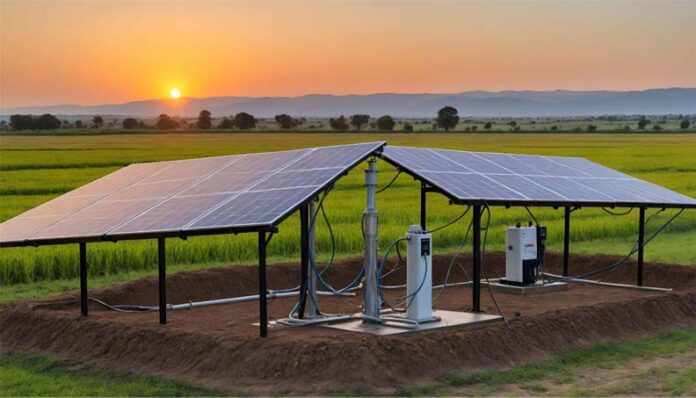
Honestly, solar water pumps are an absolute lifesaver here, providing clean, free energy straight from the sun. But behind every great solar panel setup, there is a hidden piece of tech doing all the heavy lifting: the inverter.
When you’re planning a water setup for a village or a remote farm, you will hit a major fork in the road: Should you go with a single-phase or a three-phase system? If you choose the wrong pump, water might flow very slowly, valuable solar power could be wasted or the motor might fail very quickly.
Let us break down the technical differences between single-phase and three-phase setups so you can get the absolute most water from your land without the stress:
Key Takeaways
- Single-Phase Inverters are perfect for shallow wells, smaller fields and basic everyday home water needs (usually under 3 HP).
- Three-Phase Inverters are built for heavy-duty work, deep wells and large-scale community farming because they handle massive power without breaking a sweat.
- Getting a premium, highly durable Newpro solar pump inverter gives you smart features like dry-run protection, meaning your pump won’t burn out if the well runs empty.
Why Solar Pump Inverters Matter in Rural Electrification
Many rural communities still face challenges related to electricity access and water control. Traditional diesel pumps can be expensive to operate, require regular fuel purchases and generate continuous maintenance costs.
Solar pump systems are a cleaner and more reasonable choice. The inverter is an important part of the system. It converts the Direct Current (DC) generated by solar panels into Alternating Current (AC) required to operate water pumps. Without the inverter, the pump cannot work efficiently.
Selecting a good inverter helps ensure regular performance, lower energy losses and longer tool life. As IRENA (the International Renewable Energy Agency) points out, renewable energy solutions continue to play a central role in expanding energy access and supporting sustainable development in rural communities worldwide.
Breaking Down Single-Phase Solar Pump Inverters
Single-phase solar pumps are pretty much the standard setup you find in normal residential homes. They operate on a plain two-wire AC electrical system with one live wire and one neutral wire, normally rated at around 220V.
If you are running a fast operation, single-phase setups have some great perks. Firstly, they are cost-effective, making them highly accessible for everyday family farms. Plus, the wiring is incredibly simple. You don’t need a high-level electrical engineering degree to fix things or set them up, which is a massive plus when you’re miles away from the nearest repair shop.
However, they do have a few technical limits you need to know about. Single-phase motors need extra components, like capacitors, only to get them spinning from a dead stop. In super-hot tropical weather, these capacitors fail quickly and burst. Also, because single-phase power flows, the energy delivery pulsates rather than remaining perfectly smooth, which limits these units to smaller, shallow wells.
Looking at Three-Phase Solar Pump Inverters
If single-phase is a standard daily driver, then three-phase is a heavy-duty monster truck. These systems use three separate alternating currents that overlap flawlessly. It creates a continuous, super-smooth rotating magnetic field inside your pump motor that never drops to zero.
- Massive Power Limits: These setups easily handle massive commercial and agricultural pumps ranging from 5 HP to over 20 HP.
- Insane Lifespan: Because the power flow is completely continuous, your pump doesn’t vibrate violently. It keeps the internal bearings and seals working perfectly for years.
- Better Wiring Efficiency: Running at higher voltages (such as 380V to 440V) lets you use much thinner copper wires over long distances without losing power along the way.
The only real downside is the price tag. The internal tech is much more complex and you need to buy and connect more solar panels in a row to meet the high startup voltage these units require.
Single-Phase vs Three-Phase Solar Pump Inverters: Technical Comparison
The easiest way to understand the differences is through a side-by-side comparison.
| Feature | Single-Phase Inverter | Three-Phase Inverter |
| Power Capacity | Lower | Higher |
| Pump Size Support | Small to Medium | Medium to Large |
| Energy Efficiency | Good | Excellent |
| Installation Complexity | Simple | Moderate |
| Initial Cost | Lower | Higher |
| Motor Performance | Standard | Smoother |
| Future Expansion | Limited | More Flexible |
| Best For | Homes & Small Farms | Large Farms & Projects |
While both systems perform well, a good choice depends on your specific application, not only on selecting the most powerful choice.
How to Choose the Perfect Setup for Your Land
Picking between these two options comes down to checking your specific water depth and daily needs. For smaller lifestyle farms, minor livestock watering stations or easy surface-level drip lines, a single-phase system is a great, wallet-friendly choice that gets the job done perfectly.
But the second your farming needs grow, three-phase becomes the clear winner. If you need to drop a submersible pump down a deep well past 100 meters, a single-phase unit will seriously struggle with the heavy lifting and waste way too much electricity.
To bridge this gap effortlessly, a smart and versatile newpro solar pump inverter provides your field installation team with elite features, including automatic variable-frequency speed control.
This tech safely slows your pump down when clouds block the sun, instead of turning it off completely, keeping your water flowing all day long. Investing in high-grade equipment matters; it reduces the chances of sudden breakdowns, so your community stays active, stable and more independent for years.
Let’s Wrap This Up
Selecting single-phase and three-phase solar pump inverters isn’t about finding which tech is universally better; it’s about matching the hardware to your actual on-site requirements. Single-phase systems give you amazing savings and total simplicity for smaller, shallow setups. On the other side, three-phase systems deliver the ultimate electrical efficiency and muscle needed to sustain large, deep-well village irrigation systems.
Ready to upgrade your farm with the absolute best tech? Visit Newpro Solar today to discover incredibly trustworthy, field-tested energy solutions built to keep your water flowing non-stop!
The team at Newpro Solar specializes in solar pump inverters, renewable energy systems and rural electrification solutions. With years of industry experience, they help customers implement efficient, trustworthy solar-powered water-pumping methods.