
That paradigm is now changing. The rapid adoption of rooftop solar, Distributed Renewable Energy (DRE), Electric Vehicles (EVs), Battery Energy Storage Systems (BESS), smart meters, prosumers and flexible loads is turning the distribution network into an increasingly dynamic and interactive system. A consumer can simultaneously be a consumer and a generator; a battery can alternate between charging and supplying electricity; and an EV charging cluster can create a new local peak that did not exist when the network was originally designed.
The distribution network is therefore no longer simply the final link between generation and consumption. It is becoming the platform on which India’s energy transition will ultimately be experienced.
Against this backdrop, the initiative of the All India Discoms Association (AIDA), in collaboration with the Central Electricity Authority (CEA), research institutions and partner DISCOMs, assumes considerable significance. The objective is to customise and institutionalise modern distribution network planning to improve reliability cost-effectively while facilitating greater integration of DRE.
The establishment of the Institute of Technology & Policy for Electricity Distribution (ITPED) as a resource and knowledge centre further strengthens this effort by creating an institutional platform for technology, policy, research and capacity building in the distribution sector.
Why Distribution Planning Must Change
The conventional electricity system was essentially based on a one-way flow:
Generation → Transmission → Distribution → Consumer
The emerging electricity system increasingly resembles:
Grid ↔ Prosumer ↔ Solar ↔ Battery ↔ EV ↔ Flexible Load
This transformation fundamentally changes the planning problem. A planner can no longer ask only: Where will demand increase? The planner must also anticipate where rooftop solar and other DRE resources will emerge; how much DRE a feeder can accommodate; where EV charging infrastructure will develop; where battery storage can provide network flexibility; how reverse power flow will affect voltage and protection systems; how reliability can be improved at least cost; and which investments made today will remain useful as the system evolves.
Distribution planning must consequently move from reactive network augmentation to anticipatory, integrated and data-driven planning.
From Overload to Optimisation
Traditional planning can be represented as:
Demand Forecast → Identify Overloading → Network Reinforcement → Capacity Addition
A future-ready planning architecture should instead follow:
Data → Demand Forecast → Digital Network Model → Load Flow → Reliability Assessment → DRE Hosting Capacity → Network Alternatives → Cost Optimisation → Investment Roadmap
The fundamental question must therefore change from: “Where is the network overloaded today?” to: “What will the network look like tomorrow, and what is the most economical way to make it reliable, resilient and DRE-ready?”
This shift represents the real significance of the AIDA initiative: not merely developing another planning model, but creating a systematic approach through which distribution planning becomes a continuous, forward-looking institutional function.
DRE Hosting Capacity
One of the most important additions to modern distribution planning is DRE hosting-capacity assessment. Hosting capacity seeks to determine how much distributed generation a feeder can accommodate without causing unacceptable impacts on voltage, thermal loading, protection, power quality or system stability.
A feeder that appears adequately sized under conventional loading conditions may encounter voltage rise or reverse power flow when rooftop solar penetration increases significantly.
A systematic hosting-capacity assessment can therefore help DISCOMs determine where additional DRE can be connected; how much generation a feeder can accommodate; which feeders have technical constraints; where reinforcement is necessary; whether storage or smart controls can defer conventional augmentation; and which solution provides the least-cost pathway.
This approach can make renewable-energy integration more transparent, technically robust and economically efficient.
Data: The Planning Foundation
The quality of a planning decision can never exceed the quality of the underlying data. Modern distribution planning requires reliable information on substations, feeders, transformers, consumer categories, feeder-level load profiles, smart meters, rooftop solar, EV charging infrastructure, technical losses, reliability indices, voltage profiles, existing assets and planned investments.
The integration of GIS, SCADA, AMI, smart meters, asset-management systems and advanced analytics can provide DISCOMs with a significantly more accurate understanding of network behaviour.
However, digitalisation should not become an objective in itself. The real transformation is:
Data → Information → Analytics → Prediction → Optimisation → Decision
This creates a fertile environment for Artificial Intelligence, Machine Learning, Digital Twins and advanced distribution-system analytics. The ultimate objective is not to create more data, but to create better decisions from data.
Balancing Reliability and Cost
Distribution reliability cannot be separated from economics. DISCOMs operate within significant financial constraints. Investments must compete among loss reduction, metering, system strengthening, reliability enhancement, renewable integration and other competing requirements.
The critical question is therefore: Where should the next rupee of investment be deployed to obtain the maximum improvement in reliability and network capability?
Future planning should simultaneously consider SAIDI and SAIFI; technical losses; feeder and transformer loading; voltage performance; DRE hosting capacity; network congestion; CAPEX; O&M cost; lifecycle cost; consumer benefits; and climate resilience.
The objective should neither be to construct the strongest possible network nor simply to minimise initial expenditure. The objective should be to develop the least-cost network capable of delivering the required reliability, resilience and DRE integration. This naturally creates a strong role for multi-objective optimisation and techno-economic analysis.
One Size Doesn’t Fit Every DISCOM
India’s DISCOMs operate in highly diverse environments. An urban DISCOM may face dense commercial loads, high rooftop-solar penetration and rapidly growing EV charging demand. A rural DISCOM may deal with long agricultural feeders and dispersed consumers. Industrial networks may demand very high reliability, while geographically challenging regions may face significantly higher construction and maintenance costs.
Therefore, India needs standardisation of methodology but customisation of application.
A practical classification could include:
- Urban Networks: High-density loads, rooftop solar, EVs and commercial consumers.
- Rural Networks: Long feeders, agricultural loads and dispersed consumers.
- Industrial Networks: Large concentrated loads and stringent reliability requirements.
- Renewable-Rich Networks: High DRE penetration and potential reverse power flow.
- Climate-Vulnerable Networks: Exposure to flooding, cyclones, extreme rainfall, heat and landslides.
Such segmentation can enable a common national planning framework while allowing network-specific assumptions, parameters and investment priorities.
ITPED: Building Institutional Capability
The establishment of ITPED adds an important institutional dimension to the initiative. Technology by itself cannot transform distribution planning. The required ecosystem encompasses:
Technology + Data + Research + Skills + Policy + Regulation + Institutional Capability
The word “institutionalise” is therefore crucial. A planning methodology will deliver lasting value only when it becomes embedded in the routine decision-making processes of DISCOMs—including network planning, capital investment planning, DPR preparation, regulatory submissions, asset management, reliability improvement, DRE integration and workforce development.
Bridging the Industry
The AIDA–ITPED initiative also presents an important opportunity to address the long-standing gap between industry and academia.
DISCOMs possess:
Real Problems + Field Experience + Operational Data
Academic institutions possess:
Research Expertise + Analytical Capability + Modelling Tools + Faculty + Students
Bringing these capabilities together can create an effective Industry–Academia–DISCOM ecosystem.
The objective should be to move beyond the traditional cycle of:
Academic Research → Publication
towards:
Industry Problem → Research → Field Validation → Solution → Scale-up
Such a model can simultaneously make academic research more relevant and enable DISCOMs to access emerging technologies and specialised expertise.
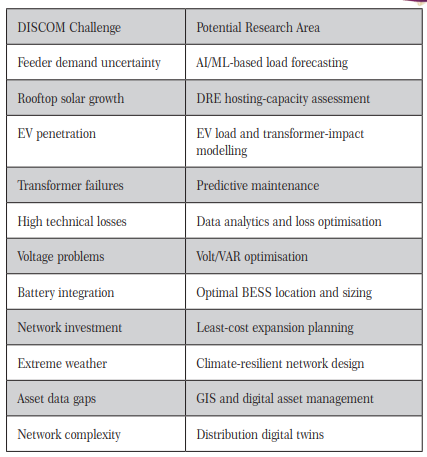
A Live DISCOM Research Bank
One practical mechanism could be the creation of a Live DISCOM Research Problem Bank.
DISCOMs could continuously identify real operational, technical, economic and policy challenges and place them before academic institutions and research organisations.
Examples include:
These challenges can become B.Tech projects, M.Tech dissertations, PhD research, pilot projects and utility solutions.
This would make the university ecosystem a genuine extension of the DISCOM’s innovation and problem-solving capability.
Feeders as Living Laboratories
Selected distribution feeders could be developed as Living Laboratories for Distribution Innovation.
A typical cycle could be:
Actual Feeder → Digital Network Model → Demand & DRE Forecast → Hosting-Capacity Assessment → Reliability Analysis → Alternative Network Solutions → Cost Optimisation → Pilot Implementation → Performance Validation
Such living laboratories could provide controlled environments for testing:
- Battery storage;
- Smart inverters;
- Demand response;
- AI-based forecasting;
- Predictive maintenance;
- Digital twins; and
- Advanced voltage control.
They would also give students and researchers exposure to actual engineering constraints rather than limiting research to theoretical models.
Beyond Electrical Engineering
The complexity of modern distribution systems makes interdisciplinary collaboration essential.
The future planning ecosystem will require:
Electrical Engineering + AI/ML + Economics + Management + Public Policy + Regulation + Environmental Studies
Consider EV planning. Transformer capacity is only one component. Charging behaviour, consumer response, tariff structures and urban mobility patterns are equally important.
Similarly, rooftop-solar adoption depends not only on technology but also on economics, consumer preferences, tariffs and regulatory incentives.
The opportunity therefore extends beyond electrical-engineering departments to management schools, public-policy institutions, economics departments and multidisciplinary research organisations.
Climate Resilience
Distribution networks must increasingly be designed for a changing climate.
Flooding, cyclones, extreme rainfall, heat waves and landslides can affect substations, transformers, feeders and communication infrastructure.
Future planning should therefore integrate:
Climate Hazard → Asset Vulnerability → Outage Risk → Economic Impact → Adaptation Investment
This represents a transition from conventional reliability planning towards resilience-oriented planning.
A resilient network is not necessarily one that never fails. Rather, it is one capable of withstanding disruptions, isolating faults and restoring supply rapidly.
From Planning to Distribution Intelligence
The long-term ambition should be the creation of Distribution Intelligence.
A future planning platform could integrate:
GIS + AMI + SCADA + Smart Meters + Digital Twin + AI/ML + Power-System Simulation + Optimisation
Such a platform could support:
- Feeder-level demand forecasting;
- DRE hosting-capacity assessment;
- EV-load forecasting;
- Transformer health prediction;
- Loss reduction;
- Reliability improvement;
- Investment prioritisation; and
- Climate-risk assessment.
Yet technology must remain an enabler—not the decision-maker.
Engineering judgement, field experience, economics, regulation and consumer welfare must remain central to investment and planning decisions.
Industry–Academia–DISCOM Scale-up Model
A sustainable collaboration could follow an eight-stage cycle:
- Problem Identification: The DISCOM identifies a genuine operational or planning challenge.
- Research Framing: ITPED and academic partners convert the challenge into a research problem.
- Research & Modelling: Faculty and students develop alternative solutions.
- Industry Validation: DISCOM engineers validate assumptions against field conditions.
- Pilot Demonstration: The solution is tested on an actual feeder or network.
- Performance Assessment: Technical, economic and reliability benefits are measured.
- Standardisation: Successful methodologies are incorporated into planning practices.
- Scale-up: Validated solutions are replicated across other DISCOMs.
This creates a powerful pathway:
Problem → Research → Pilot → Policy → Practice
Measuring Success Through Outcomes
The success of the initiative should ultimately be assessed through measurable utility outcomes, rather than merely the number of meetings, reports or research projects.
Potential KPIs include:
- Improvement in SAIDI and SAIFI;
- Increase in DRE hosting capacity;
- Reduction in technical losses;
- Reduction in avoidable CAPEX;
- Improved asset utilisation;
- Faster DRE connections;
- Number of applied research projects;
- Number of participating academic institutions;
- Student and faculty engagement;
- Technology pilots completed;
- Research publications and intellectual property;
- Solutions scaled across DISCOMs; and
- Number of professionals trained.
These indicators can ensure that research, technology and capacity building remain firmly connected to actual utility outcomes.
The Way Forward
The AIDA–CEA–ITPED initiative offers an opportunity to establish a new paradigm for distribution planning in India.
Its objective should not be limited to developing better network models. The larger objective should be to create institutional capability for continuous planning, learning, innovation and adaptation.
A national ecosystem could connect:
CEA + AIDA + ITPED + DISCOMs + Regulators + IITs + NITs + Universities + Research Institutions + Industry + Start-ups
This ecosystem could support:
Planning → Research → Innovation → Demonstration → Capacity Building → Standardisation → Scale-up
Such an approach can simultaneously address three critical requirements of India’s power sector:
Reliable Electricity + Renewable Integration + Skilled Human Capital.
Conclusion
India’s energy transition will ultimately be experienced at the distribution level.
Rooftop solar, EVs, batteries, smart meters, prosumers and flexible loads will increasingly converge on local distribution networks. The DISCOM of the future therefore cannot limit itself to asking:
“Do we have sufficient network capacity today?”
The more important question is:
“What will our consumers, distributed energy resources and network look like tomorrow—and what is the most reliable, resilient and economical way to prepare for it?”
The AIDA initiative, in collaboration with CEA, research institutions and partner DISCOMs, provides an important opportunity to answer this question through data-driven planning, DRE integration, reliability optimisation and institutional capacity building.
Its greatest potential, however, lies in creating a sustained Industry–Academia–DISCOM partnership.
When real DISCOM problems become research questions, research becomes field-tested solutions, and successful solutions become institutional practices, a powerful cycle can emerge:
Problem → Research → Innovation → Demonstration → Learning → Standardisation → Scale
The transformation required is therefore much broader than network augmentation:
From Network Augmentation → Integrated Distribution Planning
From Integrated Planning → Distribution Intelligence
From Industry–Academia Separation → Industry–Academia Co-creation
The future of India’s energy transition will depend not only on how much renewable capacity is installed, but also on how intelligently the distribution system is planned, financed, operated and continuously upgraded.
The AIDA–ITPED initiative can consequently become much more than a distribution-planning programme. It has the potential to evolve into a national platform for applied research, technology innovation, capacity building and the development of future-ready DISCOMs.
Ultimately, the objective can be expressed simply:
Smarter Planning → Better Investments → More Reliable Networks → Faster DRE Integration → A Stronger
Energy Transition.
The integration of GIS, SCADA, AMI, smart meters, asset-management systems and advanced analytics can provide DISCOMs with a significantly more accurate understanding of network behaviour…
Prof. (Dr.) Bibhu Prasad Rath, currently serving as Professor of Practice at the National Institute of Technology Meghalaya, is a distinguished industry leader with more than 36 years of extensive experience in the power sector, with core expertise spanning Energy, Environment, and Economics. He possesses strong domain knowledge in operations, design, procurement, feasibility analysis, policy formulation, investment appraisal, and carbon credit mechanisms, complemented by a 13-month tenure at the Ministry of Power. He earned his Ph.D. in Business Administration from Aligarh Muslim University and has authored numerous research papers presented and published in reputed journals and conferences.