
Data centres are becoming one of the most demanding electrical environments in the modern power system. India’s operational data-centre capacity has reached around 1.7 GW, with another 1.3 GW under construction and a further 3.2 GW of projects in the pipeline, according to recent industry estimates. The Ministry of Power has estimated that electricity demand from data centres could reach 13.56 GW by 2031-32.
The scale of this expansion is changing the electrical design conversation. Supplying more electricity is only one part of the challenge. That electricity has to be transformed, converted, conditioned and delivered to highly sensitive loads continuously, while keeping losses, heat and equipment footprint under control.
This is making power conversion increasingly important to data-centre architecture. The question is no longer simply how much power a facility can receive, but how efficiently and reliably that power can be processed before reaching the computing equipment.
Power Demand
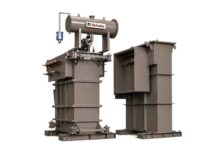
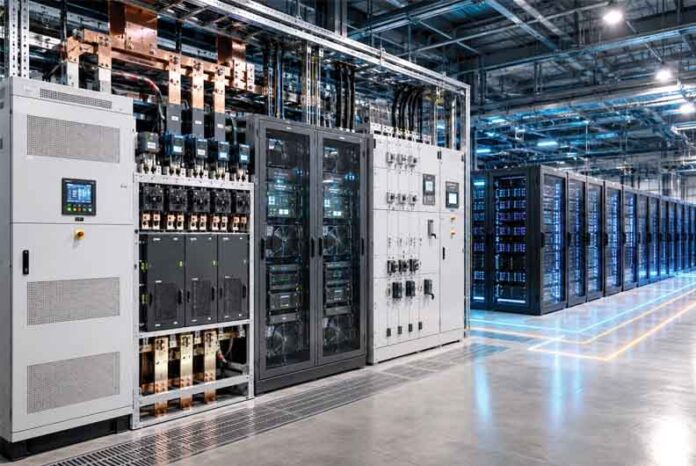
A conventional data-centre electrical system involves several stages between the utility connection and the IT load. Incoming AC power passes through transformers and switchgear before reaching UPS systems and other power-conditioning equipment. Rectifiers convert AC to DC, intermediate buses distribute power, and DC-DC stages subsequently provide the voltage required by servers and other electronics.
Every conversion stage performs an essential function, but each also introduces losses, heat and additional equipment. As data-centre loads become larger and more concentrated, these losses become increasingly significant.
Power density is adding another dimension to the challenge. Recent industry discussions indicate that cabinet power requirements can range from around 6 kW to 150 kW in high-density environments. Such a change affects not only cooling and rack design but also the way electrical power is distributed and converted. For converter designers, this means handling greater power within smaller physical spaces while maintaining efficiency, transient performance, reliability and serviceability.
India’s data-centre market has the opportunity not merely to deploy the latest global electrical architectures but also to develop local capabilities around them…
Conversion Chain
The electrical path inside a data centre is therefore becoming an important engineering consideration in its own right. Traditional architectures may involve several AC-DC and DC-DC conversion stages before electricity reaches processors and other electronic loads. Reducing unnecessary conversions can lower losses, simplify infrastructure and reduce the amount of heat that needs to be removed.
This does not mean that every conversion stage can simply be eliminated. Isolation, voltage regulation, redundancy and protection remain essential. The objective is to find an architecture in which each conversion stage performs a necessary function at the highest practical efficiency.
Power converters are consequently being designed around higher switching frequencies, improved semiconductor materials, better control systems and greater power density. At the same time, the physical relationship between the converter, distribution system and computing load is changing. The result is a shift from viewing converters as individual components towards treating power conversion as part of the overall data-centre electrical architecture.
Efficiency Pressure
Efficiency has always been important in critical infrastructure, but the scale of today’s data centres makes incremental improvements more valuable.
A small percentage of energy lost during conversion may appear insignificant at equipment level. Across a large facility operating continuously, however, those losses translate into substantial electricity consumption. They also become heat, increasing the cooling requirement.
The challenge is particularly relevant at partial loads. Data-centre electrical equipment does not necessarily operate at its maximum rating all the time, making part-load efficiency an important consideration alongside peak efficiency.
Modern UPS and power-conversion systems are therefore being developed around higher efficiency, modularity and better control of operating modes. Transformerless designs, modular architectures and improved semiconductor switching are contributing to this evolution.
Yet efficiency cannot be considered in isolation. Data-centre operators cannot accept a system that saves energy but introduces unacceptable reliability risks. Converter architecture has to balance efficiency with redundancy, fault tolerance, power quality and response to sudden changes in load. That balance is driving the next major development in data-centre power architecture.
The DC Shift
The renewed interest in high-voltage DC is arguably the most significant development in the power-conversion discussion. The conventional approach to distributing power within a data centre relies heavily on AC infrastructure and multiple conversion stages. As rack power rises, however, the current required at lower DC voltages becomes increasingly difficult to manage.
An 800 VDC architecture addresses part of this problem by allowing large quantities of power to be distributed at a much higher voltage. NVIDIA has been promoting an 800 VDC architecture designed for next-generation data centres and rack loads extending towards the megawatt range. The architecture is intended to reduce conversion stages, improve efficiency and address the physical limitations associated with distributing very high currents at lower voltages.
Higher voltage means lower current for the same power. This can reduce conductor losses and potentially reduce the amount of copper required in distribution infrastructure. But moving to 800 VDC is not simply a matter of replacing AC cables with DC cables. Protection, insulation, grounding, switching and fault interruption all require careful consideration. DC faults can be more difficult to interrupt because there is no natural current zero as in an AC waveform. This is where power converters become central. An 800 VDC backbone still needs efficient conversion to the lower voltages required by computing equipment.
The technology is already moving into the product-development stage. In March 2026, STMicroelectronics announced new 800 VDC-to-12 V and 800 VDC-to-6 V power-conversion architectures developed with NVIDIA. The company positioned these alongside an earlier 800 VDC-to-50 V solution as part of a broader high-voltage data-centre power portfolio. Texas Instruments has also been developing power-management and sensing technologies for DC architectures reaching 800 V, working with NVIDIA on an 800 VDC distribution ecosystem. These developments suggest that high-voltage DC is moving beyond a conceptual architecture and beginning to influence the converter products being developed for future facilities.
Silicon Evolves
The shift in architecture is accompanied by a shift in semiconductor technology. Silicon carbide and gallium nitride devices are attracting increasing attention because their switching characteristics can support higher-frequency and higher-efficiency power conversion.
For data centres, the value of SiC and GaN is not simply that they are newer semiconductor materials. Their importance lies in what they can enable at system level. Higher switching frequencies can reduce the size of magnetic components, while lower losses can improve efficiency and reduce thermal requirements.
GaN is particularly attractive for high-frequency conversion, while SiC is increasingly relevant to higher-voltage and higher-power stages. The choice depends on voltage, frequency, topology, thermal requirements, cost and reliability. Recent industry development is also extending GaN applications into data-centre power supplies, with manufacturers targeting higher power density and improved conversion efficiency.
The adoption of wide-bandgap devices therefore needs to be evaluated stage by stage. Replacing conventional silicon everywhere is not necessarily the objective. The real opportunity lies in identifying where their characteristics deliver a meaningful system-level advantage.
Storage Integration
Power conversion is also becoming increasingly important at the intersection of data centres and energy storage. UPS systems and battery energy storage systems are beginning to be considered as complementary elements rather than completely separate technologies. A UPS is primarily designed to maintain power quality and continuity for critical loads, while behind-the-meter BESS can support longer-duration energy management, flexibility and interaction with the wider electrical system.
Both depend heavily on power conversion. Bidirectional converters allow energy to move between batteries and the electrical system, creating opportunities for peak management, renewable-energy integration and improved utilisation of storage assets.
For data centres, this could eventually create a more integrated energy architecture in which the UPS protects the immediate critical load while BESS supports broader facility and grid requirements. The development is particularly relevant in India, where data-centre expansion is occurring alongside renewable-energy growth and increasing interest in battery storage.
Thermal Limits
Higher power density, however, creates another problem: heat. Even an efficient converter dissipates some energy. When hundreds of kilowatts or more are being processed continuously, the resulting thermal load becomes significant.
Converter design therefore increasingly has to consider semiconductor temperature, magnetic losses, packaging, cooling and reliability together. Higher switching frequencies can reduce component size, but they can also introduce switching losses and electromagnetic challenges. Higher-voltage architectures can reduce current-related losses, while increasing requirements for insulation and protection.
Cooling is consequently becoming an important part of power-conversion design. As data-centre rack densities rise, liquid cooling and other advanced thermal-management approaches are being adopted alongside higher-density electrical equipment.
The converter and cooling systems can no longer be treated as entirely independent engineering disciplines. Improving conversion efficiency reduces heat, while increasing power density increases the importance of removing the heat that remains.
Grid Interaction
Another emerging consideration is the relationship between increasingly converter-dominated data centres and the grid supplying them. Large data centres can represent substantial concentrated loads, and their power-electronic front ends must respond effectively to changes in voltage, frequency and grid conditions.
Recent research is examining how UPS rectifiers can remain stable under weak-grid conditions, particularly when converter controls interact with grid impedance and rapidly changing IT loads. Advanced control approaches are being investigated to improve voltage support and maintain stable power transfer during such conditions.
This issue could become increasingly relevant as data-centre development moves into locations where grid infrastructure is less robust or where new capacity is being connected rapidly.
For India, the question is particularly important because data-centre growth is concentrated around major electrical and digital hubs while new facilities are also beginning to emerge in other regions.
India’s Test
India’s data-centre expansion provides a significant market for these technologies. Recent forecasts suggest operational capacity could rise from around 2.2 GW in 2025 to approximately 12 GW by 2030.
Such growth will require more than additional generation and transmission capacity. The electrical systems inside these facilities will need to deliver increasingly large quantities of power efficiently and reliably.
This creates opportunities for India’s UPS, power-electronics, electrical-equipment and engineering industries. Domestic manufacturers can participate in the development of high-efficiency UPS systems, converters, power supplies, storage interfaces and associated protection equipment.
At the same time, adoption of higher-voltage DC architectures will require appropriate standards, testing facilities, safety procedures and engineering expertise. India’s data-centre market therefore has the opportunity not merely to deploy the latest global electrical architectures but also to develop local capabilities around them.
The Architecture Ahead
For data-centre operators, power conversion is becoming a much bigger part of the design discussion. A few percentage points of efficiency, a smaller converter footprint or one less conversion stage can have a real impact when the facility is handling hundreds of megawatts.
That is also why developments around 800 VDC, SiC and GaN, high-density UPS systems and battery-integrated power architectures are worth watching closely. They are not just component-level improvements; they are changing the way power can be delivered inside the facility.
India’s data-centre build-out gives these technologies a large market to prove themselves. The next few years should show which of these approaches can deliver the right combination of efficiency, reliability, cost and practicality at scale.