
A typical temperature profile (measured through the borehole) of a fire-affected mine is shown in Fig – 4. From Fig – 4 it can be seen that in fire affected coalfield the surface zone temperature may range from 40-1000 C dotted with smoke vents and fractured ground. As we go down the temperature gradually increases to about 7000 C at the burning coal seam at a depth of 100-150m. Gas composition comprises mostly of CO, CO2, CH4, C2H4, C2H2 due to cracking of coal gas. Below the burning coal seam there is often a stratum of sandstone layer that extends from ~150m to 200m. Due to heat transferred from the burning coal seam to the sandstone layer down below, the underlayer is heated up to 2000 C. Safe coal field where there is no underground fire is characterised to have steady normal geothermal gradient of about 30 to 450 C, and gas composition is mostly CO2 with traces of CH4.
Taming Inferno to Geothermal Energy Source
The persistent fires in the Jharia coalfield present high temperature anomalies, and holds significant potential for geothermal energy production in this region. Sub-surface mapping identifies hotspots at a temperature of around 400-7000 C in Barakar formation burning coal seams and local hotspots at ~20000 C surrounding sandstone layers near the burning zone at depths of 100-1000m. The thermal conductivity of sandstone layer is 2.42W/m.K, and specific heat capacity: 0.2388-0.3105 BTU/lb for rocks, suitable for geothermal plant.
Extraction method
Water cannot be directly injected into the burning coal seams to extract geothermal energy. Doing so would cause catastrophic explosions, generate toxic gases, and accelerate the fire by supplying air through fissures. Instead, a safe closed loop geothermal method may be used to harness the intense waste heat from the Jharia coal field fires. The schematic arrangement of the closed loop method is shown in Fig –5.
For harvesting geothermal energy from the burning JCF closed-loop systems such as two-phase closed loop syphons (refer Fig – 5) or coaxial borehole heat exchangers are considered the most suitable compared to traditional open-loop geothermal systems (as have been successfully tested in other active coal fire zones of China, Germany, Japan) due to the following reasons:
- Jharia fires emit highly toxic gases like CO, CO2, CH4. Closed loops isolate the working fluid from the toxic underground environment, and thus prevent the release of these poisonous gases to the surface.
- JCF has been pitted with so many voids, fissures and fractured rock strata, which make it impossible to control and recover water, if open-loop setups are used.
- In the closed loop system cold, high-pressure water is pumped down through the injection well and injected into the highly porous, highly conductive hot sandstone layer below the burning coal seam. As it travels, it absorbs geothermal heat and the heated fluid returns to the surface through the insulated production well.
At the surface, the extracted high-temperature fluid can drive turbines for electricity generation. The high permeability of sandstone allows water to be injected or withdrawn through wells drilled into the formation.
Sandstone formation can store significant amounts of thermal energy. The mineral composition of sandstone can withstand repeated heating and cooling cycles without degrading. Sandstone rock formation has high thermal diffusivity ~1mm2/s allowing the rock to absorb heat more quickly during the charging phase and release it rapidly during the discharging phase.
A typical 10MWe plant may require about 5 production wells and 5 injection wells to return the cold water back into the reservoir, spaced suitably around the active fire zone. For a liquid dominated 10MWe plant, flow rate of injected water at ~800C to flush it into steam usually requires ~100 kg/s of water, i.e. 20 kg/s in each injecting pipe of size about 113 mm nominal bore.
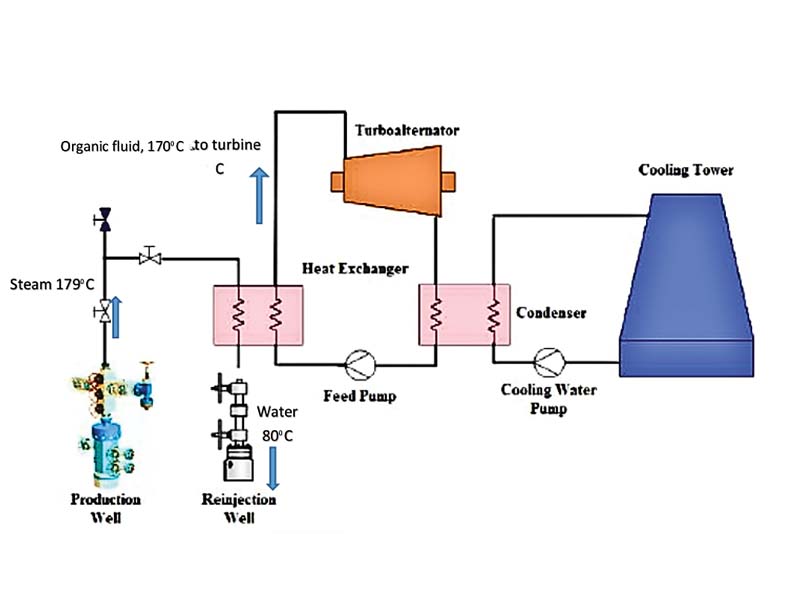
Production well pipe should be well insulated, to be made of corrosion resistant alloy steel and pipe size about 250 mm NB. Life span of the plant depends on – how long the underground sandstone mass can sustain the bed temperature of 2000C (typically a geothermal power plant life is about 25 years). However, it will cool the coal bed gradually to make mining safer. Flow diagram of the closed loop system is shown in Fig – 6.
Step-by-step Implementation Procedure
Based on test borehole data on temperature profile, permeability and heat retention capacity of underlying sandstone layer, make design of injection and production well systems. Accordingly, construct operating well system which should be located away from active fire zone, using steel casings and proper cementing to prevent collapse, and to be drilled to a depth around 150-200 m into the sandstone.
Actual operation involves injecting treated water in controlled amount maintaining pressure and temperature as per operating norm into sandstone layer avoiding quenching of heated layer. Recover heated water/steam from production well and route it through surface separator to remove particulates. Collect dry steam and pass it through heat exchanger to generate high pressure vapour using organic fluid like isobutene, pentane to be fed to the Organic Rankine Cycle (ORC) turbine, where it expands, and turn the generator.
harvesting…
Conventional steam turbines require high-temperature, high pressure steam above 2000 C to operate efficiently, whereas ORC turbines use organic fluid with low boiling point that allows to extract heat from sandstone layer at temperature below 2000 C at a reasonable cycle efficiency of ~18%. ORC turbines are smaller, simpler, reliable and costing much less.
Cost analysis
Cost break up (CapEx) in Rupees can be summarised as follows for a 10MWe geothermal power plant at JCF:
- Estimated drilling cost + casing and piping cost for production wells = 25 crore.
- Estimated cost of drilling, piping, pumps and control system for injection wells = 10 crore.
- Cost of binary cycle ORC turbine along with heat exchanger = ~ 180 crore.
- Cost of services like cooling tower, water treatment plant, monitoring devices = ~ 20 crore.
- Civil works, land, infrastructure, electrics = ~ 30 crore
Total = ~265 crore, add contingencies @ 10% i.e. 26 crore. Grand total = 291 crore
Considering operating expenditure around 8 crore/year and annual generation (considering 90% capacity factor) as ~80,000MWh, Levelized Cost of Electricity (LCOE) would be Rs3/ kWh which is compatible with coal based power plant LCOE.
Conclusion
Geothermal installations in the burning Jharia coalfield can transform the region’s century-old underground fires into valuable assets. Extracting this trapped waste heat provides a sustainable, low-to-medium grade geothermal resource.
Harnessing this energy is complex due to environmental and geological constraints of the area. The plant must be carefully designed to optimize control injection flow of water and prevent hazardous rock fracturing.
Techno-economic assessments for such geothermal plant in MW scale show that the source temperature around 15000 C could provide a heat-recovery system that is economically viable. The future application of this technology serves a dual purpose of simultaneously generating green energy and suppress the expansion of mine-fires.
Concluded …

Rathindra Nath Biswas is the Dy. General Manager, In-Charge (Retired), MECON, Durgapur.