
Electrical short circuits are responsible for nearly 70% of building electrical fires in India built environment, a statistic that has remained stubbornly unchanged for years despite growing urbanization, rising construction activity, and successive rounds of regulatory intent. Hospitals have lost patients. Families have lost everything. And each time, the post-incident conversation circles the same uncomfortable truth: the building was not wired for the life being lived inside it. India’s construction sector has long treated electrical installation as the last item on the budget sheet, the place where corners get cut, where cheaper conductors replace specified ones, where load calculations are frozen at the point of original design and never revisited. The consequences are not hidden. They are just not attributed correctly.
In this context the revised National Building Construction Standard 2026, The Bureau of Indian Standards’ notification of the National Building Construction Standard (NBCS) 2026 presents the most substantive overhaul of India’s building electrical framework in a generation. For decades, the National Building Code (NBC) governed how buildings were wired – a document rooted in an era of modest load, predictable consumption, and buildings that drew from the grid without giving anything back. That era is over.
As urbanisation accelerates, commercial construction scales, and India’s energy transition reshapes what buildings are expected to do, the NBC’s electrical provisions had become not just outdated but genuinely inadequate. The NBCS 2026 does not patch that inadequacy. It replaces the underlying logic entirely, setting a new baseline for what electrical safety, reliability, and future-readiness must mean in an Indian building.
To appreciate what NBCS 2026 changes, it is worth being clear about what the NBC was. Its electrical provisions were civil in their orientation, concerned with containment, basic protection thresholds, and steady-state consumption in buildings that were simple load environments. Predictable, low-diversity consumption. That framework held for as long as buildings remained passive. The moment India’s buildings started generating solar power from their rooftops, charging electric vehicles in their basements, housing data infrastructure on their upper floors, and running HVAC systems that would have been classified as industrial loads two decades ago, the NBC’s assumptions did not just become dated; they became a liability. The NBCS 2026 is the acknowledgement, in enforceable regulatory language, that India’s buildings have fundamentally changed and that the standard governing their electrical infrastructure must change with them.
What Standard Now Demands
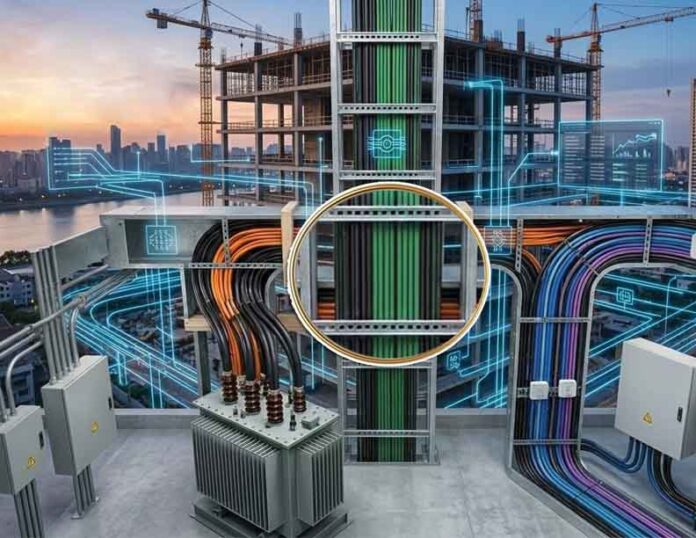
The NBCS 2026 introduces a set of concrete, enforceable changes that every stakeholder in the construction value chain of developers, electrical engineers, contractors, and facility managers, who must now incorporate into practice. The most immediately impactful is the revision to conductor sizing: the NBC’s 16 mm² threshold for fixed electrical wiring is replaced by a universal minimum of 25 mm², rising to 50 mm² for multi-storey buildings, important public buildings, and high-load commercial structures. Residual Current Device sensitivity is fixed at 30 mA, the internationally recognised life-safety standard, replacing the variable and frequently inadequate specifications of the NBC era. High-voltage cable requirements for dry-type transformers have been upgraded from 12 kV to 36 kV. Bus duct systems now carry mandatory conductor material and cross-section specifications, closing a gap that previously allowed cost-driven substitution at the installation stage without consequence.
But the standard also carries an explicit advisory for auditing and upgrading electrical installations in existing buildings, where legacy wiring falls short of revised requirements. NBCS 2026 is not only about what gets built from here. It is about what is already standing.
On load planning, the standard makes an equally decisive departure from the NBC. Diversity factor tables have been substantially expanded to formally incorporate HVAC systems, elevators and escalators, heat pumps, data centres, EV charging infrastructure, and laundry systems into the design calculus from the outset. One of the most persistent failure modes in Indian building electrical systems has been the chronic underestimation of actual in-service load. Buildings designed for one era of consumption are progressively loaded with the appliances and infrastructure of the next – without corresponding upgrades to their electrical backbone. Circuit overloading, protection device failure, and accelerated wiring deterioration are the direct and predictable consequences. NBCS 2026 removes the basis for designing this gap from the start.
From Civil Code to Technology Standard
The most consequential thing about NBCS 2026 is not any single specification. It is what the standard signals about how India must now think about building electrical systems. The NBC was a manual of civil minimums such as floors, walls, conduit, switchgear, and a set of thresholds calibrated for a building that consumed electricity passively and predictably.
The NBCS 2026 is a technology integration standard. The difference is not incremental. A civil minimum tells you how to contain an electrical installation. A technology integration standard tells you how to design an electrical system that performs as the active interface between a building and a national energy infrastructure. Solar PV systems, Battery Energy Storage Systems, and EV charging infrastructure are not addenda in NBCS 2026.
They are primary provisions. Buildings are now required to design for bidirectional energy flows, not just drawing from the grid but feeding back into it. Cable specifications for solar DC circuits are mandated per IS 17293. The electrical engineer walking onto a project brief today is not doing the same job as the one who worked for the NBC. The scope, the responsibility, and the consequences of getting it wrong are categorically larger.
The technology transition NBCS 2026 is designed to govern is not on the horizon. It is already inside India’s buildings.
India’s air conditioning market, valued at USD 6.15 billion in 2025, is projected to reach USD 21.59 billion by 2034. Each of these trajectories ends inside a building. The question NBCS 2026 answers, firmly, and in enforceable language is whether that building will be ready to receive them.
Buildings are now required to design for bidirectional energy flows, not just drawing from the grid but feeding back into it…
Why Compliance Must be Complete
India’s construction sector is operating at a scale that makes the quality of its electrical standards a matter of national consequence. The industry is growing at 6.4% in real terms in 2026, as per GlobalData.
Infrastructure capex between FY26 and FY30 is projected at Rs 90-100 lakh crore, a 60% increase over the previous five-year cycle, as per Crisil Intelligence. The FY2026-27 Union Budget carries a capital expenditure allocation of Rs 12.2 lakh crore, an 11.5% increase year-on-year.
Every building commissioned in this cycle is subject to NBCS 2026 standards. The standard’s provisions are enforceable, and the direction of India’s regulatory environment makes clear that enforcement will intensify over time. The industry faces a straightforward choice: implement at the design stage, where cost is manageable and outcomes are designed in or implemented reactively, through retrofits, inspection failures, and liability exposure that are categorically more expensive in every dimension that matters.
Across NBCS 2026’s most significant revisions – the conductor sizing uplift to 25 mm² and 50 mm², the bus duct specifications, the legacy wiring advisory – the performance requirements align directly with what high-load, technology-integrated building environments demand of their electrical materials. India’s copper consumption in building construction grew 11% in FY25, reflecting the same specification trajectory the standard now makes mandatory. Where the standard leads, material choices follow.

Amol Kalsekar is the Director – Marketing at International Copper Association (ICA) India.