
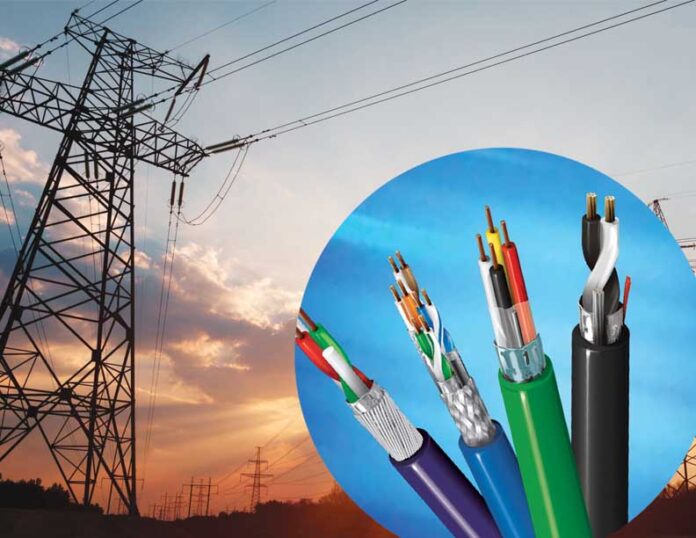
Cables and wires form the silent backbone of electrical and electronic systems across power generation, transmission, and distribution. Traditionally, their selection has relied on deterministic calculations, tabulated current-carrying capacities, safety margins, and accumulated engineering experience. While these methods have served the industry well for decades, the operating environment of power systems has changed fundamentally.
Today’s power sector is characterised by:
- Rapid growth of renewable energy
- Proliferation of power electronics
- Urban underground cabling
- Electric Vehicle (EV) charging infrastructure
- Climate-induced thermal and environmental stress
- Increasing pressure to reduce losses, costs, and emissions
Under these conditions, conventional rule-based cable selection methods – largely static and conservative – often lead to over-design, under-utilisation of assets, or unexpected failures. Artificial Intelligence (AI) and Machine Learning (ML) offer an opportunity to transform cable and wire selection into a dynamic, data-driven, and sustainability-aligned engineering decision process.
This article presents an industry-oriented framework for applying AI and ML to cable and wire selection across Generation–Transmission–Distribution (G–T–D) systems, with relevance to utilities, EPC contractors, consultants, OEMs, and regulators.
Conventional Cable Selection Practices and Their Limitations
Established Engineering Methods
- Cable selection today is primarily based on:
- EC 60287 and IEEE 738 standards
- Manufacturer catalogues and derating tables
- Short-circuit withstand calculations
- Ambient and installation condition corrections
- Engineering safety factors
These approaches are deterministic and intentionally conservative to ensure safety and reliability.
Challenges in Modern Power Systems
However, in present-day applications, several limitations become evident:
- Static assumptions: Load growth, renewable intermittency, and EV charging profiles are dynamic, but cable selection is typically frozen at design stage.
- Climate sensitivity ignored: Rising ambient temperatures, heat waves, flooding, and soil drying significantly affect ampacity and aging.
- Oversizing penalties: Excessive conductor size increases CAPEX, material usage, and embodied carbon.
- Undersizing risks: Inadequate margins lead to thermal stress, insulation degradation, and premature failures.
- Losses overlooked: Lifecycle energy losses are rarely optimised against upfront cost.
These gaps create the need for intelligent decision-support tools that can learn from data, adapt to changing conditions, and balance multiple objectives.
What AI and ML Bring to Cable Engineering
AI and ML do not replace engineering standards; rather, they augment engineering judgment by learning from historical data and simulating complex trade-offs that are difficult to capture analytically.
Key Capabilities
AI-based systems can:
- Learn from historical load, failure, and operational data
- Incorporate site-specific environmental conditions
- Evaluate thousands of cable configurations rapidly
- Optimise across cost, losses, reliability, and sustainability
- Adapt recommendations as system conditions evolve
Importantly, AI should be viewed as a decision-support system, not a ‘black box’.
Overview of AI and ML Techniques Used
Supervised Machine Learning
Used to predict suitable cable types and sizes based on historical examples.
Typical algorithms
- Random Forest
- Gradient Boosting (XGBoost)
- Artificial Neural Networks
Inputs
- Voltage level
- Load profile
- Ambient temperature
- Installation method
- Reliability requirement
Output
- Conductor material
- Cross-sectional area
- Insulation type
Optimization Algorithms
Cable selection is inherently a multi-objective problem.
Algorithms
- Genetic Algorithms (GA)
- Multi-objective GA (NSGA-II)
- Particle Swarm Optimisation (PSO)
Objectives
- Minimise technical losses
- Minimise lifecycle cost
- Maximise thermal margin and reliability
- Minimise carbon footprint
Reinforcement Learning
- Reinforcement Learning (RL) is suited for long-term grid planning.
- The algorithm ‘learns’ from scenarios of load growth, climate variation, and asset aging.
- Particularly relevant for urban distribution networks and transmission expansion planning.
Fuzzy Logic Systems
Fuzzy logic incorporates expert judgment and uncertainty, such as:
- ‘High ambient temperature’
- ‘Poor soil conditions’
- ‘Frequent overloads’
This is especially useful in Indian field conditions where precise data may not always be available.
Proposed AI-Based Cable Selection Framework
An industry-friendly, step-by-step workflow is proposed:
Data Collection
- Load profiles
- Environmental conditions
- Installation details
- Historical failure data
Load Characterization
- Clustering of demand patterns
- Peak and diversity assessment
AI-based Prediction
- Identification of feasible cable options
Multi-objective Optimisation
- Cost–loss–reliability–sustainability trade-off
Standards Compliance Check
- IEC / IEEE validation
Final Engineering Recommendation
- Transparent and auditable output
- This framework ensures regulatory compliance while enabling innovation.
Applications Across the Power Value Chain
Power Generation
In generation plants – thermal, hydro, solar, or wind—AI-based cable selection supports:
- Generator stator and rotor winding design
- Auxiliary and balance-of-plant cabling
- Solar PV DC cable optimisation
- High-temperature cables for power electronics
- Aging prediction for critical circuits
Benefits
- Reduced overheating
- Improved reliability
- Optimised material usage
Transmission Systems
Transmission networks face increasing stress due to renewable integration and right-of-way constraints.
AI applications include:
- Selection of advanced conductors (AAAC, HTLS)
- Dynamic line rating using weather and load data
- Underground EHV cable system optimization
- Climate-resilient conductor selection
Outcomes
- Higher power transfer capacity
- Reduced congestion
- Deferred capital investment
Distribution Networks
Distribution systems are undergoing rapid transformation due to urbanisation and EV adoption.
AI-enabled cable selection supports:
- Underground cabling in cities
- EV charging infrastructure planning
- Smart distribution transformer networks
- Loss reduction in LT and HT feeders
Impact
- Lower technical losses
- Improved reliability indices (SAIDI, SAIFI)
- Better customer satisfaction
Sustainability and ESG Perspective
Cable selection has a direct and indirect impact on sustainability.
Energy Losses and Emissions
- Every unit of technical loss translates into additional generation and emissions.
- AI optimisation reduces I²R losses over the asset lifecycle.
Material and Carbon Footprint
- Optimal sizing avoids excessive copper or aluminium use.
- Supports circular economy through recyclable materials.
Alignment with National Goals
- Net-Zero commitments
- Smart Grid Mission
- Distribution sector reforms
- Climate-resilient infrastructure
AI thus becomes a tool for ESG-aligned engineering.
Illustrative Industry Example
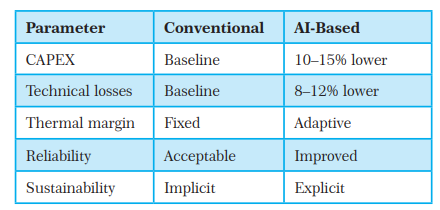
An indicative comparison between conventional and AI-assisted cable selection shows:
Such improvements are significant at utility scale.
Benefits to Power Sector Stakeholders
Utilities
- Better asset utilisation
- Reduced failures and outages
- Improved regulatory performance
EPC Contractors & Consultants
- Faster, optimised designs
- Competitive bidding advantage
OEMs
- Data-driven product development
- Value-based differentiation
Regulators & Policymakers
- Evidence-based planning
- Transparent investment decisions
Implications for Engineering Education and Skills
The adoption of AI-based cable engineering supports:
- Outcome-based engineering education (NBA)
- Industry-ready graduates
- Integration of AI, sustainability, and power systems
For management education (AACSB/EQUIS), it enables:
- ESG analytics
- Infrastructure investment evaluation
- Responsible leadership in energy transition
Conclusion
The selection of cables and wires is no longer a purely static engineering exercise. In an era of smart grids, climate uncertainty, and sustainability imperatives, AI and Machine Learning provide a powerful decision-support layer that enhances traditional standards-based engineering.
By enabling data-driven optimisation across cost, reliability, and environmental performance, AI-based cable selection frameworks can significantly contribute to building resilient, efficient, and sustainable power infrastructure for India and beyond.

Dr. Bibhu Prasad Rath is a senior power sector professional with over 36 years of experience at NTPC Limited, India’s largest power utility, where he superannuated as Additional General Manager. His expertise spans power generation, electrical systems, sustainability, project appraisal, procurement, and policy formulation. Dr. Rath holds an M.Tech from IIT Delhi and a Ph.D. in Business Administration, and works at the intersection of power engineering, digital technologies, and ESG-driven infrastructure planning. He actively contributes to industry discourse through research, teaching, and professional publications. https://www.linkedin.com/in/bibhu-rath-a1b52622/