
Most Indian EV charging facilities continue to operate under fixed tariffs, offering the same price to every user irrespective of demand conditions, time of day, or user affordability. This approach, although simple, leads to low charger utilisation during off-peak hours, congestion during peak periods, and significant rejection of cost-sensitive users.
Given India’s wide socio-economic diversity, a uniform pricing model is inherently inefficient. This article presents how AI-driven dynamic pricing, supported by real-time decision intelligence, can improve charger utilisation, user acceptance, and revenue stability – without compromising fairness.
Why Fixed Pricing Fails in the Indian Context
India’s EV user base is highly heterogeneous, ranging from two-wheeler owners and fleet operators to premium car users. A single tariff cannot accommodate:
- Variations in willingness-to-pay
- Differences in urgency and charging flexibility
- Temporal demand fluctuations
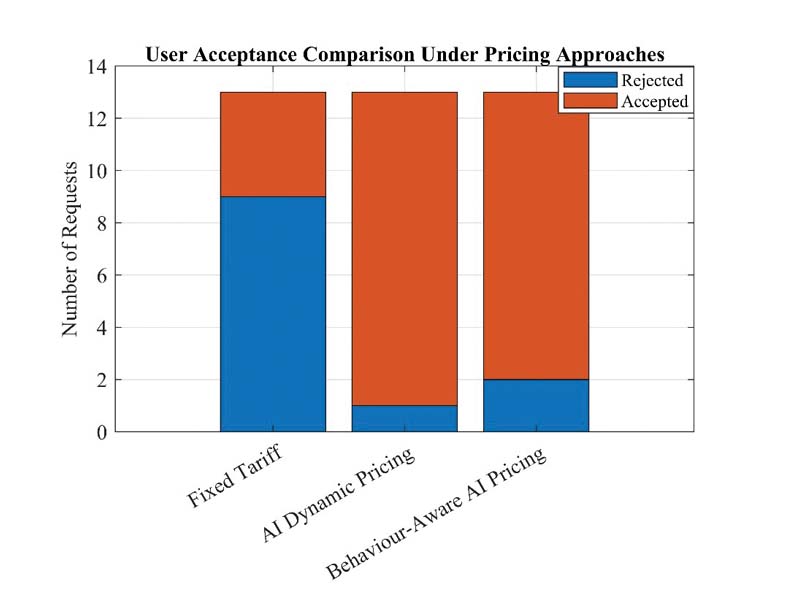
As illustrated later in Fig. 1, fixed tariffs result in a large number of rejected charging requests, even when physical charger capacity is available. This mismatch leads to idle infrastructure and lost revenue opportunities, especially during non-peak hours.
AI-Driven Pricing: Conceptual Overview
The proposed AI-driven pricing framework introduces behaviour awareness into charging decisions. Instead of treating all users identically, the system adapts prices based on observed affordability and real-time system conditions.
As shown in Fig. 2, the pricing workflow consists of four intuitive stages:
- EV User Arrival – A charging request arrives with time and duration requirements
- Affordability Estimation – The system infers the user’s typical willingness-to-pay based on historical data
- Price Decision – An intelligent pricing engine selects an appropriate tariff
- Offer & Response – The user accepts or rejects the offered price
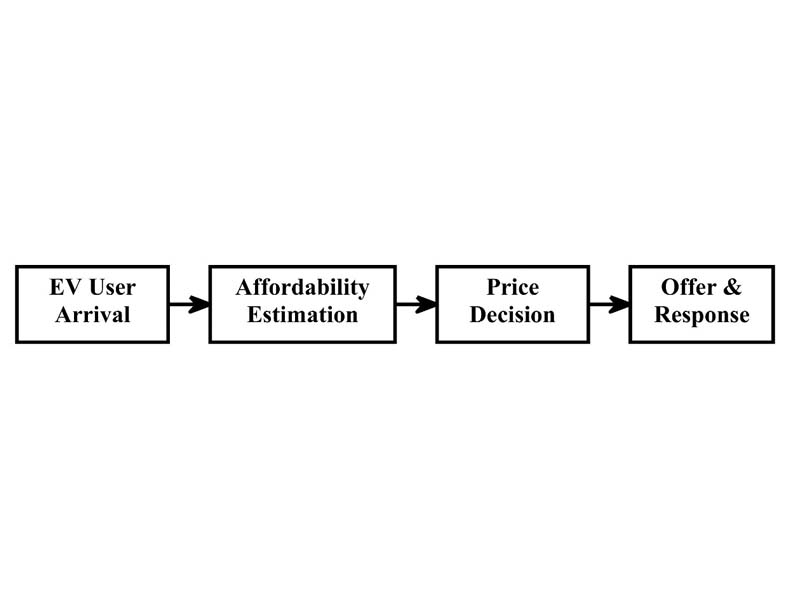
This workflow operates online, requiring no future demand forecasts and no explicit disclosure of user income or preferences.
Diversity in EV User Willingness-to-Pay
A key enabler of intelligent pricing is understanding budget diversity among EV users.
Figure 3 shows the distribution of historical charging budgets along with a smooth fit representing underlying affordability trends. Three dominant budget ranges emerge:
- Low-budget users – highly price-sensitive
- Mid-budget users – flexible within a moderate range
- High-budget users – less sensitive, time-critical
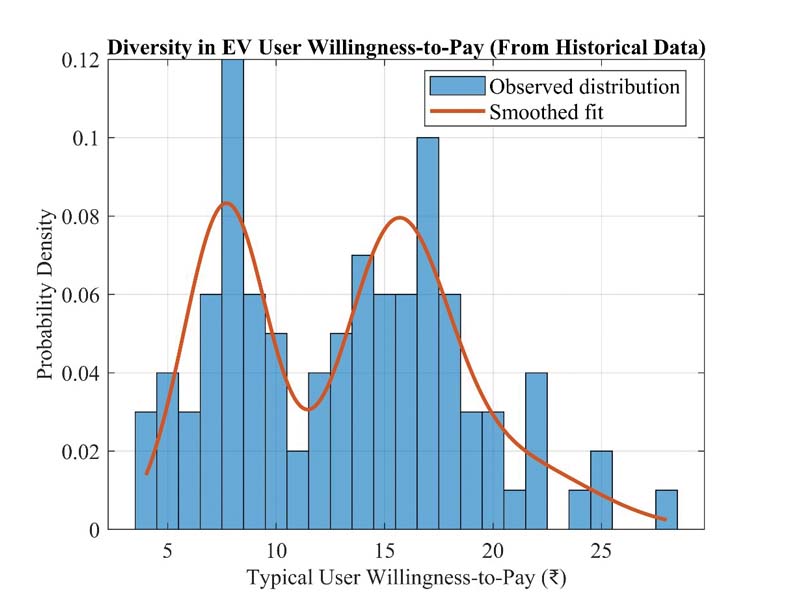
This diversity explains why fixed tariffs fail: a price acceptable to one group may be rejected by another. AI-based pricing leverages this insight to offer context-appropriate prices, improving overall acceptance.
Impact on Charger Utilisation
Beyond acceptance, pricing decisions directly affect how effectively charging infrastructure is used.
Figure 4 compares hourly charger utilisation under three approaches:
- Fixed Tariff
- AI Dynamic Pricing
- Behaviour-Aware AI Pricing
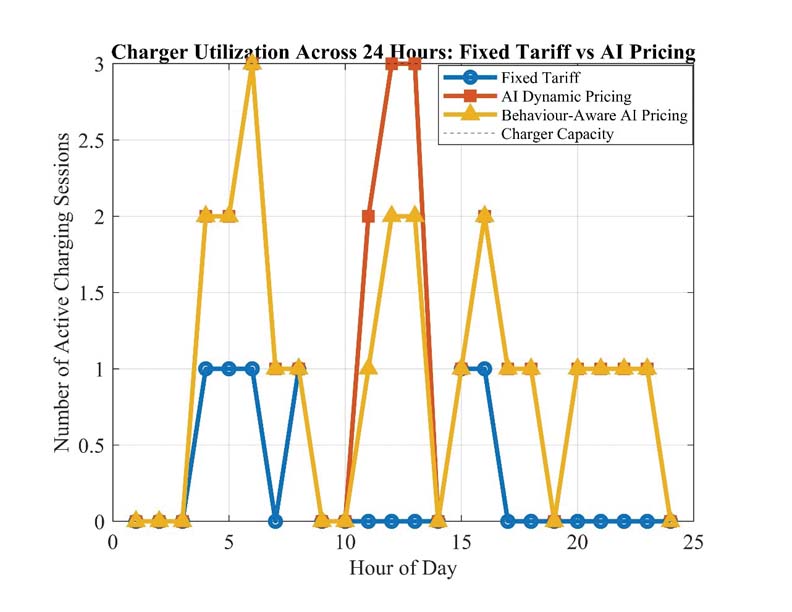
Under fixed tariffs, chargers remain idle for large portions of the day and experience under-utilisation even during moderate demand. AI-based pricing significantly improves utilisation by encouraging flexible users to shift charging to less congested periods.
The behaviour-aware AI approach achieves the most balanced utilisation, maintaining near-capacity usage during peak hours while avoiding excessive congestion.
User Acceptance Performance
User acceptance is a critical indicator of pricing effectiveness.
Figure 1 clearly demonstrates that fixed tariffs result in a high number of rejected requests. In contrast, AI-driven pricing approaches achieve substantially higher acceptance, with behaviour-aware pricing performing the best. This improvement is achieved without lowering prices indiscriminately, but by matching prices to user affordability.
Revenue and Acceptance Trade-Off
Charging operators often fear that higher acceptance may reduce revenue. The results show otherwise.
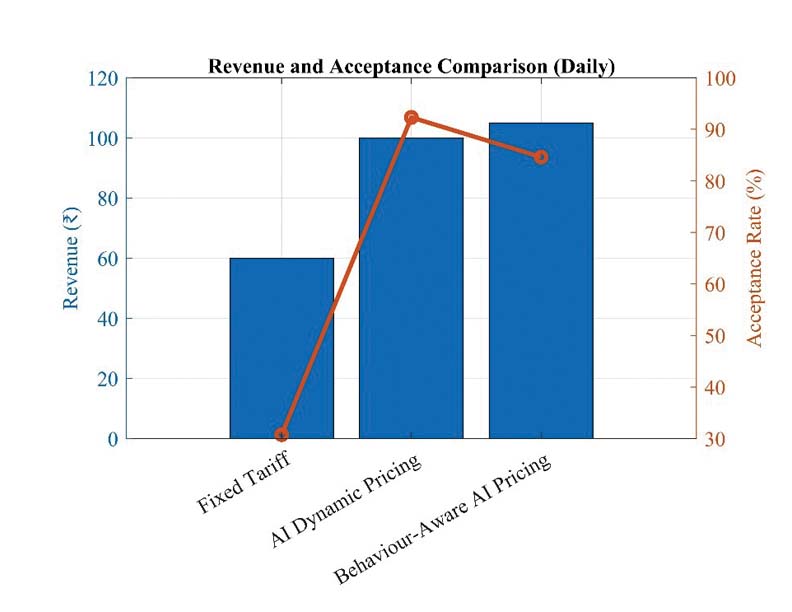
Figure 5 presents a combined view of daily revenue and acceptance rate. Fixed tariffs generate the lowest revenue due to poor acceptance. AI dynamic pricing improves both metrics, while behaviour-aware AI pricing achieves high acceptance with stable or higher revenue. This demonstrates that intelligent pricing does not mean cheaper pricing, it means smarter pricing.
Alignment Between Offered Price and User Budget
A major advantage of behaviour-aware pricing is its ability to align offers with user expectations.
Figure 6 compares offered prices against user budgets. Fixed tariffs show no alignment, leading to frequent rejections. AI dynamic pricing improves alignment, while behaviour-aware AI pricing closely follows the ideal “offer = budget” trend.
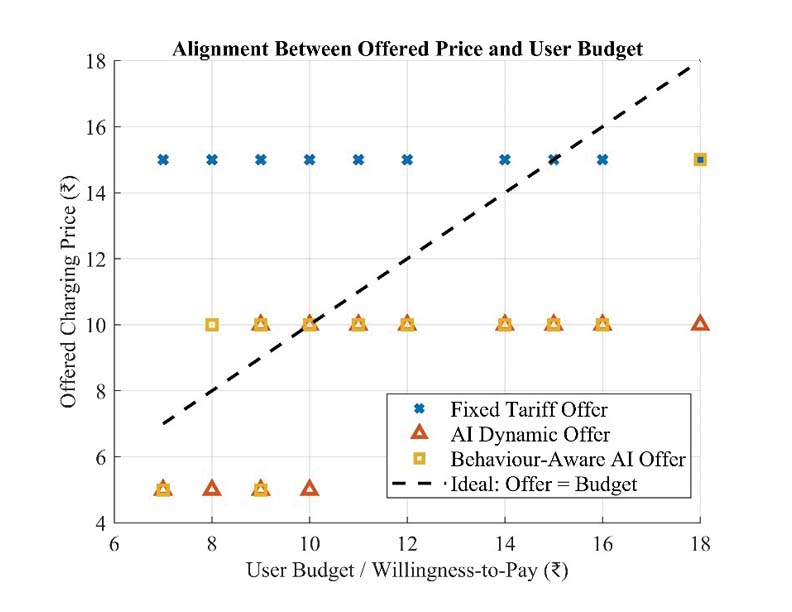
This alignment explains the observed improvements in acceptance and utilisation.
Practical Implications for Indian Charging Infrastructure
For charging station operators, AI-driven pricing offers:
- Improved asset utilisation
- Faster return on investment
- Reduced idle capacity
For DISCOM-supported stations, it enables:
- Load smoothing
- Reduced peak stress on distribution networks
For policy makers, it supports:
- Fair access across income groups
- Market-driven efficiency without heavy regulation
Importantly, implementation is software-centric, requiring no hardware upgrades and integrating seamlessly with existing charging management systems
Conclusion
India’s EV charging ecosystem is at a decisive stage. While infrastructure expansion is essential, pricing intelligence will determine operational success. The results presented through Figures clearly show that AI-driven, behaviour-aware pricing significantly outperforms fixed tariffs in terms of user acceptance, charger utilisation and revenue stability.
By respecting user diversity and responding dynamically to demand, AI-based pricing offers a scalable and inclusive solution for India’s evolving EV landscape. As India moves toward large-scale electrification of transport, intelligent pricing will be as critical as physical chargers themselves.

Chodagam Srinivas is an esteemed academician and dedicated researcher with over a decade of experience in Teaching, and Research. As an Assistant Professor at Madanapalle Institute of Technology & Science in Andhra Pradesh, India, Srinivas has become a prominent figure in advancing sustainable energy solutions. His expertise bridges the gap between complex concepts and real-world implementation, making him a sought-after speaker at industry events.

Mohammad Basha Shaik is pursuing his Bachelors in Electrical and Electronics Engineering at Madanapalle Institute of Technology & Science in Andhra Pradesh, India. His expertise lies in PLC and PCB Designing for real time industrial applications. He has completed six certificate courses in MATLAB from Mathworks. His area of interest includes Power Systems and Machine Learning Applications in distribution systems.