
The story begins not in a laboratory but in nature. The ancient Greeks observed static electricity as early as 600 BCE when Thales of Miletus noticed amber attracting feathers when rubbed and notably, the Greek word for amber is the root of word “electron”. The first scientific leap came in 1752 when Benjamin Franklin proved lightning was electrical in nature.
Michael Faraday then changed everything in 1831 by demonstrating that a moving magnetic field could generate electric current — the foundational principle behind every power generator on earth to this day.
The first electric street light in India was lit in Calcutta in 1879. The first hydroelectric power station came up at Sidrapong, Darjeeling in 1897, marking India’s formal entry into organised power generation.
Thomas Edison started the commercial era on 4th September 1882 – origin of the Pearl Street Power Station in New York City — the world’s first central electric power plant — serving 85 customers and 400 light bulbs using Direct Current (DC).
India’s early industrialists understood this viscerally. Jamsetji Tata envisioned large-scale hydroelectric power for Western India as early as 1900, a vision that materialised as the Tata Hydroelectric Power Supply Company in 1910 — the foundation of what became Tata Power. He saw electricity not as a product but as the prerequisite for all industrialisation.
Then, as any revolution moves on, there was never an end to this, with Alternating Current (AC), high-power three-phase electric current leading to the conceptual birth of the grid (which was based on the premise that electricity can travel real fast and very vast distances) and the world’s first fully integrated national grid opened in 1935 in the United Kingdom covering the entire nation, making electricity cheaper and universally stable for the first time. From that point, the grid never stopped growing. Probably, no other human invention has travelled that distance so far and so fast. Today it is the lifeline of human beings. We can’t survive without it.
Electricity Vis-A-Vis Electronics & Digital
The grid is fundamentally different from electronics and digital infrastructure. Electronics manipulates electrons in controlled circuits measured in milliwatts. Digital infrastructure processes information. But the power grid delivers raw energy at scale — measured in megawatts and gigawatts — to make everything else possible.
Electronics manipulates electricity in miniature circuits. Digital technology converts electricity into information. Communication technology transmits electricity as signals. But none of them generate electricity — they only consume it.
Every device we celebrate today as a “marvel of modern technology” — Smartphones, Laptops, Electric Vehicles, Satellite Networks, Digital Payment Systems, Hospital Equipment, state-of-the-art Defence Systems, Data Centre or even our new God aka “Artificial Intelligence” — runs on one single, non-negotiable, indispensable foundation: “ELECTRICITY”.
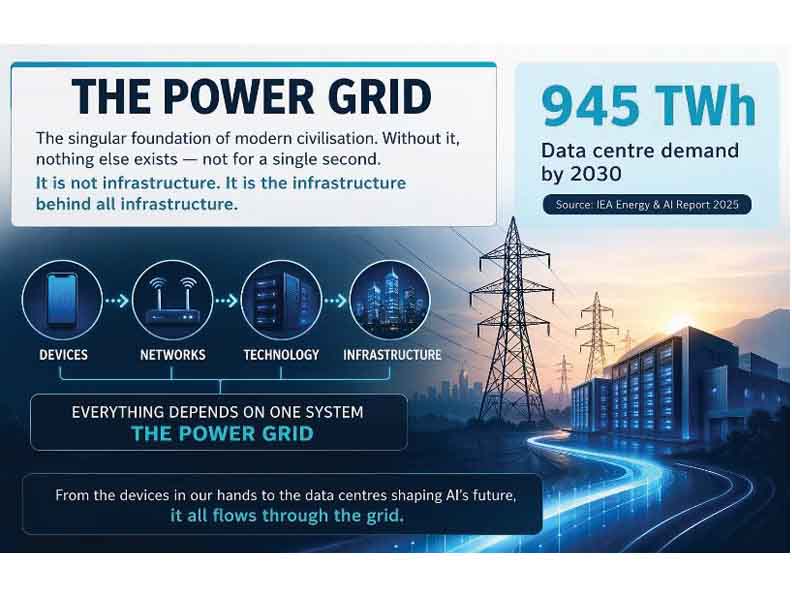
So, if there is no Power, doesn’t it mean that we will have no Internet, no Smartphone, so technically no AI?
WiFi — The Invisible Crown of the Digital Age
WiFi, undoubtedly the uncrowned King of our lives, without whom we cannot survive today. WiFi is the undisputed invisible force, which connects entire humanity today.
But what if, I were to say that, WiFi is a technology, which the world celebrates as the symbol of wireless freedom, is perhaps the Greatest Illusion of our Digital Age?
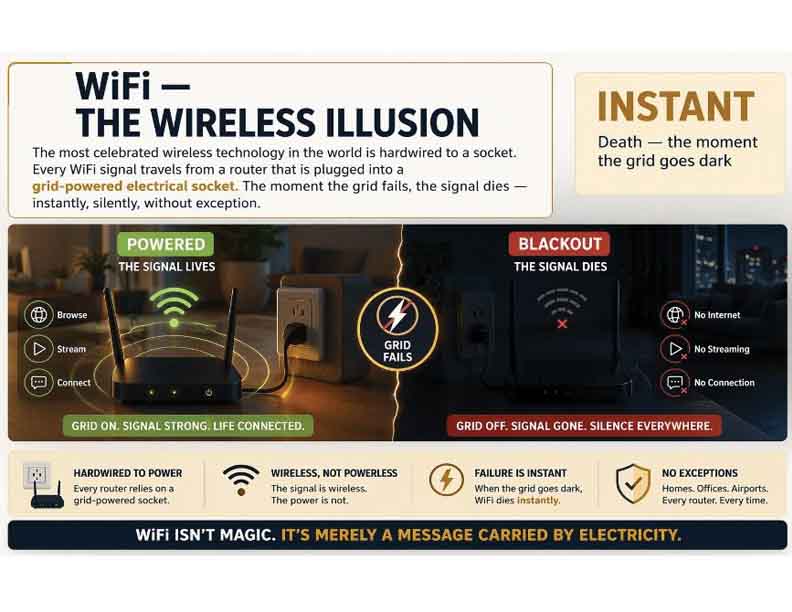
Every WiFi signal that travels invisibly through walls and across rooms, originates from a router that is hardwired to an electrical socket, powered by a grid, fed by a power station —and the moment that grid fails, the signal vanishes, the connection drops and the wireless world goes completely, silently and instantaneously dark.
There is nothing wireless about WiFi. It is electricity wearing an invisible costume.
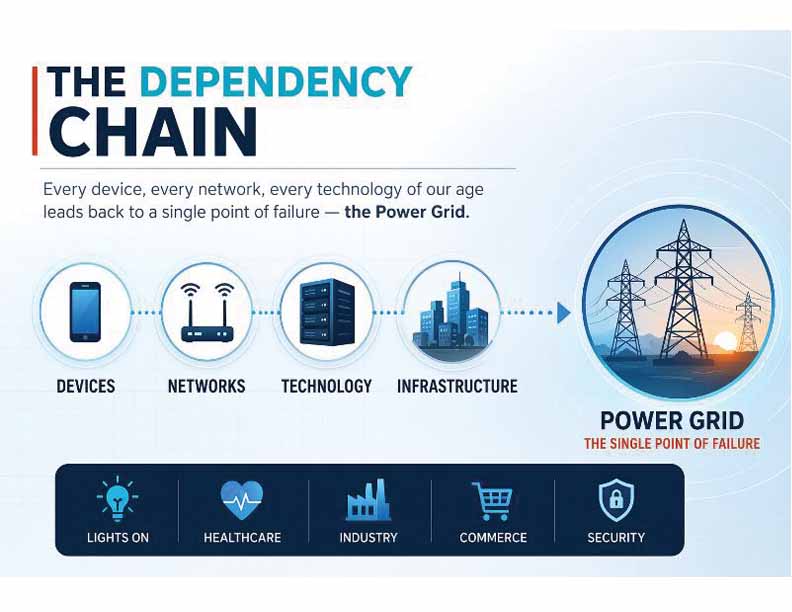
So, as we can see from the above, all these Electronics or Technology or Digital Marvels or whatever name we call by, are nothing but simply “TENANTS”. The Power Grid is the BUILDING. Remove the Building and every Tenant ceases to exist — instantly, simultaneously and without exception.
This is not a Dependency. This is an Absolute.
The Grid is not “Infrastructure”. It is the “Infrastructure behind all Infrastructure”
Data Centres: The New Nerve Centres of Civilisation
Try to recollect the famous dialogue from the Hollywood movie “Syriana” : “In this town, it’s not about who you are, it’s about what you have. And if you have the oil, you have the world” or the Bollywood movie “Once upon a time in Mumbaai” : where the hero says “Dhande mein koi kisi ka bhai nahi, koi kisi ka beta nahi… jisne tel nikaala, wahi sultan” (In business, no one is a brother or a son… whoever extracts the oil is the King).
So, we all have grown up in this world, where we knew that the “person who owns Oil is the King”. But then last few years, this changed slightly with a new saying that “Data is the new Oil”.
One, who has maximum data is the king.
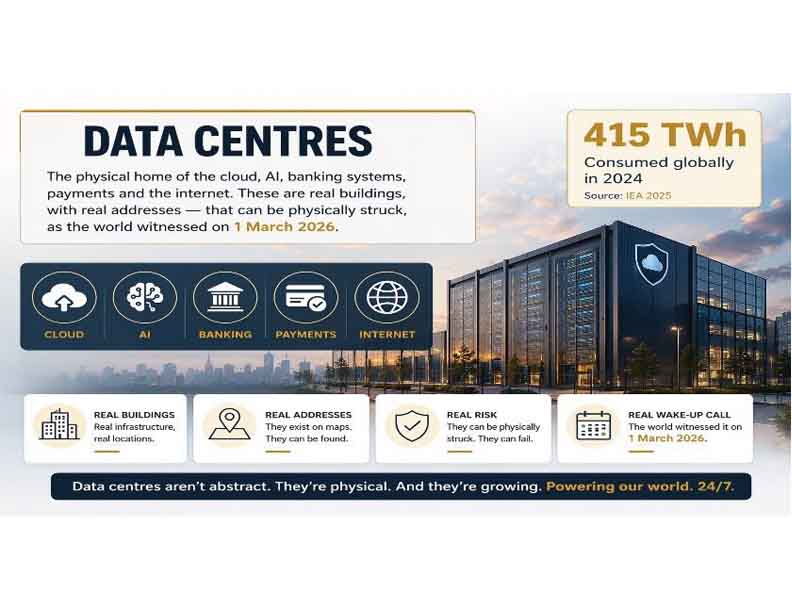
So, over time, technology companies started becoming bigger and bigger. They started needing bigger spaces for managing loads of data. So, Data Centres became a priority. As per a report by the International Energy Agency (IEA), global electricity consumption from data centres reached approximately 415 TWh in 2024. This was, however, approximately 150–200 TWh in the mid-2000s. So, it has almost grown over 3x in 20 years.
So, technically when there is “No Power” the situation would be like
“Power is Dead. Long live the WiFi”
Without the Grid, there is no “Electronics”
Without the Grid, there is no “Digital”
Without the Grid, there is technically “Nothing”
So, if there is no Power, there is “No Live Wire”
No Live Wire means the “Wireless is Dead”
But this huge jump is not really gradual. It had grown to just around 200 TWh in 2017. But post 2017, the world switched over to cloud computing and social media at an unprecedented speed and the electricity consumption has also been crazily skyrocketing. Now with AI etc.. it is just going to be crazy consumption. By 2030, the IEA projects this will more than double to 945 TWh — roughly equivalent to Japan’s entire annual electricity consumption today. As per a very recent report by Nicole Greenfield in Consumer Reports, Nicole states that a typical hyperscale data centre uses 100 megawatts — as much as 100,000 households. She goes on to state that Meta’s Hyperion project in Louisiana alone will require at least 5 GW, three times the electricity consumption of the entire city of New Orleans.
Now, the world no longer runs behind Oil. It runs behind DATA. But Data runs on Electricity.
Power Failure shall lead to a Dead Database
Artificial Intelligence: The Unavoidable Future
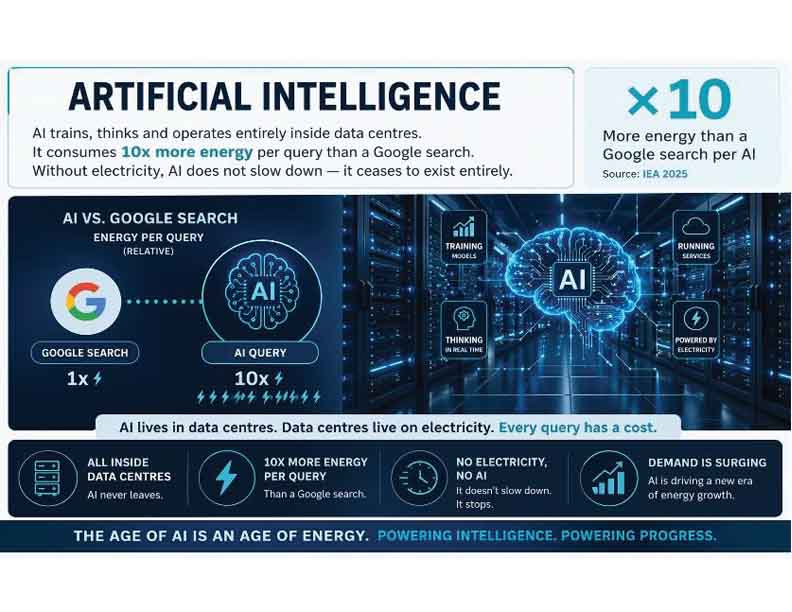
There is no second thought today that Artificial Intelligence (AI) is the most important and undisputed fact of our lives, whether we like it or not. AI is the present and it is the unavoidable future. Now, some interesting known facts about AI.
AI is not just hungry for electricity, but it is extensively thirsty for water as well.
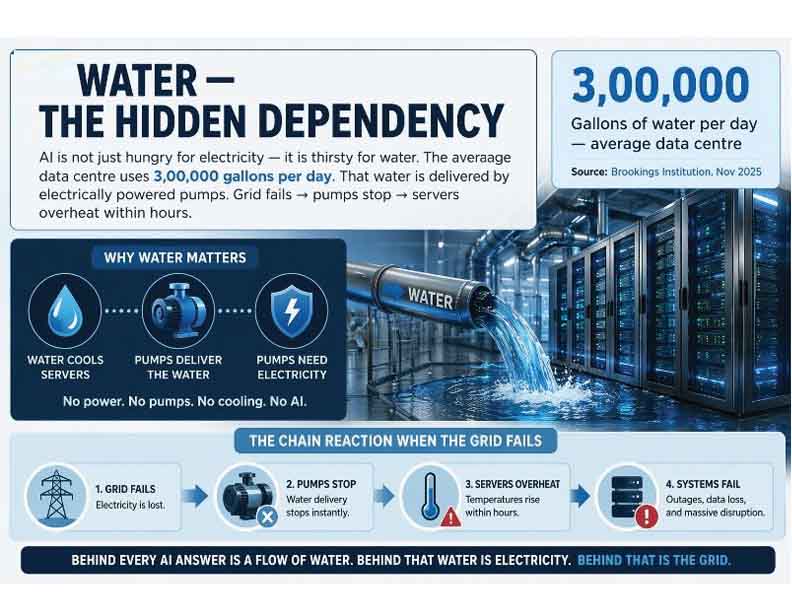
We are all heavy consumers of AI today. While this makes AI a very hot topic, did you know that AI actually is very HOT in nature. As per research by the University of California, Riverside every 100-word AI prompt consumes approximately one 500ml bottle of water — in cooling alone. As per a report by the Brookings Institution last year, an average data centre consumes 300,000 gallons of water per day — equivalent to the daily water needs of approximately 1,000 households. Lincoln Institute of Land Policy reports that a larger AI Data Centre consumes over 5,00,000 gallons of water per day.
In the year 2023, while Google has reported consumption of over 6 billion gallons of water across all its data centres, Microsoft has stated that over 40% of its water usage came from areas already experiencing water stress. As per ScienceDirect — Sustainable AI Infrastructure Study in Sept. 2025, training Google’s Gemini AI model was estimated to use over 1 million litres of water for a single training cycle. Data centres in Texas alone are projected to require 399 billion gallons of water by 2030 — an increase of 870% from 2025 levels.
So, it is not ironical that the locals in the US are against such data centres and are in a huge protest mode, as reported by various local news agencies there like the heatmap.news and datacentrewatch.org. It seems water consumption is the single most cited reason (in at least 40% cases) for opposition to data centre projects in the United States. 25 data centre projects were cancelled in the US in 2025 due to local opposition — a fourfold increase from the previous year. In a very significant move, it is reported that as of mid-2025, an estimated $98 billion worth of US data centre projects had been blocked or delayed — driven by grassroots community opposition across 28 states. In one Georgia county, as reported by foodandwaterwatch.org, taps ran dry after Meta broke ground on a $750 million data centre. Local water rates are set to rise by 33% in two years — against a typical annual increase of 2%. Google was reportedly forced to withdraw its data centre proposal in Indianapolis after hundreds of citizens protested at the city council. 3 people were reportedly arrested in Wisconsin during a public council meeting opposing an OpenAI and Oracle data centre project. Having said this, it can indeed be seen that such big multinationals from the US have been creating their data centres in other nations. News reports confirm that:
- Microsoft has committed $15 billion to data centre and AI infrastructure expansion in the UAE alone by 2029.
- Amazon AWS committed $5 billion to build a new AI data centre hub in Riyadh, Saudi Arabia, in partnership with state-backed “Humain”.
- The UAE committed $1.4 trillion and Saudi Arabia $600 billion toward AI and data centre infrastructure — triggered by US President Trump’s Gulf tour in May 2025.
- OpenAI, Nvidia, Oracle and Cisco are involved in the Stargate UAE campus — a planned facility spanning 10 square miles with a 5GW capacity — one of the largest AI infrastructure projects in the world.
Interestingly, arid regions like Saudi Arabia and the UAE, which already suffer from severe water scarcity, have seen a significant uptick in data centre developments, correlating directly with growing domestic resistance in the United States. So, when these data centres have moved to countries like the water stressed regions of UAE and the Saudi Arabia, apart from India and China, which because of their huge population size requires a higher water consumption, is there a thought how to manage this water menace that will come from the AI? A big question mark.
“Is the US exporting its water problem along with its data centres to other nations?”
Now, Water does not arrive at a Data Centre by Gravity or Goodwill. It arrives because electric pumps are working around the clock to push it there. Every Data Centre that consumes millions of gallons of water daily depends on electrically powered pumping stations, water treatment plants, and pressurised distribution networks to deliver that water.
Moment Power Grid fails, waterflow stops – not in hours, not in days, but almost immediately.
Will this melt down our “AI”?
Transport Runs on a Plug
Saving fuel was a mission to reduce dependency on oil. Nations are rapidly moving transport onto the grid. EVs (Electric Vehicles) are becoming a norm these days. As per the IEA’s Global EV Outlook 2025, electric car sales exceeded 17 million globally in 2024 — reaching a sales share of more than 20% of all new cars sold worldwide. In China alone, 1 in every 10 cars on the road is now electric. The global stock of EVs is set to more than triple by 2030.
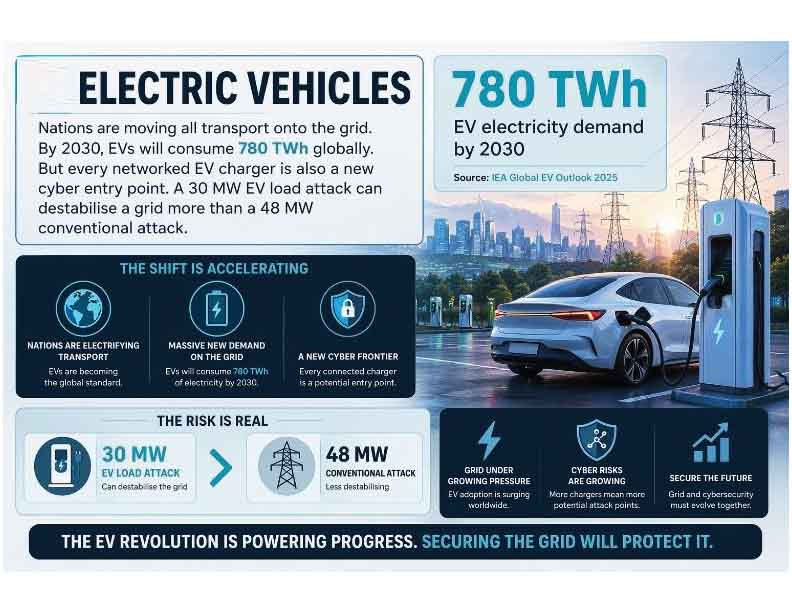
As per reports by the IEA, in 2024, the Global EV fleet consumed around 180 TWh of electricity — more than Argentina’s entire annual electricity consumption — and this is projected to more than quadruple to 780 TWh by 2030. To put this in perspective, by 2030, EVs alone will account for approximately 4% of total global electricity consumption. Public charging infrastructure, as per the IEA, will need to grow almost ninefold globally by 2030 to support projected EV growth under current policies. Every single one of those charging points runs on one thing — the power grid.
Now, manual and mechanical stuff cannot be hacked. But electrical stuff can be hacked, can be controlled remotely. Research published in ScienceDirect has demonstrated that a coordinated cyberattack using EV charging loads can completely destabilise a power grid — and crucially, a smaller 30 MW EV load attack can cause more damage than a 48 MW attack using traditional residential loads, because EV loads carry higher reactive power demand. In 2024, cyberattacks on utilities increased by 70% year on year, as documented by Check Point Research. The number of vulnerable points in the grid is increasing by approximately 60 per day, according to the North American Electric Reliability Corporation (NERC). Every new EV added to the road is, simultaneously, a new point of potential entry into the grid.
No Power: Transportation comes to a Halt.
The Wake-Up Call : Iran Strikes the Cloud
What exactly happened?
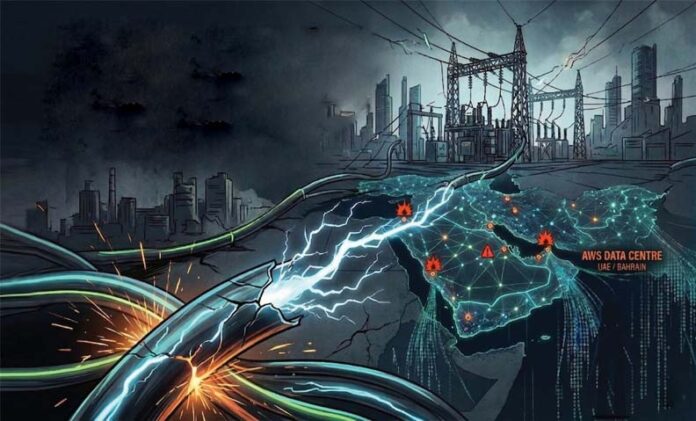
- Iranian Drone Strikes damaged two Amazon Web Services Data Centres in the UAE and a third in Bahrain, disrupting power flow, triggering fires and water damage requiring prolonged repair. Iran’s IRGC claimed responsibility, framing these commercial cloud hubs as legitimate wartime infrastructure. (source : datacentremagazine) While Amazon confirmed their UAE data centre being struck by some objects, they have denied any linkage to Iranian strikes.
- When the strikes hit, millions in Dubai and Abu Dhabi awoke to locked-down digital lives — people found they could not pay for a taxi, order dinner, or check their bank balance on their phones. (source: Manara Magazine).
- Analysts described these as among the first known physical attacks on data centres — buildings that hold infrastructure powering everything from banking apps to cloud services and AI platforms. (source: Euronews)
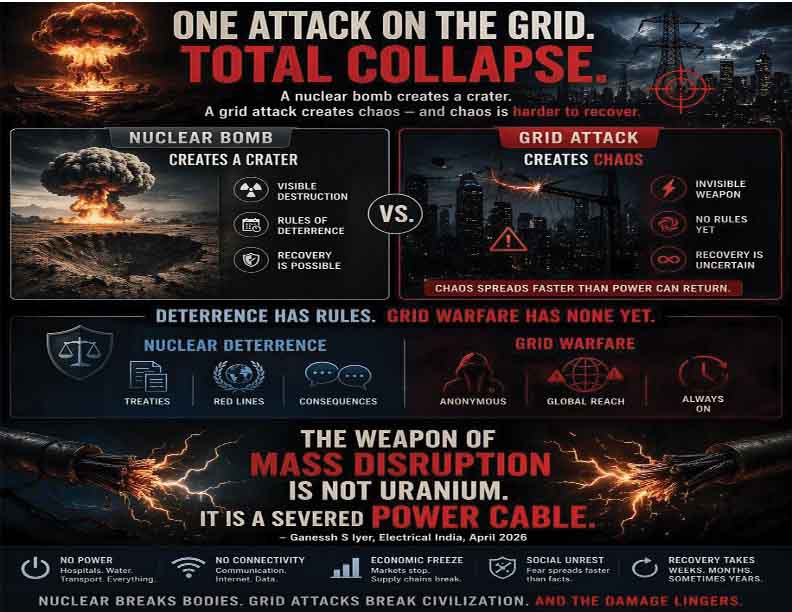
- This was not a nuclear strike. No mushroom cloud. No radiation. Yet a city of millions was paralysed. That is the lesson. The world witnessed a new kind of warfare on 28 February — 1 March 2026 — not aimed at soldiers, but at servers.
- The world’s largest AI investment corridor has effectively been operating in a region now exposed to active conflict. Recent attacks have fundamentally reshaped how risk is assessed across the Gulf, showing how digital infrastructure can be at risk of direct military strikes.
- This marks a significant shift: Digital assets are no longer threatened only by cyberattacks, but also by physical and kinetic actions targeting critical infrastructure.
- For years, Gulf leaders made a simple promise to Silicon Valley: Bring your data, your models, your chips and we will give you stability.
- On Sunday, that promise ended in flames, after Iran’s retaliatory strikes in response to U.S.-Israeli assault set an Amazon data center in the United Arab Emirates on fire.
- An adversary who destroys a power grid doesn’t just kill computers — it stops the water flowing into cooling towers. AI literally dries up because AI needs electricity to think. AI needs water to cool itself while it thinks. Water needs electricity to reach AI.
Electricity is not just the Fuel. It is the Lifeline of the Lifeline. Attack the grid once – and you kill both simultaneously.
- This attack has raised many eyebrows and probable risks of Business Continuity Plans and Disaster Recovery Solutions.
- Similarly, EV charging infrastructure introduces a new and growing cyber-physical risk to power systems. Reason: Large numbers of chargers can be centrally managed or networked, a coordinated disruption — such as switching many chargers on or off simultaneously could create sudden load fluctuations and stress local grid stability. Similar risks have existed with other controllable or aggregated electrical loads; EVs primarily increase the scale and complexity of this exposure.
Nuclear vs Grid: The Doctrine of Asymmetric Paralysis
Nuclear weapons destroy. A grid attack enslaves — you leave the population alive but incapable.
- For years, Gulf states positioned themselves as stable anchors for global data and AI infrastructure, offering reliability to international technology firms. That assumption is now under strain. On March 1, Amazon Web Services confirmed that one of its UAE data centres was struck by unidentified objects, triggering a fire and service disruptions during a broader wave of Iranian missile and drone activity across the region — though the company stopped short of formally attributing the incident.
- The episode underscores a structural shift in risk: digital infrastructure is no longer exposed solely to cyber threats, but increasingly to physical, kinetic events linked to geopolitical conflict. For investors and operators alike, resilience can no longer be assessed purely in terms of uptime and redundancy — it must now account for proximity to conflict and the vulnerability of critical infrastructure on the ground.
- According to Rest of World, the UAE intercepted a large volume of incoming threats — including ballistic missiles, cruise missiles, and hundreds of drones — over a two-day period, though a number of projectiles still penetrated defences, underscoring the cost asymmetry between attack and defences.
- A Director at the Centre for Strategic and International Studies told CNBC, as reported, that recent Iranian strikes indicate data centres may increasingly be viewed as legitimate targets in modern conflict, prompting a reassessment of infrastructure security.
Reports from Cyber Security News indicate that widespread GPS disruptions affected commercial vessels across Gulf waters following the strikes, with some ships showing false positions at airports, industrial sites and inland locations — highlighting the scale of electronic interference in the region.
According to PBS, Iran has developed significant offensive cyber capabilities, with affiliated groups targeting U.S. critical infrastructure, including water utilities, as well as attempting to access networks linked to defence contractors and political entities.
Reports cited by Industrial Cyber, indicate that Iranian-aligned threat groups have claimed intrusions into oil and gas organisations across Israel, Jordan and Saudi Arabia, alongside conducting Distributed Denial of Service (DDoS) attacks targeting government and military-related entities in the Gulf region.
Threat intelligence assessments from CloudSEK suggest that by early 2026, Gulf Cooperation Council (GCC) states — particularly the UAE — were experiencing a sustained increase in sophisticated cyberattacks targeting government and financial sectors, with indications that Iranian-linked advanced persistent threat groups have established ongoing access within parts of the region’s critical infrastructure.
Conclusion
So, to summarise, a nuclear bomb creates a crater. A Grid Attack creates chaos — and chaos is harder to recover from. Nuclear deterrence has rules. Grid warfare has none yet.
India has been identified as a key importer of energy from the Gulf region and a major provider of IT and BPO services to clients in the Middle East and Israel. Because of this, it faces risks of indirect impact and disruptions in specific sectors if the conflict escalates.
India’s large outsourced IT workforce, its growing ambitions in the Electric Vehicle (EV) sector and its reliance on remittances from the Gulf are all connected to critical infrastructure — such as power systems — that could be vulnerable if targeted.
In a post-nuclear war, soldiers march. In a post-grid-attack world, electric cars sit dead on roads. The dependency on a single infrastructure has never been greater.
The Question the World must now ask is not whether nuclear weapons will define the next world war – but whether the next world war has already quietly begun, one drone strike at a time, aimed not at soldiers but at server rooms. The weapon of mass disruption is not Uranium. It is a Severed Power Cable.
All images are AI-generated for representation only.

CA Ganessh S Iyer
B.Sc. (Chem.), A.C.A., Director, Chary Publications Pvt. Ltd., Founder & CEO, Pro-Risk Group, BFSI Advisory Board Member of IILM University, Strategic Advisor – ENTRUST Family Office, Amazon Best Selling Author.
Chartered Accountant with around 30 years of experience in Risk Management, Insurance, Operations Excellence, Process Controls, Underwriting, Claims and InsurTech. An entrepreneur – Founder of Pro-Risk Group and Visiting faculty at NIA Pune, BIMTECH, IIRM, ICAI and III. Amazon Bestselling Author — “Creating Digital Excellence: 7 Key Strategies for Digital Transformation” (Ranked #2, Engineering and Technology, Amazon.in Kindle Store, November 2025).