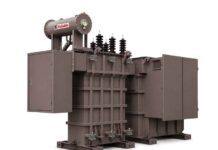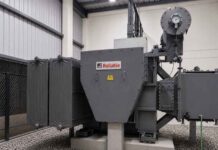


A Distribution Transformer (DT) is an electric machine that works on the principle of electromagnetic induction, and is used to transfer electrical power over the same frequency. Its main function is to step-down the higher voltage level to normal voltage level usually 11kV to 440V for three-phase and 11kV to 220V for a single-phase system. The distribution transformer is very costly and critical equipment in the electrical distribution network.

The main parts of the distribution transformer are core, winding, transformer oil, main tank, breather, cooling, radiator, and bushings. (Refer figure 2)

Internal Factors of DT Failure
Internal failures are often the result of aging, poor maintenance or manufacturing defects that compromise the transformer’s physical integrity.
- Transformer Core Failure: The transformer core is designed to provide a path for the magnetic field to flow around, which is necessary for the induction of the voltage between the two windings. It gets damaged due to some reason like poor maintenance, old oil, and corrosion. If the lamination of the core gets damage (Refer Figure 3) then it will increase the eddy current which is directly proportional to thermal heat – and due to this thermal heat, the distribution transformer gets damaged.

- Transformer Windings Failure: The windings suffer from three types of stresses during the process of transferring high voltage/low current are dielectric stress, thermal stress, and mechanical stress. The faults that occur in the winding due to these stresses cause failure winding and the breaking of the winding or burn out (Refer figure 4).

- Transformer Tank Failure: Transformer tank is used to contain the transformer oil and protect the core & windings from outer conditions like lightning, dust, rain, etc. Because of corrosion, environment stress, and high humidity, etc., cracks in the wall of tanks occur and it leads to leakage of oil,,which finally results in a reduction of oils.
From this leakage and reduction of oil, there is a reduction of insulation in the winding due to this the temperature of the distribution transformer starts increasing during the operation and may result in damage to the transformer.
- Conservator Tank Failure: If there is any blockage or leakage in the conservator tank, then it is not able to absorb the increased volume of oil in their free upper space and the tank will burst because of high oil pressure at full loading condition.
- Buchholz Relay Failure: Buchholz relay acts as a protective device and used to sense the faults due to high temperature inside the transformer, and it is connected between the main tank and conservator tank (Refer figure 5). If the Buchholz relay fails, it will not detect the fault, then gas moves upward and the alarm doesn’t work due to this transformer goes in a danger zone, and transformer will get damaged due to high oil pressure.

- Explosion Vent Failure: The purpose of the explosion vent in a transformer is to prevent damage of the transformer tank by releasing any excessive pressure generated inside the transformer. The failure of explosion vent will be a reason to failure of transformer during fault in the system.
- Breather Failure: The breather acts like an air filter for the transformer and controls the moisture level inside a transformer during breathing process. If there is any fault in the breather (Refer figure 6), then it will not absorb moisture which is present in the air of tank due to which moisture and dust are added in oil and that oil will lose its dielectric properties and transformer will get damaged.

- Radiator Failure: Radiator is a collection of hollow pipelines, (Refer figure 7) which are used for cooling the transformer oil that reduces the winding temperature under loading conditions. If radiators get damaged, then it will not cool down the temperature of transformer oil with the help of atmospheric air due to which the temperature of the oil will increase and may become the cause of failure.

- Bushing Failure: The main failure mode of the bushing is a short circuit. It may be due to material fault in the insulator or due to mechanical damage. However, the cracks in the porcelain and ingress of water inside the insulation of bushing may lead to its failure (Refer figure 8).

Prevention of Failure Due to Defect in Parts of DT
- Prevention of Failure of Transformer Core: The material of the core should be having high permeability and high resistivity because high permeability takes high magnetic flux, and high resistivity provides low conductivity that prevents eddy currents. Instead of having one big solid iron core as a magnetic core material of the transformer, the magnetic path is split into several thin electrical steel sheets known as laminations. (Refer figure 9).

- Prevention of Failure of Winding of DT: The fault of transformer winding can be reduced by providing proper insulation for inter-turn separation as well as Ph-Ph or Ph-E separation. The use of good quality of insulation paper and proper drying process may help in preventing winding failure.
- Prevention of Failure of Main Tank of DT: To avoid Environmental stress, corrosion, high humidity, and solar radiation, the oil tank of the transformer is made up of pure steel. Another way is we can paint the oil tank from outside to avoid corrosion.
- Prevention of Oil Leakage: The main reasons for the leakage of transformers are: radiator fins, bad welds, cracked bushings, gaskets, butterfly valves controlling the flow of oil between the radiator and main oil tank.
- Prevention of Failure of Conservator Tank of DT: Only a small transparent window is provided in a conservator tank to see the oil level. Workers can see the level of oil directly from outside. You can wipe it off with a rag when the crystal is dirty. Periodic checking of the window may help in the reduction of failure due to low oil level.
- Prevention of Failure of Breather of DT: Before filling the container with silica gel, clean and dry all parts of the breather. Verify that the oil level in the oil cup is correct.
When the silica gel is installed, the crystal has a blue colour of tint, and after the operation, the colour of the crystals gradually changes to pink, this indicates that the silica gel is becoming saturated and losing its absorbent properties. When these crystals get pink then silica gel should be changed.

- Prevention of Radiator: It is a very important part of the transformer because it provides cooling to the transformer oil, so its prevention is important. With the help of paint, we can avoid it from environmental stress like corrosion, solar radiation, etc.
Prevention of Failure of Bushing: Bushing failure can be prevented by:
- Proper installation with good quality of gasket will stop moisture ingress and helps in preventing failure.
- Proper maintenance and cleaning of the bushing on regular basis must be done.
Failure of DT due to External Factors
The main causes of failure of distribution transformer due to its external parameters are given below:
- Overloading Failures: As we know that every transformer has its own current ratings. If the current flow is according to its rating, then the percentage of failure of the distribution transformer decreases. But if the current flow crosses the rating, then the chance of failure increases because of the generation of heat due to which transformer may get damaged.
- Failure due to Loose Connection: In loose Connection, there are some air gaps between the line terminal and equipment terminal. If high amount of current is flowing through the line and air gap is present between the line terminal and the equipment terminal, then the air particles gets ionized and produce heat – resulting in the formation of the fire triangle (Refer Figure 11) if flammable material is present.

- Transformer Oil Leakage: If the oil leakage from the transformer tank starts, then the oil level in the tank will drop. In the worst case, the connections to bushings and parts of the winding will get exposed to air. It will increase the temperature of windings. This will result in damage to the insulation of the winding. Apart from this, moisture can come through the leak and degrade the transformer oil. It could lead to an overheating situation.
- Failure due to Improper Earthing / Grounding: Earthing is the most critical safety and performance component, yet it is often the most neglected in India.
From the point of view of safety, it is equally important that earthing should ensure efficient and fast operation of protective gear in the case of earth faults. (Refer figure 12)

- Failure due to Harmonics: The harmonic currents which are created by different non-linear system generate a substantial amount of 3rd harmonic current and due to the mathematical phase properties of odd harmonics, third harmonic currents add instead of canceling out each other on the neutral wire. Therefore, the neutral wire needs to carry much higher currents than it is designed for. The fact is that the harmonic current alone in the neutral wire can be up to 1.7 times larger than the full rated current of the power wiring. This causes the overheating of the system and overheating of the equipment used in the system that can lead to the occurrence of fire in the system and wiring.
Failure due to Over-Voltage in Power System: These can be divided into two groups as below:
Switching Over voltages or Transient voltages of high frequency: This is caused when switching operation is carried out under normal conditions or when a fault occurs in the network. When an unloaded long line is charged, due to Ferranti Effect the receiving end voltage is increased considerably resulting in overvoltage in the system.
- Temporary Over Voltages:These are caused when some major load gets disconnected from the long line under normal or steady-state conditions.
- Over Voltage due to External Causes: This cause of overvoltage in the power system is the lightning strokes in the cloud. This takes the form of a surge and has no direct relationship with the operating voltage of the line. (Refer figure 13)
- Failure due to Arcing Ground: Arcing ground is the surge, which is produced if the neutral is not connected to the earth..During the fault, the voltage across the capacitance reduces to zero in the faulted phase, while in the other phases the voltage is increased by a factor of √3 times.

When SLG fault happens, the capacitive current over 4 to 5 ampere flows through the fault that gives rise to an arc in the ionized path of the fault. With the formation of the arc, the voltage across it becomes zero, and therefore the arc is extinguished. The potential of the fault current restored due to which the formation of a second arc takes place. The phenomenon of intermitting arcing is called the arcing grounding. (Refer figure 14).

The alternating extinction and re-ignition of the charging current flowing in the arc build up the potential of the other two healthy conductors due to the setting of the high-frequency oscillations. The high-frequency oscillations are superimposed on the network and produce the surge voltage as high as six times the normal value. The overvoltage damages the healthy conductor at some other points of the system and may become the cause of the fire.
Failure due to Replacement without Root Cause Analysis: In free repair service and repair contract, very less effort is made by utilities to find out the main root cause of failure, which could be one of the reasons why a damaged transformer is replaced by a new one without analyzing the causes of damage, leading to failure immediately or within a very short period.
Failure due to Use of Renewable System: Nowadays consumers have become prosumer i.e., consumers are also producing energy using renewable energy system. The renewable energy systems (SPV) operate at unity power factor. Such systems when connected to the grid, leads to a lower power factor at the load end, as the part of the active power (otherwise provided from the grid) is met through the source of renewable energy.
But since the power supply capacity of renewable energy systems is less than the load at the consumer end, and the grid supplying balance active power while maintaining the same amount of reactive power to the connected load.
The poor PF in turn leads to problems such as heating of components in the electrical network including DT, thereby increasing the risks of failure.
Failure due to Protection System Issue: The main function of the Protection system is to protect the transformer from faults by detecting the transformer. The protection system includes overvoltage relay, over current Relay, differential relay etc. The defect of protection system may lead to failure of distribution transformers.
Poor Maintenance: Last but not the least; poor maintenance is also cause of failure transformer. Maintenance detects problems at an early stage and can prevent further deterioration. Preventive maintenance includes oil quality, oil’s moisture level, winding resistance, leakage, and hot spot testing, etc.
Conclusion
The summary of the study is given below in a table.


Dr. Rajesh Kumar Arora obtained his B. Tech. and M.E. degrees in Electrical Engineering from Delhi College of Engineering, University of Delhi. He completed his PhD in grounding system design from UPES, Dehradun. He is also a certified Energy Manager and Auditor and has worked in 400kV and 220kV Substations for more than 14 years in Delhi Transco Limited (DTL). He has also worked as Deputy Director (Transmission and Distribution) in Delhi Electricity Regulatory Commission (DERC). Presently he is working in D&E (Design and Engineering) department of DTL.