
As I was recently going through the report “Countries without Electricity 2026” published by World Population Review, I was highly shocked to note: “In many countries, only a small fraction of residents has access to electricity. The greatest need for electricity access is in sub-Saharan Africa, which is home to nine of the top 10 countries with the most scarce access to electricity.”
The compiled report indicating 10 countries with the least access to electricity, states that – only 8.4% of population in South Sudan; only 10.3% of population in Burundi; only 11.7% of population in Chad; only 14% of population in Malawi; only 15.7% of population in Central African Republic; only 19% of population in Papua New Guinea; only 19.5% of population in Niger; only 19.5% of population in Burkina Faso; only 21.5% of population in Democratic Republic of Congo; and only 29.4% of population in Sierra Leone has access to electricity.
It is really a matter of deepest concern today that how in this toughest time of global warming, people in those countries survive. Thanks to our prudent government, comparatively, as the citizens of a developing country, we are at much better state. Just to be more specific, I wish to highlight a brief (comparison) information in the next two paragraphs .
Then and Now
In May 2014, when the Bharatiya Janata Party won an absolute majority in the Lok Sabha, our total installed power generation capacity was approximately 249 GigaWatts (GWs): Thermal Power— dominated by coal and lignite, this was the largest contributor, accounting for nearly 68% of the total capacity; Hydel Power— made up approximately 16% of the grid capacity; Renewable Energy: accounted for about 12% to 13% of the capacity, largely composed of wind and small-scale solar; and Nuclear Power— stood at around 4.7 gigawatts, or less than 2% of the total mix.
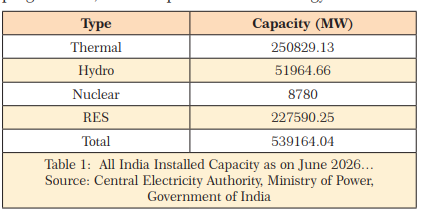
Today, India’s total installed power generation capacity stands at over 539.16 GW. Our power mix is nearly evenly split between fossil fuels and non-fossil sources, with non-fossil fuel capacity accounting for roughly 50.6% of the overall pie diagram.
Glimpses of India’s Sustainable Plan and Progress
A recent analytic report from the global energy think tank, EMBER, states that electricity lies at the heart of modern economies and underpins India’s economic growth story. Globally, electricity accounted for 21% of total final energy consumption in 2024. In addition, it is the primary energy source for sectors representing over 40% of global economic activity and the main source of energy for households.
EMBER’s minute observation highlights, “India has set ambitious targets for its power sector as part of its clean energy transition. The country aims to achieve 500 Giga Watts (GW) of non-fossil fuel installed capacity by 2030, reflecting its commitment to decarbonisation and sustainable economic growth. In FY2025, India added 29 GW of renewable capacity, which was led by 24 GW of solar, pushing cumulative solar installations past 100 GW. By October 2025, India’s total installed renewable capacity reached 251 GW, spanning solar, wind, hydro and bio-power sources. These additions enabled India to achieve 50% of installed power capacity from non-fossil sources, meeting its original 2030 target five years ahead of schedule. Sustained national and state-level efforts, backed by targeted policies and flagship programmes, have expanded clean energy access and strengthened the foundation for faster renewable growth. India’s global ambitions, including hosting the 33rd Conference of the Parties (COP33) in 2028, further signal its commitment to aligning economic growth with environmental stewardship.”
India’s Vision and Priority
Recently, while delivering the valedictory address of Bharat Electricity Summit 2026, Union Power Minister, Manohar Lal, pointed out that India has a vision of Viksit Bharat by 2047 and for achieving this vision, electricity is a common resource that is needed by all economic stakeholders and citizens. Under Saubhagya Yojna we succeeded in ensuring that electricity has reached all nook and corners of the country.
Speaking on the importance of solar energy and cooperation across countries, Lal noted the words of Prime Minister Narendra Modi — One Sun, One World, One Grid. These words he said, points to the need for working together as one global family. Our focus has to be on sustainability and thus expansion of renewable energy including solar energy is critical.
Addressing from the same dais, Shripad Naik, Minister of State for Power and MNRE, pointed out that — what stands out most clearly from the deliberations in the summit is that: India’s power sector is not merely expanding — it is advancing through a deeply coordinated federal architecture, where national vision and state-led execution are seamlessly aligned.
Thus, our power sector’s advancement is a country-wide coordinated journey towards sustainability and energy security.
Need for Shifting Focus from Uniform National Level Planning
EMBER notes that our rising generation capacity has been accompanied by the growing electricity demand. India’s electricity consumption increased by 33% from FY2021 to 1,694 Billion Units (BUs) in FY2025, translating to a Compounded Annual Growth Rate (CAGR) of 7.4%. This surge will further accelerate because of expanding industrial and commercial activities, rising ownership of appliances such as air conditioners, electrification of the mobility sector, and the proliferation of data centres and digital services. Renewable generation now supplies a growing share of this rising demand, with over 404BUs generated from renewables, roughly 22% of total electricity generation in FY2025. Projections under the International Energy Agency’s (IEA) current policy scenario indicate an 80% increase in electricity demand by 2035, the fastest among emerging economies, driving the need for higher overall electricity generation.
However, the clean energy transition has not been uniform across Indian states. Such divergence is inevitable at the sub-national level given the structural and historical factors, including differences in resource endowment, development legacies, states’ fiscal and economic conditions, rural-urban composition, and institutional capacity within the power sector. Each state presents unique challenges. While some have advanced rapidly in deploying renewable energy and strengthening grid infrastructure, others are only now gathering momentum, although with encouraging prospects for accelerated growth. Understanding these state-level differences is essential for designing policies and interventions. A purely national overview risks overlooking the distinct progress, constraints, and opportunities that exist across states.
At the same time, a Just Transition lens capturing socio-economic dimensions such as livelihoods, fiscal dependence and energy security is also important for certain states. For example, Jharkhand has a significant share of state revenue linked to legacy sectors, making socio-economic transition risks especially salient and requiring careful planning.
Conclusion
India’s electricity generation plan is highly appreciable because it rapidly scales up non-fossil capacity while balancing soaring economic demand. By achieving over 50% of its installed electricity capacity from green sources (like solar, wind, and hydro) years ahead of schedule, our nation has proved that it can successfully marry accelerated economic development with aggressive sustainability goals.
We have ranked third globally in “Renewable Energy Installed Capacity,” no doubt it’s a big achievement. However, as of now, India is a combination of 28 States and 8 Union Territories (UTs). The geographic, socio-economic, demographic and many other conditions vary from state to state or UT. Therefore, henceforth, any planning needs to be focused on regional needs, potentials and feasibilities. That will definitely yield better result — and accelerate our energy transition and sustainability journey.
By P. K. Chatterjee (PK)