
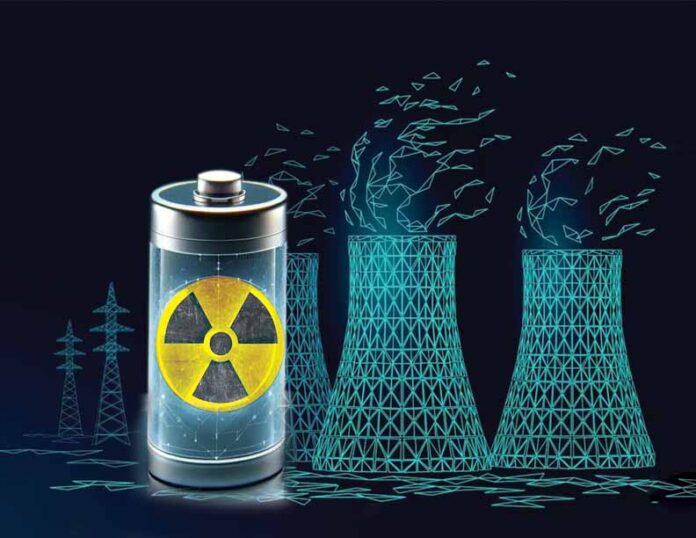
Nuclear batteries have drawn the attention of scientists as early as 1900. Nuclear batteries convert the energy of high energy particles into electrical energy. These batteries have many advantages like long lifetime, because the half-life of the radioisotope is as long as several decades or thousands of years. The device also has advantages of stable output performance, high energy density and environmental resistance.
These superior advantages make nuclear batteries very suitable for powering the equipment which work in difficult to access locations like space, desert, undersea, icy land etc.
Practically no maintenance would be required for theses robust batteries. These batteries can be made into smaller sizes to power miniature devices safely without failure. Key types include radioisotope thermoelectric generators that use thermocouples to convert heat generated from radioactive decay into electricity.
Although they are reliable but have low efficiency. The second type is non-thermal converters that use beta particles (high speed electrons) from radioactive source like Tritum/Nickel-63 or carbon14 to generate electricity via a semiconductor PN- junction.
Diamond nuclear battery is betavoltaic cell that use carbon-14 emitting beta particles securely shielded in synthetic diamond, with a potential lifespan of thousands of years. The radioactive material is securely contained inside the hard robust diamond shell, making it extremely safe from leakage The battery is coupled with synthetic diamond as the semiconductor materials to create a P-N junction or Schottky junction. Alpha particles are used in alphavoltaic cells to generate electricity. But alpha particles can cause severe radiation damage and, hence where safety is concerned betavoltaics are preferred.
Turning Nuclear Waste into Battery
Nuclear reactors generate heat from highly radioactive uranium rods. The rods are placed in blocks of graphite to control the heat flow and nuclear reactions. After years of absorbing nuclear radiation, the graphite blocks become highly reactive as well. The neutron radiation during operations activates the non-radioactive carbon by capturing a neutron and producing radioactive carbon-14, mostly at the surface of the blocks.
There are at least 250,000 tonnes of irradiated graphite blocks around the world. Such waste is not heat generating, but has a radioactive content exceeding 12 GBq/tonne beta activity presenting a long-term hazard, and are to be contained in safe containers to eliminate radiation hazard.
The cost to make diamond from the radioactive blocks is a lot less than disposing of nuclear waste. When nuclear power plants are decommissioned, they have to dispose of the graphite blocks. These spent radioactive graphite blocks could be heated to convert it into gas and then compressed to form diamond. Because of its radioactive nature, it can generate a small electric current and this requires no moving parts or maintenance.
What is C14
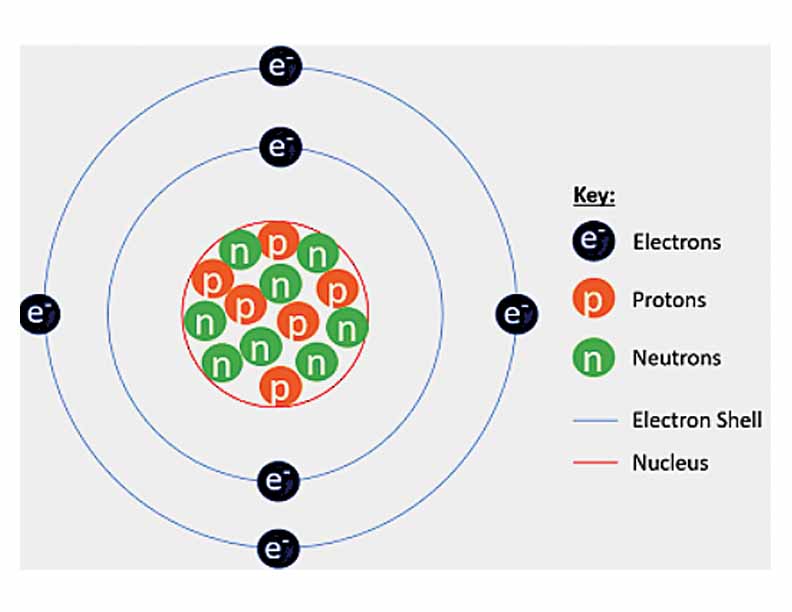
Carbon-14, also known as radiocarbon is a radioactive, unstable isotope of carbon containing 6 protons and 8 neutrons, resulting in an atomic mass of 14. It decays via beta particle emission into nitrogen-14, with a half-life of approximately 5700 years. Carbon-14 is produced in nuclear reactor where graphite is used as moderator, primarily through neutron activation of nitrogen-14 impurities and carbon-13 isotopes
within the graphite moderator, resulting from high neutron flux.
Nitrogen is present in graphite as an impurity or trapped in pore surfaces. Nitrogen-14 absorbs a neutron and emits a proton to form carbon-14. Besides, graphite naturally consists of about 1.1% carbon-13 isotope that absorbs a neutron to directly form carbon-14. The majority of carbon-14 is often found on the outer 5 mm surface layers of graphite rods, resulting from adsorption of nitrogen gas onto the graphite pores. The structure of C-14 is shown in FIG – 1.
Making of Diamonds from C14
Carbon-14 is retrieved from irradiated reactor graphite by high temperature oxidation. The process involves heating the graphite around 36420C to its sublimation point, which releases the trapped C-14 as a gas. This process can selectively release 90% of C-14 as gas, which is then converted into a form suitable for diamond growth, such as methane gas containing C-14 (CH4C14), or it can be directly used in plasma deposition process.
To grow synthetic, radioactive-resistant diamond layers for long lasting betavoltaic nuclear batteries, often chemical vapour deposition (CVD) process is used. The C-14 gas is introduced in a plasma reactor where, a thin film of diamond is grown on the seed isotope.
For substrate preparation, a non- radioactive diamond seed crystal (e.g. C-12) is cleaned and placed in a CVD reactor to act as a substrate for epitaxial growth. The reactor chamber is filled with a mixture of methane gas containing C-14 and hydrogen.
Plasma activation is done by microwave radiation to break down the gases, forming highly reactive plasma cloud. The radioactive C-14 atoms are deposited onto the substrate, creating a diamond film. This layer acts as the radioactive source.
The CVD method allows for the creation of non-radioactive C-12 diamond films that ‘sandwich’ the C-14. The resultant diamond is a synthetic single crystal structure that acts as a secure container for the short-range beta radiation produced by the isotope. The resulting diamond sandwich, often thin platter like chunks is removed, polished, and laser cut to fit the battery housing. Process flowsheet of making synthetic diamond for betavoltaic battery is shown in FIG – 2. As the C-14 decays it emits electrons, and when these electrons pass through the semiconductor structure of diamond, they generate electricity.
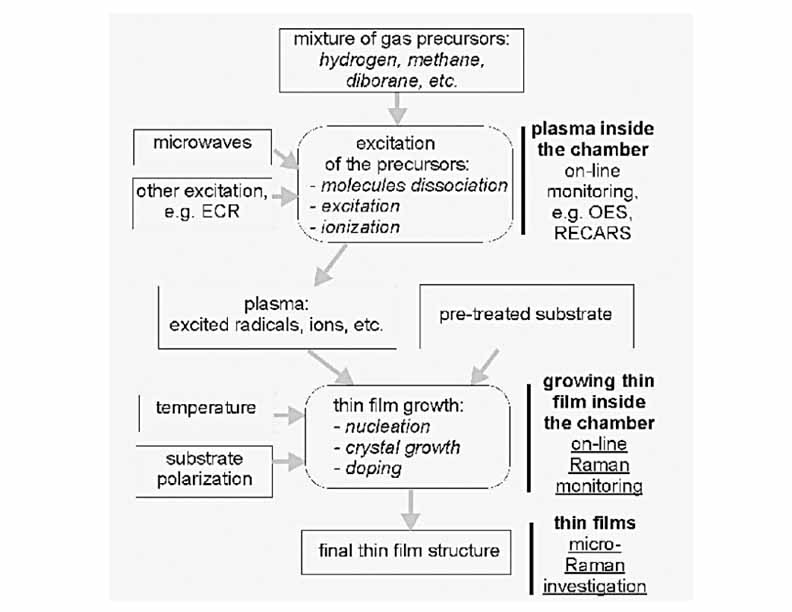
FIG – 2: Process flowsheet of diamondgrowth by CVD process…
Decay Reaction
The core of the battery is the radioactive decay of C-14, a by-product of nuclear reactor operation. The process is a beta-minus decay, where a neutron in the C-14 nucleus converts into a proton, emitting high speed electron (beta particles) and antineutrino, resulting in stable Nitrogen-14 as shown in FIG -3. Reaction equation is given below:
146C®147N + b– + anti-neutrino
The emitted beta particles, with an average energy of 50keV strike the synthetic diamond semiconductor, creating electron-hole pairs and the process generates a small electrical current.
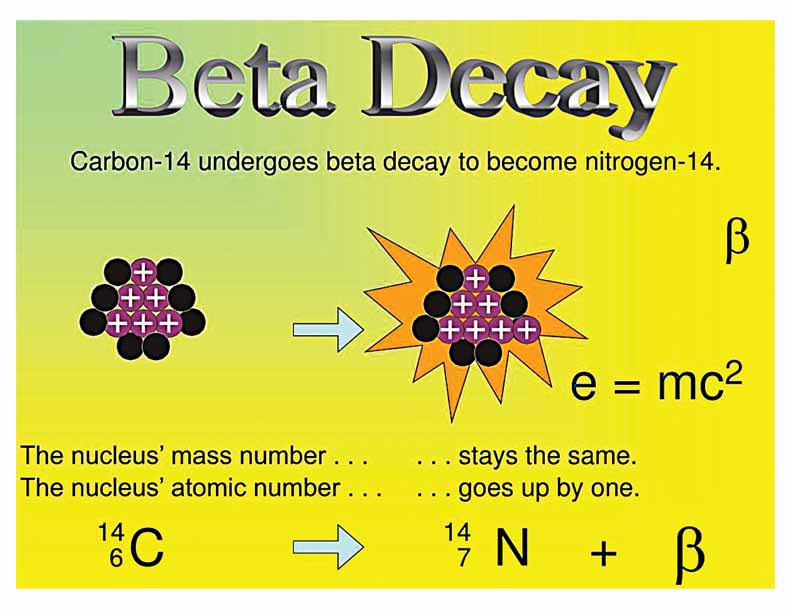
FIG – 3: Scheme of beta decay of C-14…
How it Works
The working principle of betavoltaic convertor of diamond battery is very similar to that of photovoltaic cells as shown in FIG -4, and the battery consists of a diamond semiconductor p-n junction and a C-14 beta source.
The beta particles falling on the semiconductor junction creates electron hole pairs and it gets separated by the built-in electric field at the junction that pulls apart the charge carriers (electrons and holes) generated by the beta radiation before they can recombine, consequently generating current.
The p-n junction maintains a high built-in potential, allowing for high open circuit voltage. Some of electron-hole pairs recombine again and leads to the radiative losses in the betavoltaic device. Most of the betavoltaic devices with diamond p-n junction on diamond substrate have high VOC (open-circuit voltage) of about 4.26 V and conversion efficiency of around 24%. Schematic of the diamond p-n junction betavoltaic battery is shown in FIG – 5. While a single basic cell has one junction, high output battery uses hundreds of p-n junctions layered together.
Diamond based p-n junctions provide superior performance over other semiconductors in nuclear batteries due to higher collection efficiency and lower leakage current, allowing for extremely long-lasting applications.
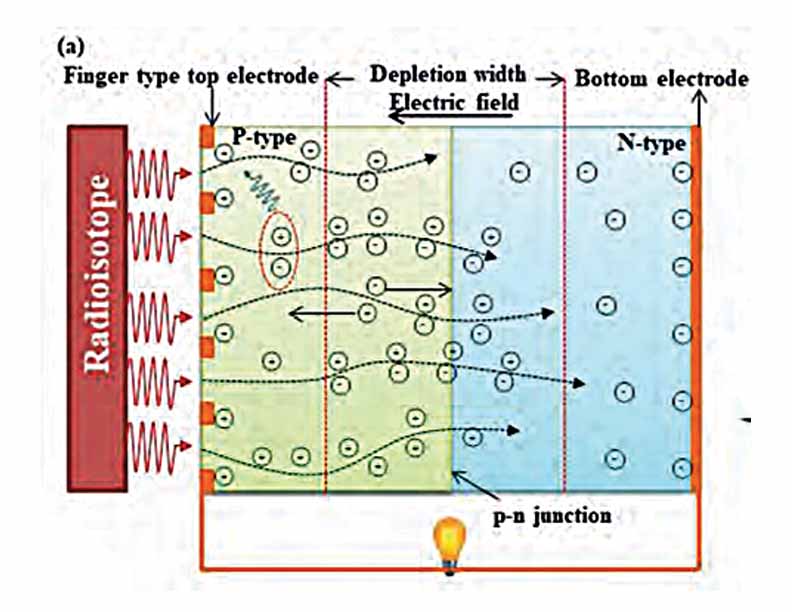
FIG – 4: Working scheme of diamond betavoltaic battery…
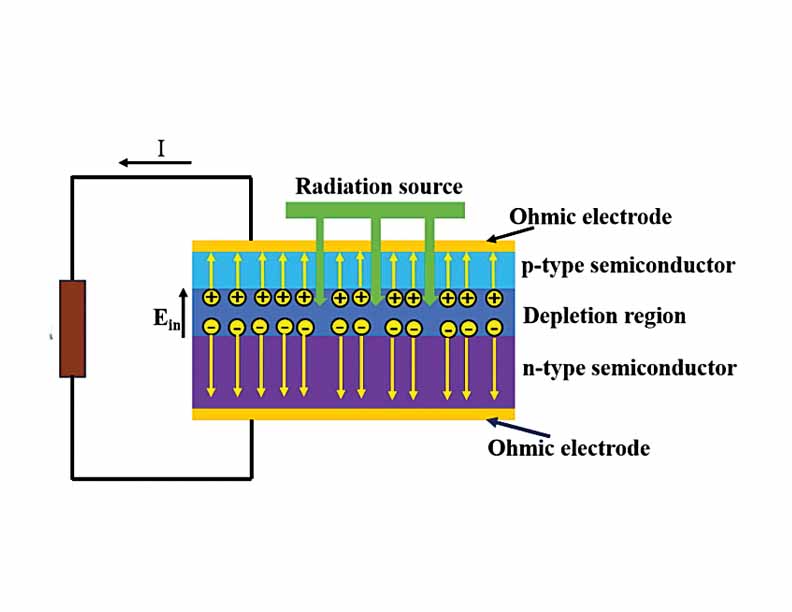
FIG – 5: Scheme of nuclear diamond battery with P-N junction…
Key Details of Battery Junction
Semiconductor plays an important role to tap or to convert the energy of the beta particles into electrical energy. The beta particles collide with the semiconductor interface and generate electron-hole pairs. Depending on the type of beta particles, there could be as many as 100-1000 pairs generated from a single beta particle.
Until now semiconductors have not shown 100% conversion due to various losses such as back scattering, self- absorption, nuclear losses, electrode barrier, recombination and collection losses. The beta particles collide with semiconductor materials resulting in loss of energy in the form of acoustic phonons and optical phonons. Most energy loss during the conversion process occurs during the conversion process while using different devices like Schottky junction, P-N junction etc.
Nano-diamonds hold high promise to achieve high conversion efficiency by improving the diamond-metal interface. The large band gap materials are quite successful in increasing efficiency as well as to protect against radiation damage. This is the reason why synthetic diamond with a band gap of 5.5eV is a better choice over silicon which has a band gap of 1.12eV.
Betavoltaic diamond nuclear batteries, generally utilize one P-N junction per conversion cell to separate charges. While a single unit has one, the overall battery system may involve many such junctions layered together. They often feature a p-type diamond layer and an n-type diamond layer to form a P-N junction, generating electricity from radioactive beta particles.
Some designs use a Schottky barrier diode that uses a single junction between metal and semiconductor rather than a P-N junction for ease of fabrication. A diamond P-N junction is preferred for its high built-in potential of around 4.5 V which enables higher conversion efficiency of over 30% as per simulation result which is higher compared to other materials. Recent research works show that it is possible to make high power density batteries using layered structures of p+, p, n, n+ layers.
Sequence of Reposition Steps in CVD
Firstly, a non-radioactive high purity single crystal diamond is placed in the CVD reactor as a seed substrate. An initial layer of high-quality CVD diamond is deposited on the seed that serves as the foundation. P-type diamond is easier to grow and acts as the conductive layer. Boron is the primary dopant added along with a mixture of methane and hydrogen feedstock, and the mixture is fed to the CVD chamber to make the P-type layer. The plasma breaks down the gas, depositing boron-doped diamond on the base substrate. Phosphorus is then introduced into the CVD chamber along with the gas feedstock during growth to grow phosphorus-doped n-type diamond film.
Making of C-14 radioisotope layer is a key functional step, when gas feedstock is changed to include radioactive C-14 methane along with Hydrogen. This creates a synthetic diamond layer where C-14 is embedded directly into the diamond crystal lattice during growth process.
Radioactive C-14 creates a radioactive layer that emits electrons that travel through the diamond crystal structure. The diamond semiconductor collects these electrons to produce a consistent flow of electricity, similar to PV cells.
Ohmic contacts using Titanium or Gold are deposited on the surface to collect the generated current. A final, thick layer of non-radioactive (C-12) synthetic diamond is deposited on top of the radioactive material, which acts as a protective, safe casing for containing the radiation.
Power Density
Carbon-14 diamond batteries offer very low power density – approximately 10 microwatts/cm3 or 15J/day per gram whereas, a standard 20g alkaline AA battery provides around 700 J/gm, far exceeding a diamond battery. But the C-14 battery lasts for thousands of years, whereas the AA lasts for 24 hours. While power output is low for C-14 batteries, their energy density is exceptionally high considering their thousands of years of lifespan. Although they are unsuitable for high-power applications, but ideal for long-life, low power applications in space, medical implants, sensors that require very low, consistent power over decades. These batteries can achieve at least 2 Volts. The approximate size of diamond device excluding metallic contacts and wiring is 10mm x 10mm x 0.5mm thick.
C-14 diamond batteries are experimental technology and early estimations suggest very high costs, around $200,000 for a 10 microwatt for low power prototypes. A prototype of such battery is shown in FIG -6. The primary cost driver is the extraction and purification of the C-14 isotope sourced from the graphite blocks in nuclear reactor. These batteries, being in experimental stage, are not for sale to the public at present.
Since these batteries are made from processed nuclear graphite blocks, they could potentially become cheaper to produce in future as they also solve waste disposal problem. Although the initial cost is high, the ‘cost over time’ is projected to be incredibly low, eliminating the need for replacements and labour costs associated with maintenance over many decades.
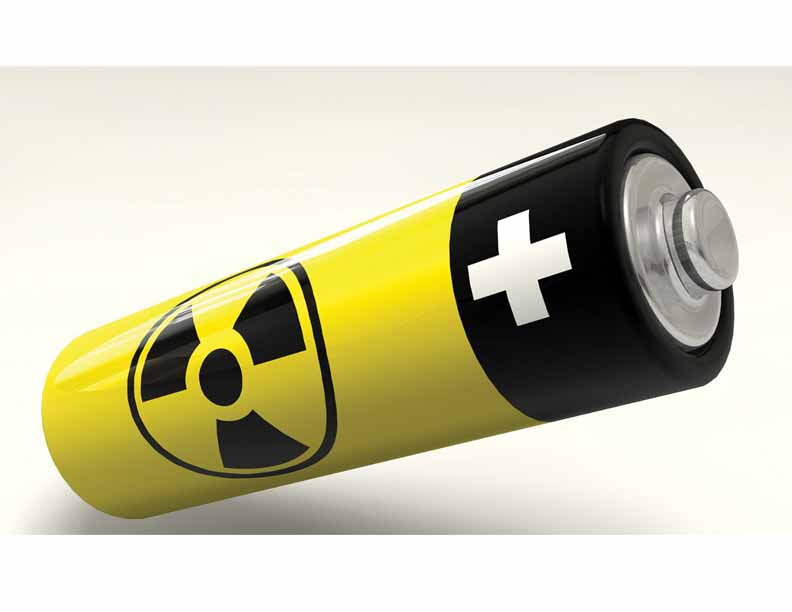
FIG – 6: Prototype of C-14 diamond battery…
Nuclear diamond batteries can provide power for decades continuously without charging to sensors located in inaccessible areas like space, deep sea, deserts, remote defence infrastructures or extreme cold places…
Conclusion
Diamond batteries, often referred to as nuclear diamond batteries or betavoltaic devices, are not likely to be used in coming years for high-power applications like grid level power stabilization, electric cars or smart phones. While they provide high energy density i.e., total energy stored, their power density i.e., how fast they can deliver energy, is far too short for high power applications.
The electricity generated is consistent over millennia, but it does not allow for rapidly stabilizing sudden grid fluctuations. It is expensive and its manufacturing process is quite complex. Rather than powering cities they are ideal for applications requiring extremely long-term, low maintenance energy.
It can provide power for decades continuously without charging to sensors located in inaccessible areas like space, deep sea, deserts, remote defence infrastructures or extreme cold places.
They are ideal for medical implants like pacemakers, where they can last for lifetime of the patient. Another potential future application involves using diamond battery to slowly, constantly charge a high-capacity supercapacitor that can then be used to provide high power bursts when needed.

Rathindra Nath Biswas is the Dy. General Manager, In-Charge (Retired), MECON, Durgapur.