
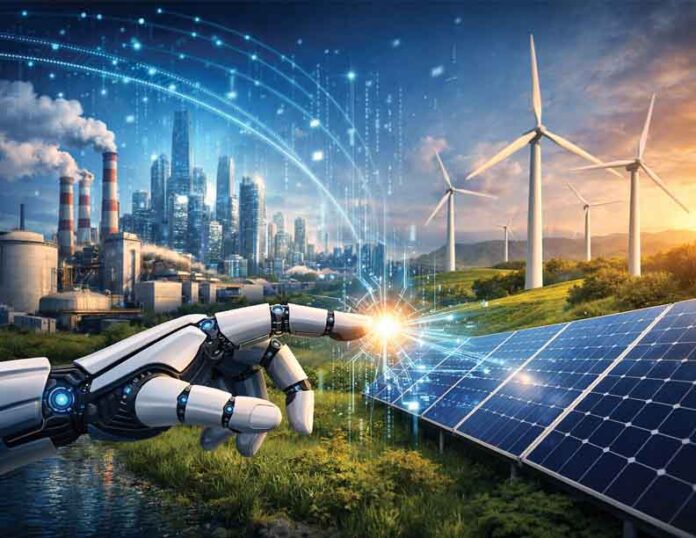
The rapid growth of renewable energy technologies has transformed the global power sector, with solar energy emerging as one of the most reliable and sustainable sources of electricity generation. Modern solar power plants are no longer limited to only converting sunlight into electrical energy; they have evolved into intelligent energy systems capable of monitoring, analyzing, and optimizing their own performance. Two revolutionary technologies driving this transformation are Artificial Intelligence (AI) and the Internet of Things (IoT). The integration of AI and IoT in solar power plants has significantly improved efficiency, reliability, automation, and energy management.
AI enables machines and systems to simulate human intelligence for decision-making, forecasting, and optimization, while IoT connects various devices and sensors through the internet to collect and exchange real-time data. Together, these technologies create smart solar power plants capable of self-monitoring, predictive maintenance, intelligent fault detection, and efficient power distribution.
Role of IoT in Modern Solar Power Plants
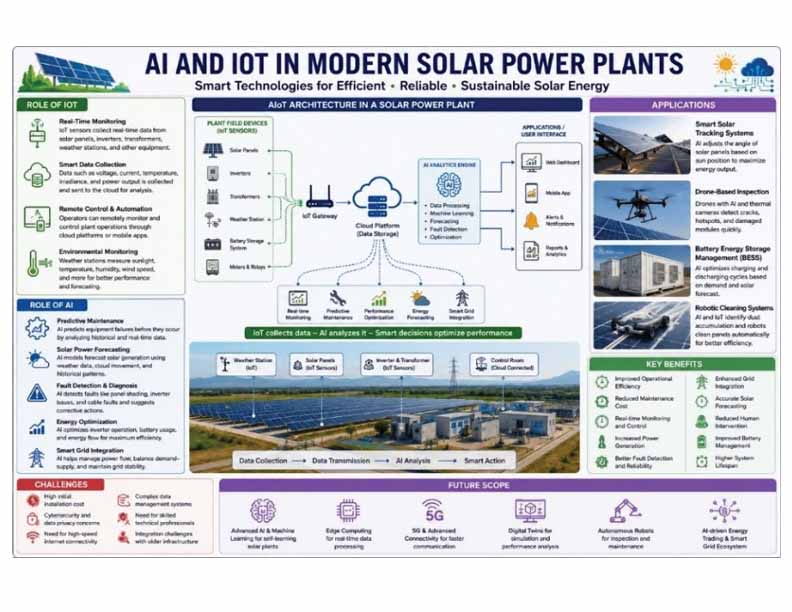
The Internet of Things plays a major role in connecting solar plant equipment such as solar panels, inverters, transformers, weather stations, and battery storage systems. IoT devices continuously gather data related to temperature, solar irradiance, voltage, current, panel efficiency, dust accumulation, and power output. Heavy fault occurs in overhead distribution lines.
Real-Time Monitoring
IoT sensors installed across the solar plant provide real-time monitoring of system performance. Operators can remotely monitor the plant through cloud-based platforms or mobile applications. This helps in identifying operational issues immediately and improves overall plant reliability.
Smart Data Collection
IoT systems collect large amounts of operational data from different components of the plant. The collected data is transmitted to centralized servers where it can be analysed for performance evaluation and fault diagnosis.
Remote Control and Automation
IoT technology allows operators to control solar plant equipment remotely. Parameters such as inverter operation, battery charging, load management, and panel orientation can be adjusted automatically to maximize energy production.
Environmental Monitoring
Weather sensors connected through IoT measure environmental conditions such as sunlight intensity, humidity, wind speed, and temperature. These measurements help optimize panel performance and improve forecasting accuracy.
Role of Artificial Intelligence in Solar Power Plant
Artificial Intelligence (AI) is essential in modern solar power plants for enhancing efficiency, reliability, and automation. AI analyses real-time and historical data from solar panels, inverters, weather stations, and battery storage to optimize plant performance. It enables predictive maintenance by identifying faults and equipment issues before they happen, minimizing downtime and reducing maintenance costs.
AI also enhances solar power forecasting by evaluating weather and sunlight patterns to accurately predict energy output. Additionally, AI supports smart energy management, fault detection, automated monitoring, and seamless grid integration. Advanced applications like smart solar tracking, drone inspections, and battery management systems further boost the productivity and performance of solar power plants.
Predictive Maintenance
Predictive maintenance is one of the most important applications of Artificial Intelligence (AI) in modern solar power plants. It refers to the use of AI algorithms, machine learning, and sensor data to predict equipment failures before they actually occur.
In a solar power plant, IoT sensors continuously collect real-time data from components such as solar panels, inverters, transformers, batteries, and cables. This data includes parameters like temperature, voltage, current, vibration, power output, and operating conditions.
Solar Power Forecasting
The AI-based forecasting models use weather data, cloud movement, irradiance levels, and historical generation patterns to predict future solar energy production. Accurate forecasting helps maintain grid stability and improves energy management.
Fault Detection and Diagnosis
Fault detection and diagnosis in solar power plants refers to the process of identifying and analysing problems in the system using AI and smart monitoring technologies. AI continuously monitors data from solar panels, inverters, transformers, and batteries to detect abnormalities such as hotspot formation, shading effects, inverter failures, cable faults, or reduced power output.
Integration of AI and IoT in Solar Power Plants
The combined implementation of AI and IoT creates highly automated and intelligent solar power systems. IoT devices collect real-time data from various plant components, while AI processes this data to generate meaningful insights and automated decisions. This integration also enables digital twin technology, where a virtual model of the solar plant is created for simulation, analysis, and performance optimization.
Applications in Modern Solar Plants
Smart Solar Tracking Systems
AI-powered tracking systems automatically adjust the angle of solar panels according to sunlight direction, maximizing energy absorption and improving efficiency.
Drone-Based Inspection
Drones equipped with AI and IoT technologies inspect solar panels using thermal imaging and computer vision techniques. These inspections help detect cracks, hotspots, and damaged modules quickly.
Battery Energy Storage System (BESS) Management
AI optimizes battery charging and discharging cycles based on energy demand and solar generation forecasts. IoT sensors continuously monitor battery health, temperature, and state of charge.
Future Point of View
The future of AI and IoT in solar power plants is highly promising. With the advancement of machine learning, cloud computing, edge computing, and 5G communication, solar plants will become more autonomous and efficient. Future solar power systems may include fully self-healing grids, autonomous maintenance robots, advanced digital twins, and AI-driven decentralized energy trading systems.
Conclusion
Artificial Intelligence and the Internet of Things are revolutionizing modern solar power plants by making them smarter, more efficient, and highly reliable. IoT enables continuous monitoring and communication between different components, while AI provides intelligent analysis, automation, and optimization. Together, these technologies improve energy generation, reduce operational costs, enhance predictive maintenance, and support sustainable energy development. As renewable energy demand continues to grow, the integration of AI and IoT will play a critical role in shaping the future of intelligent and sustainable solar power systems.

Er. Rani Reshma Swain is an O&M Engineer of Rooftop Solar Power Plant at Group Surya in Bhubaneswar, Odisha.

Dr. Sarat Kumar Sahoo is a Professor at the Department of Electrical Engineering of Parala Maharaja Engineering College in Berhampur, Odisha.