
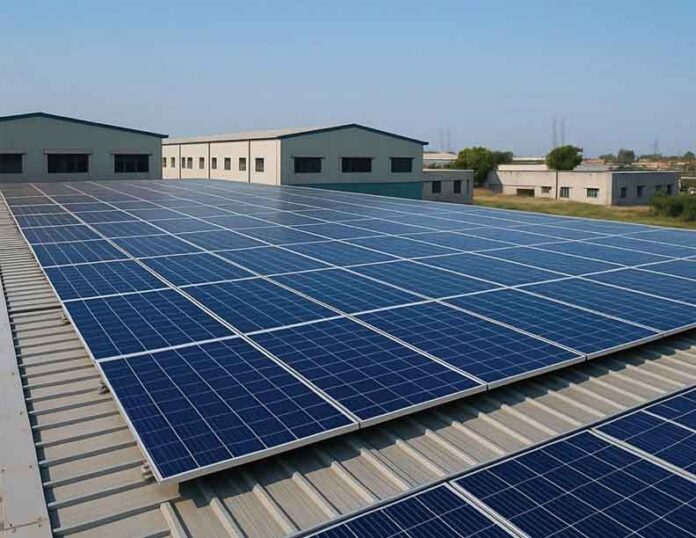
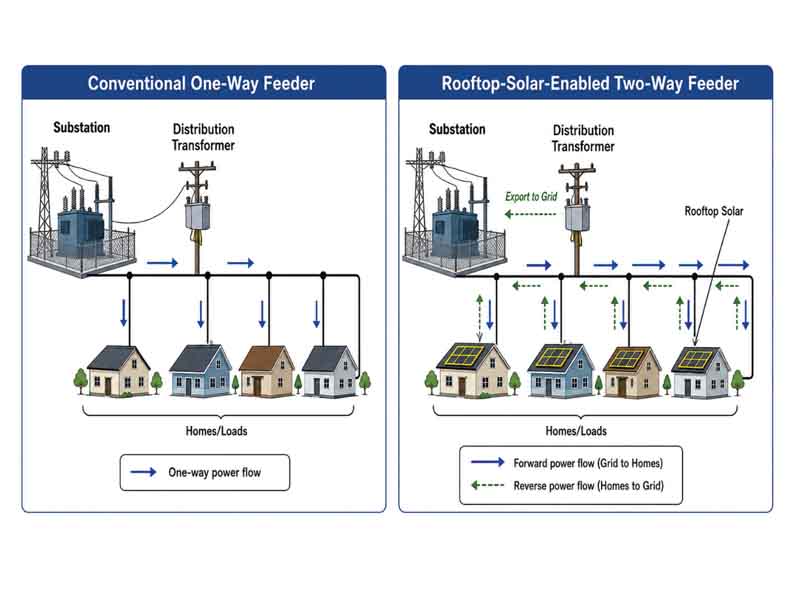
India’s rooftop solar journey has entered a new phase. The PM Surya Ghar: Muft Bijli Yojana has created strong public interest by encouraging households to generate their own electricity and reduce monthly power bills. For consumers, rooftop solar appears simple: panels on the roof, lower bills, and possible export of surplus energy. For distribution companies, however, the transition is more complex. A residential feeder originally designed to deliver power from the substation to homes must now handle two-way power flow from many small rooftop generators.
This makes feeder readiness the next major challenge in India’s solar mission. Installing rooftop solar panels alone will not guarantee reliable electricity. The feeder must also absorb local generation without voltage rise, transformer stress, protection failure, or power quality problems. Therefore, the success of PM Surya Ghar will depend not only on household adoption, but also on how quickly DISCOMs modernize local distribution networks.
From Consumers to Prosumers
With rooftop solar, a domestic consumer becomes a prosumer, producing and consuming energy at the same time. During sunny afternoon hours, household demand may be low while solar generation is high. If many homes on the same feeder export power simultaneously, power flow can reverse toward the distribution transformer.
This is a major shift for low-voltage and 11 kV networks. Conventional feeders were planned assuming that voltage reduces from the substation end to the farthest consumer. Rooftop solar can change this pattern. A far-end consumer with high solar generation may experience voltage rise, while another consumer on the same feeder may still face low voltage during evening demand. This uneven behaviour creates a new operational challenge for DISCOM engineers.
Why Hosting Capacity Matters
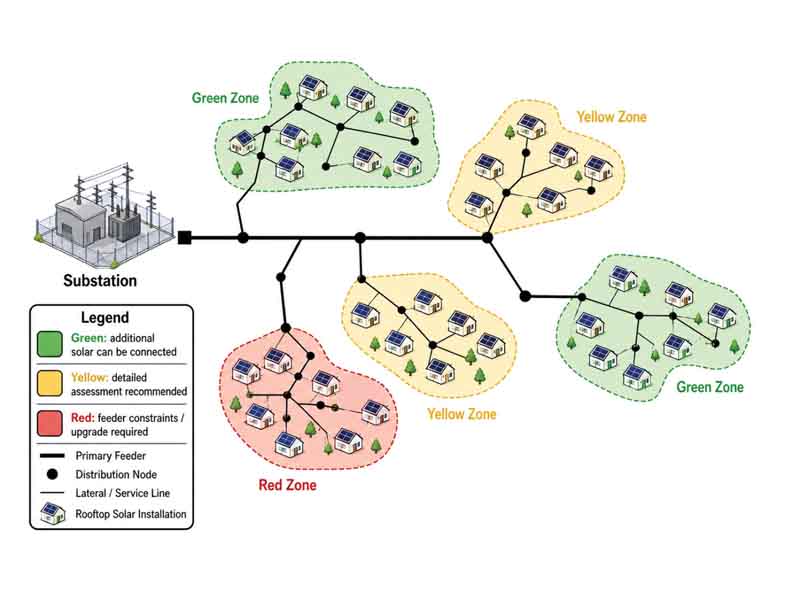
Every feeder has a technical limit up to which rooftop solar can be connected without violating operating limits. This is called hosting capacity. It depends on conductor size, feeder length, transformer rating, load pattern, voltage profile, protection system, and location of solar connections. Two feeders with the same connected load may have different solar hosting capacities.
At present, many rooftop solar approvals are processed at the consumer level. However, feeder-level visibility is equally important. If approvals are granted without studying feeder readiness, local overvoltage, transformer reverse loading, and nuisance tripping may appear after installations increase. Hence, DISCOMs need a feeder-wise solar hosting map that identifies green, yellow, and red zones for rooftop solar integration.
Technical Issues Beyond Installation
The first issue is voltage rise. When solar generation exceeds local consumption, exported power may increase voltage at consumer terminals. If voltage crosses permissible limits, appliances may face stress and inverters may trip repeatedly.
The second issue is transformer loading. High rooftop solar can create reverse loading during the day and heavy forward loading in the evening. This daily reversal increases operational complexity.
The third issue is protection coordination. Existing fuses, relays, and re-closers are designed based on one-directional fault current assumptions. Solar inverters may alter fault current levels, making conventional protection less dependable.
The fourth issue is power quality. Large numbers of inverters on the same feeder can influence harmonics, voltage fluctuation, and phase imbalance, especially in residential areas with single-phase connections.
Role of Smart Meters and Digital Feeder Monitoring
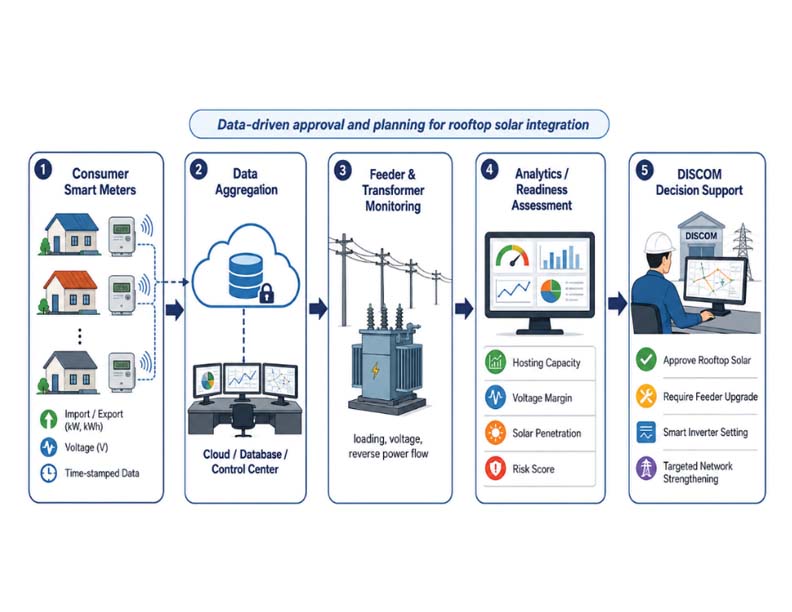
Smart meters can become the backbone of feeder readiness. They provide time-stamped data on consumption, export, voltage, and power factor. When combined with distribution transformer monitoring and feeder automation, DISCOMs can identify where solar generation is helping the grid and where it is creating stress.
Instead of treating all rooftop solar connections equally, DISCOMs can use data-driven approval. A feeder with strong voltage margin and daytime load can be given faster approval, while a weak feeder can be upgraded before additional solar is allowed. This avoids unnecessary restriction and prevents technical failure.
Need for Smart Inverters
The rooftop inverter is no longer only a conversion device. It can support the grid by controlling reactive power, limiting export during critical periods, and responding to voltage variations. Functions such as Volt-VAR, Volt-Watt, and export limiting can help manage feeder voltage without immediately curtailing solar generation.
However, these functions must be coordinated by DISCOMs. If every inverter acts independently without feeder-level planning, the response may become unstable. Therefore, India needs practical inverter setting guidelines suitable for urban, semi-urban, and rural feeders.
A Practical Roadmap for DISCOMs
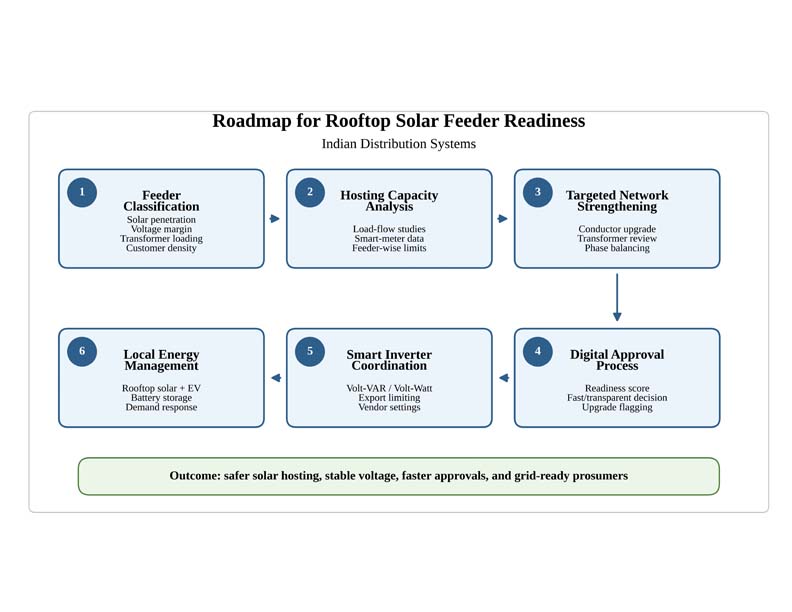
A practical roadmap can begin with feeder classification based on solar penetration, voltage margin, transformer loading, and customer density. The second step is hosting capacity analysis using load-flow studies and smart meter data. The third step is targeted network strengthening, including conductor augmentation, transformer capacity review, phase balancing, and capacitor or voltage regulator coordination.
The fourth step is digital approval. Rooftop solar applications can be linked with feeder readiness scores – so that consumers receive faster and transparent decisions. The fifth step is smart inverter coordination, where approved inverter settings are communicated to vendors and installers. Finally, DISCOMs can develop local energy management platforms that combine rooftop solar, EV charging, battery storage, and demand response.
Conclusion
PM Surya Ghar has the potential to transform Indian homes into clean energy assets. But the next stage of success depends on distribution feeder readiness. Rooftop solar should not be viewed only as a consumer subsidy programme; it should be treated as a distribution system transformation programme.
If DISCOMs adopt feeder-wise hosting capacity assessment, smart metering, smart inverter coordination, and targeted network upgrades, rooftop solar can reduce bills, support clean energy goals, and improve grid resilience. India’s solar future will be built not only on rooftops, but also inside the feeders that connect those rooftops to the grid.

Venkateswara is a second-year Electrical and Electronics Engineering student at Madanapalle Institute of Technology & Science, Andhra Pradesh. He serves as a Student Climate Ambassador under the Climate Action Unit and is interested in rooftop solar, renewable energy integration, distribution systems, and climate action.

Ch. Srinivas has over a decade of teaching and research experience in advanced power systems, electric mobility, renewable energy integration, and AI-driven energy management. He has published 30+ research papers in reputed publication houses, including IEEE, Springer, and Wiley. As a faculty member of Madanapalle Institute of Technology & Science (Deemed to be University), Andhra Pradesh, he actively guides student and faculty research in smart distribution systems, EV-integrated energy systems, battery management, and power system optimization. He also serves as the Faculty In-Charge of the Climate Action Unit at Madanapalle Institute of Technology & Science (Deemed to be University), where he contributes to sustainability-oriented academic and institutional initiatives. His work focuses on connecting academic research with practical energy-sector challenges in India.