
The era of electric vehicles began in the late 19th century because of the advantages of their uses like quick starting, a smooth operation. But due to the highly expensive and inefficient models of the battery, the cost of the Electric Vehicles (EV) has increased twice compared to the gas-powered vehicles. Concurrently, discovering oil spills on other side made people shift their interests towards the gasoline-powered vehicles, and advancement of combustion chambers and the designs of the modern vehicles’ architectures attracted people towards combustion-based vehicles. Thus, they left behind the electric vehicles for a long time.
As days went by and concerns started arising about fuel, climate issues and health issues, many researches developed interest in reducing the greenhouse gases. Researches started to work on battery designs and sustainable solutions. As a result, significant technological advancements have been made across various subsystems of EVs. Among these subsystems power electronics plays central and enabling role by energy conversion, distribution and control within the vehicle and maintaining the overall efficiency of the system.
Role of Power Electronics in Electric Vehicles
The most essential components for control and conversion processes in the electric vehicles are power electronics i.e., beginning from the charging of batteries in the initial stage to that of controlling of electric motors. Unlike normal fuel vehicles most of electric vehicle operations depend on power electronics to regulate current, voltage and efficient power transfer under dynamic load variations.
The DC-to-DC converters are integrated with closed loop control that includes the P, PI, PID controllers to reduce the steady state error and enable them to maintain the DC voltage constant at the output terminals as per requirement. Further the inverters utilize the stored DC power and convert to AC power for driving the electric motors. The AC to DC converter is utilized for onboard chargers with improved power transfer capability for systematized charging of the vehicle battery.
Recent Trends in EV Power Electronics
The swift progression of power electronics has enhanced the power density and performance of systems. Current trends focus on power semiconductor device design, optimal controlled devices and intelligent control strategies for compact devices. The latest trends in electric vehicles from the perspective of power electronics are discussed below.
- WBG and UWBG Semiconductor Devices.
- Advanced Traction Inverter-based Technologies.
- Efficient DC-DC Converters and Control Methods.
- Onboard Charges and Fast Charging Techniques.
- Bidirectional Energy Flow and V2G Compatibility.
- Intelligent Digital Control and Techniques.
WBG Semiconductor Devices
The word ‘semiconductor’ is the combination of two words ‘semi’ and ‘conductor’ – that means the properties of the material lie between the insulator and conductor. Again, the semiconductor devices are classified into intrinsic and extrinsic semiconductors. The intrinsic is the pure form of semiconductor. The intrinsic with doping makes the extrinsic semiconductor.
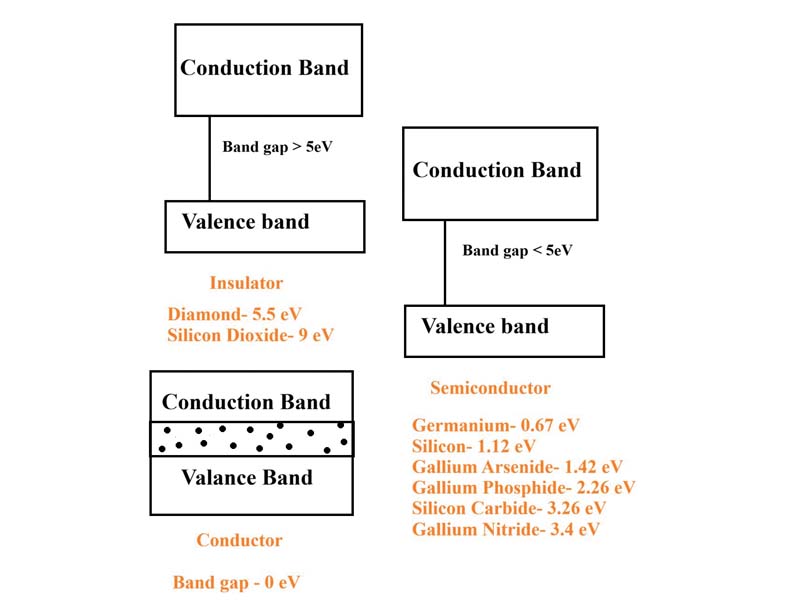
The semiconductor elements are selected from the fourth group, and the conductivity of the semiconductor is determined by each element’s energy gap. The band gap of semiconductor, insulator and conductor materials is illustrated in Fig.1. The elements Silicon (Si) and Germanium (Ge) have several properties, such as an elevated temperature limit and the ability to withstand high current, voltage, and power ratings. The wide-band gap devices, such as Silicon Carbide (SiC) and Gallium Nitride (GaN) devices, which are made to function at a frequency of several MHz, have larger breakdown voltages, and have lower operating losses.
The WBG devices are already transforming modern power electronics with higher efficiency. The UWBG device materials such as Gallium Oxide (Ga2O3), Aluminium Nitride (AlN) and diamond represents the next frontier enabling operation in critical temperature and voltage levels – although the UWBG technology is an immature technology with limited fabrication process and material defects.
Advanced Traction Inverter-based Technologies
Inverters are the DC to AC conversion devices with variable amplitude and frequency. The traction inverter technologies are designed to meet the need of growing demand for efficient motor control in electric vehicles. The traction inverters convert the DC energy stored in the battery to AC enough to drive the AC motor and control speed, torque by adjusting the frequency and amplitude of the AC power.
The design of multilevel inverters and advanced PWM techniques had reduced the overall THD, device stress, smoothened the output torque, and maintained the overall efficiency. Advanced traction inverters use multilevel inverter topologies instead of simple two or more bridge circuits. Due to their lower cost and less losses inverters like Neutral Point Clamped (NPC), Flying capacitor and Split source are being used in the EV.
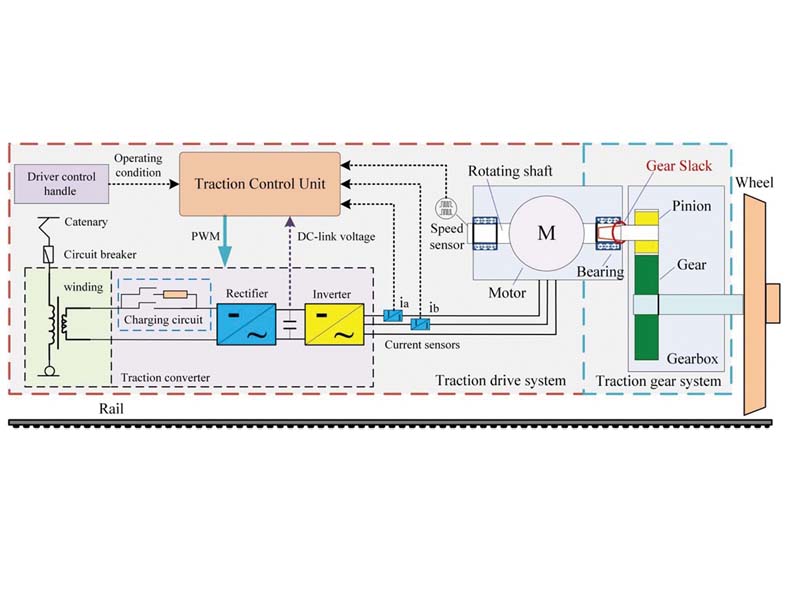
Higher efficient power modules, such as (3 in 1) = inverter + (DC- DC) converter + onboard chargers and (4 in 1) = inverter + (DC-DC) converter + charger + motor controller, are also used in EVs. The traction system for gear slack fault diagnostics is shown in Fig.2. Advanced traction- based systems support 800 V battery systems for high voltage operations.
Efficient DC-DC Converters
The DC-to-DC converter is utilized in EVs to maintain the voltage levels within the desired range. Current trends include the utility of bidirectional converters for regenerative braking and energy recovery. High frequency operation and soft switching conditions are taken in mind for improving efficiency and reducing the power loss.
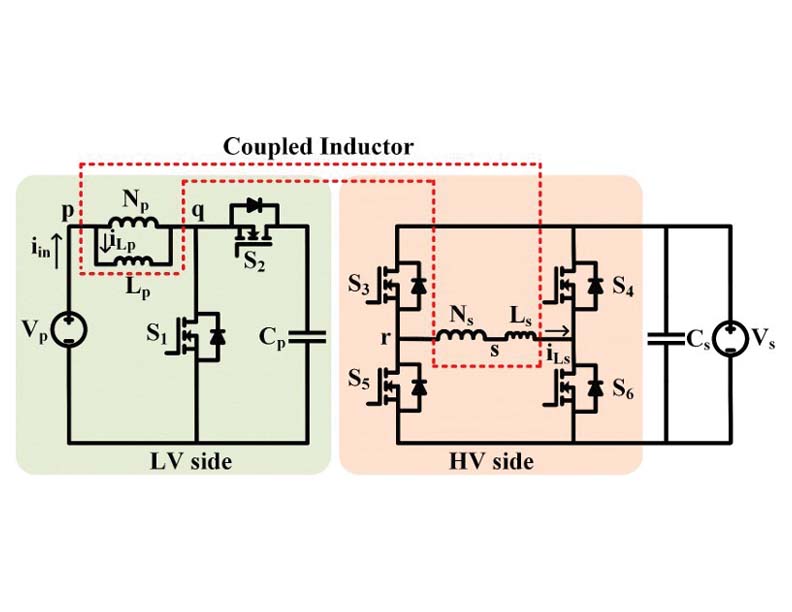
Recent advances include the utilization of coupled inductor bidirectional converter for efficient charging of electric vehicles as presented in Fig.3. The advanced modulation techniques have been integrated in converters to maintain stable output like triple phase shift, dual phase shift – and variable frequency control methods have been enabled. More recently, soft switching techniques that include the Zero-Voltage Switching (ZVS) adaptive dead time control and current shaping techniques have been implemented to reduce the switching losses.
Onboard Chargers and Fast Charging Techniques
Modern on-board chargers utilize isolated converter stages to meet the grid requirements. Recent trend shifts towards the single stage integrated converter with drive units for fast charging of the system. Advanced driver circuits and filters are being utilized to minimize the Electromagnetic interference (EMI) of the system.
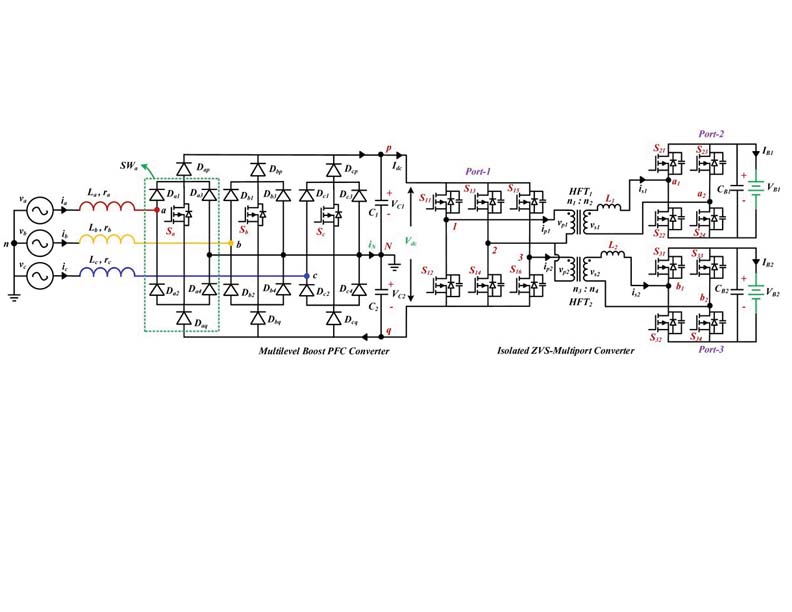
The recent advancements in charging techniques include the design of converter handling multiple vehicles at same instant. Contemporary trends in on board chargers include the multiple charging port designs. The Fig.4. illustrates the topology – it includes a three-phase multilevel inverter with Power Factor Correction (PFC) converter and Zero-Voltage Switching (ZVS) is utilized to reduce switching losses.
Bidirectional Energy Flow and V2G Compatibility
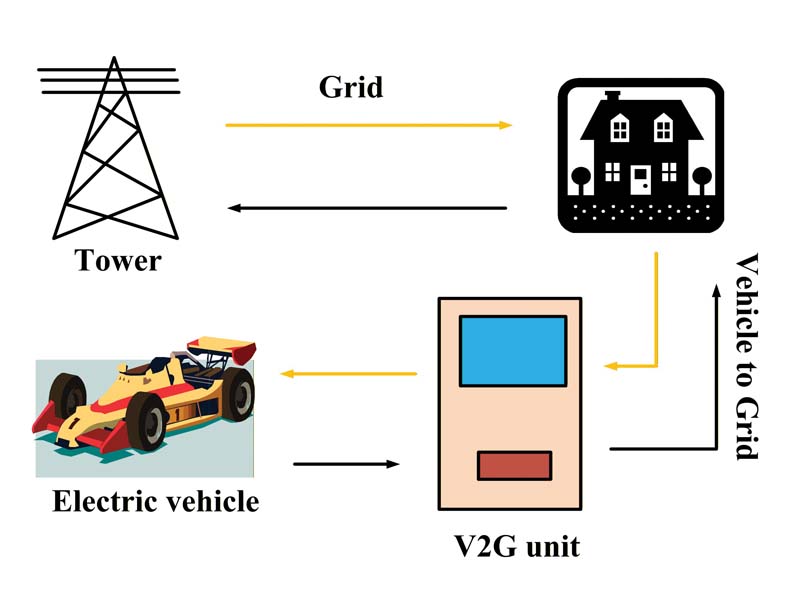
The utility of bidirectional converters allows the vehicle to grid and vehicle to home operations this transforms EV to distributed energy system and grid stability units. The increase the renewable energy sources and allows the charge to store in the battery for the required time and after complete charge the energy generated is provided back to the grid making the EV as bidirectional energy flow capable. The Fig.5. illustrates the process of V2G and V2House.
Intelligent Digital Control and Integration
The integration of digital control like Digital Signal Processors (DSP) and Field Programmable Gate Arrays (FPGA) has enabled flexible control over the designed system. Emergence of software defined power converters where converter behaviour can be analyzed dynamically, and integration of artificial intelligence and data driven techniques made easier to monitor fault and estimate the lifetime of the components.
Intelligence algorithms can improve reliability and can prevent from unexpected failures. Model Predictive Controllers (MPC), AI fault predictions, sensor less motor controlling, Digital gate driver circuits with adaptive switching frequency is integrated in the system for faithful operation.
Challenges and Design Considerations in EV Power Electronics
Despite severe advancements in the field of power electronics the electric vehicles face many practical and technical challenges. As switching frequencies, the power density and integration level increases the new design rules and constraints emerge – and these must be carefully analyzed for efficiency analysis. The major challenges are discussed below.
Thermal Management
The major primary challenge in power electronics is thermal management. Compact packing and operating at higher power led to increased heat generation. So, the converter should be designed with advanced cooling techniques. Inadequate cooling or thermal control leads to decrease efficiency and lifetime of the system.
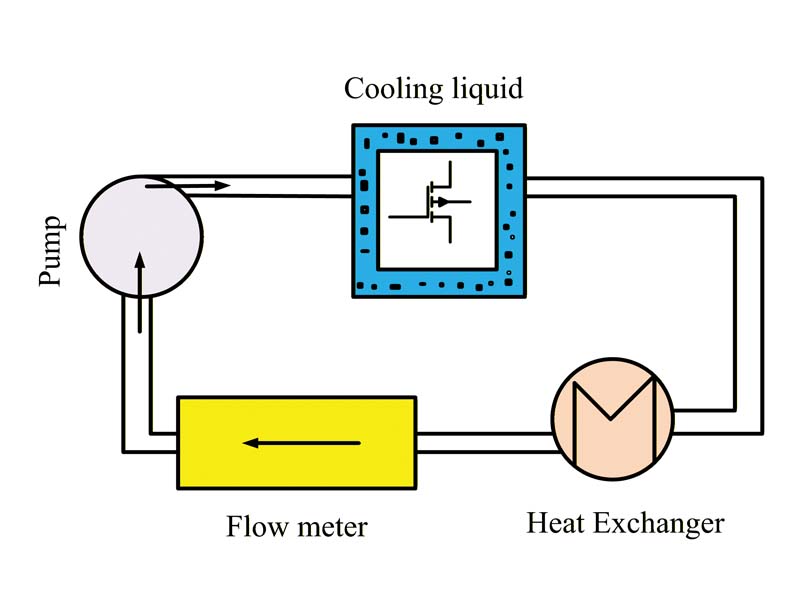
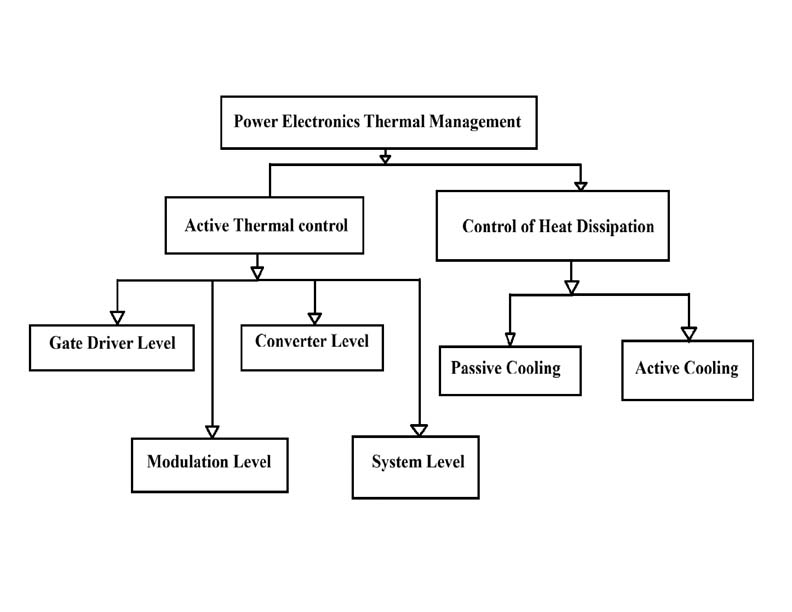
The general cooling techniques include the utilization of heat sinks, forced air cooling, utilization of Nanofluids and liquid cooling methods. Fig.6. presents the cooling process of the power circuit using the cooling liquid. The flowchart illustrated in Fig.7 describes the various thermal management in power electronics at various levels.
High frequency transitions, sudden voltage spikes and fast voltage transitions associated with modern wide band gap devices increase the EMI. The utilization of proper filters and shielding effectively reduces the EMI mitigating the losses.
Cost and Manufacturability
The advanced semiconductor devices and wide band gap devices and the integrated power modules offer superior performance but cost of the devices as per the device current and voltage rating rises. The process of manufacturing compact sized devices as per the higher rating and work under harsh dynamic conditions is expensive.
Future Outlook
The future of EV is expected to be shaped by increasing demands for higher efficiency, compactness, and reliability. As EV adoption increases power electronic systems will evolve from discrete functional blocks like highly integrated, multifunctional and software defined architectures. Ultra-Fast charging techniques can be developed for large scale electric vehicle adoption.
Conclusion
Electric vehicles still rely heavily on Power electronics for efficient conversion intelligent and systematic control. The adoption of WBG, UWBG traction inverters and DC to DC converter made the EV system reliable and the utilization of bidirectional converters help in systematic energy transfer. The advancement of the power electronic devices and converter will decide the system’s overall efficiency.

Majji Sai Manohar is currently pursuing a Bachelor of Technology in Electrical and Electronics Engineering at Vel Tech Rangarajan Dr. Sagunthala R&D Institute of Science and Technology, Tamilnadu, India. His research interests include multilevel inverters, boost inverters, and grid-tied inverters with FPGA-based control systems to enhance the performance and efficiency of power converters and drives. He had presented his work in international journal and conferences. He is currently focusing on resonant gate driver circuit.

Dr. K. Karthikumar received the B.E. degree in Electrical and Electronics Engineering from Mookambigai College of Engineering, Trichy, India, in 2008, the M.E. degree in Power Systems Engineering from the College of Engineering Guindy, Anna University, Chennai, India, in 2010, and the Ph.D. degree in 2020. He is currently a Professor in the Department of Electrical and Electronics Engineering at Vel Tech Rangara jan Dr. Sagunthala R&D Institute of Science and Technology, Chennai, India. His research intererests include renewable energy systems, operational planning, and AI-based power system optimization.

Dr. N. Kumarappan is a distinguished educator and researcher with 35 years of experience. He earned his Ph.D. from CEG Anna University in 2004 under AICTE’s QIP fellowship. As former Head and Professor at Annamalai University’s Electrical Engi neering Department, he published over 132 interna tional papers. He has held leadership roles, including Chairman of IEEE Madras Section and General Chair for MASCON 2021. He received the IEEE R10 Outstanding Volunteer Award (2022) and Best Researcher Award at Annamalai University (2018). His work with Elsevier contributes to the UN’s Sustainable Development Goals, showcasing his commitment to academic excellence and global impact.